There is a particular kind of unease that settles in when the night sky does not behave as expected. Stargazing is supposed to be a quiet pursuit, a matter of patience and clear skies and the slow turning of the heavens. But the history of skywatching is also a history of things going wrong—of clouds arriving uninvited, of equipment failing, of strange lights appearing where no lights should be, and of the occasional encounter with wildlife that reminds the observer they are not alone in the dark. This Halloween, Space.com has gathered seven such stories, and they are worth telling not despite their lack of scientific rigor but because of it.
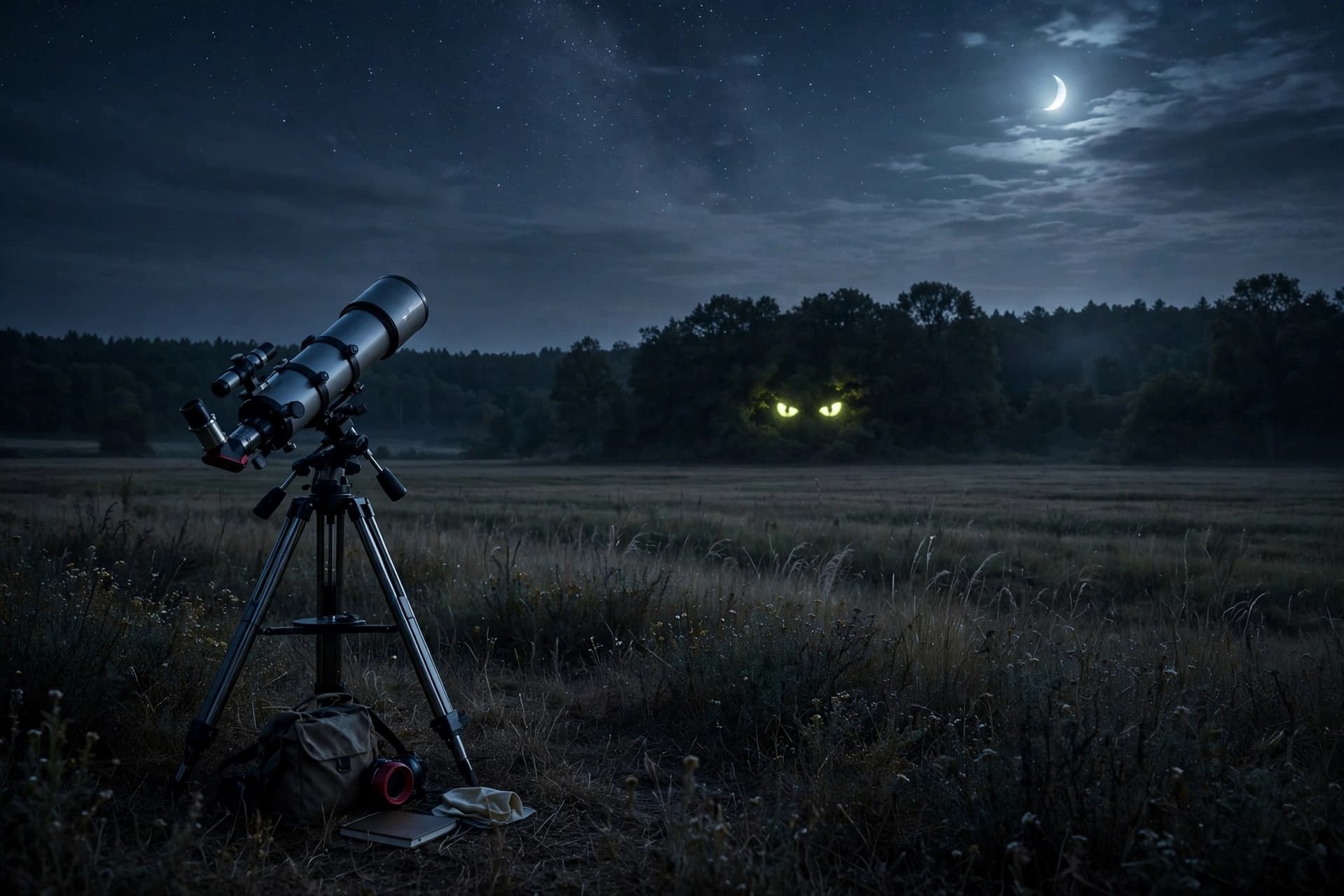
The stories range from the mundane to the unsettling. There are the big cats—mountain lions, perhaps, or bobcats—that have startled observers in the middle of the night, their eyes reflecting the beam of a flashlight in a way that transforms a familiar landscape into something primal. There are the unexplained lights, the ones that cannot be immediately identified as satellites or aircraft or planets, the ones that linger in the memory longer than they should. And there is the floodlit eclipse, a celestial event rendered strange by the intrusion of human illumination, the moon's shadow competing with stadium lights or parking lot glare.
What makes these stories compelling is not that they offer answers. They do not. They are anecdotes, fragments of experience, the kind of tales that astronomers tell each other at conferences or in the quiet hours of an observing run. They remind us that the night sky is not a controlled laboratory. It is a wild place, or at least a place where the wild has not been entirely removed. The equipment fails. The weather turns. The animal appears. The observer, alone with a telescope, discovers that the universe is larger and stranger than the charts suggested.
Space.com's collection is a seasonal offering, timed for Halloween, but it touches on something deeper than holiday entertainment. Skywatching requires a willingness to be uncomfortable—to sit in the cold, to wait for hours, to accept that the reward may be nothing more than a glimpse of a faint smudge of light. The "horror stories" are the shadow side of that willingness, the moments when the discomfort becomes something else, something that raises the hair on the back of the neck.
There is no scientific lesson to be drawn from a mountain lion sighting or a mysterious light in the sky. The scientific method cannot explain why a particular evening felt wrong, why the shadows seemed deeper than usual, why the silence was more complete. These are not data points. They are experiences, and they belong to the people who lived them.
For those who plan to spend Halloween night under the stars, the stories serve as a gentle warning and a gentle invitation. The sky is beautiful, and it is also indifferent. The big cats are out there, and the lights are not always identifiable, and the eclipse will not always be pure. But the alternative—staying indoors, keeping the curtains drawn—is its own kind of loss. The dark is worth entering, even if it occasionally gives you a story you did not ask for.
Image note: The visuals accompanying this article were generated by artificial intelligence and do not depict the actual individuals or events described.
Sources: Space.com
Published by Banx Network. This article is part of the Banx decentralized media programme, powered by the BXE token on the XRP Ledger.