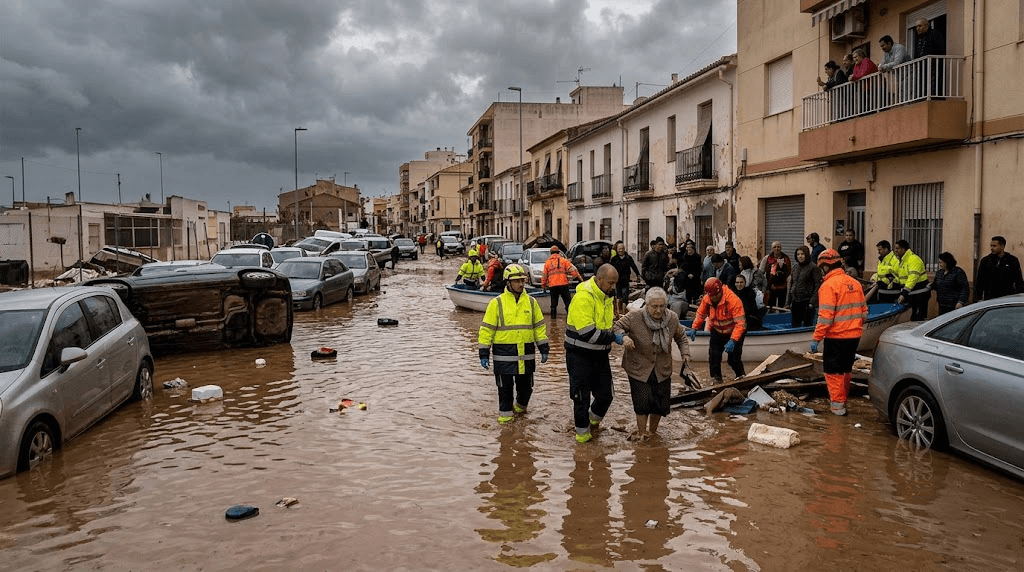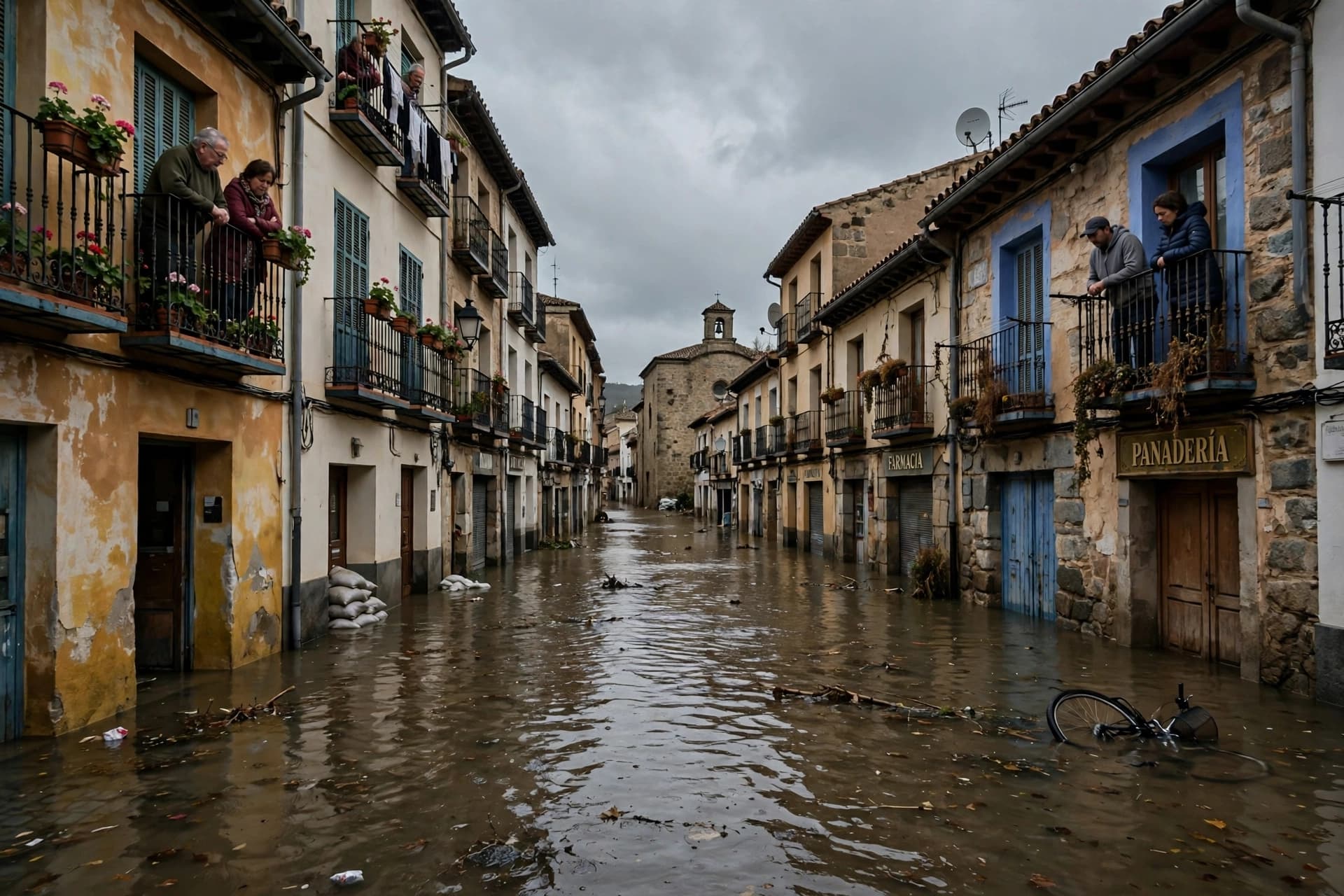
There is a particular rhythm to the way a storm arrives in Valencia, a rhythm the people of the region have learned to read with a mixture of familiarity and dread. The skies darken, the air grows thick, and the rain does not fall so much as it descends in sheets, turning streets into rivers and ravines into torrents within hours. This weekend, Storm Adam followed that rhythm, and by Tuesday, the toll was being counted: at least five dead, thousands evacuated, and a landscape scarred by water that had come too fast to contain.
The storm, a DANA weather system, began to ease on Tuesday after leaving severe flooding across eastern Spain . In the Valencia region alone, the Civil Guard evacuated more than 2,100 people and rescued nearly 500 since the storm began, deploying over 1,300 officers with helicopters, boats, and specialized rescue units . In Oliva, one of the worst-affected towns, rainfall reached 600 liters per square meter in 24 hours. Around 600 people received assistance at the municipal center, and 400 spent the night there from Monday into Tuesday .
The numbers from the broader region are staggering. In L'Atzúvia in Alicante province, 713 liters per square meter fell during the episode. Pego registered 632 liters in 36 hours, 430 of them in just six . The State Meteorological Agency described the rainfall as exceptional in the Valencian counties of La Safor and Marina Alta, among the largest accumulations recorded in recent decades, behind only the historic rainfall in Oliva in 1987 and the 2024 DANA that killed more than 230 people in the same region . The memory of that catastrophe hung over this week's response, a shadow that made the evacuations more urgent and the warnings more insistent.
The human cost is specific and irreducible. In Oliva, two bodies were found on Monday: a 79-year-old woman in her home and a man who died of a heart attack at a campsite. On Tuesday, a farmer was found dead in a marshy area of Pego-Oliva. In Sagunto, a man drowned while swimming at the beach. In Catalonia, a woman died after falling into a stream swollen by the rains . These are not statistics but lives, each one ending in a way that the survivors will carry for years.
The storm's reach extended beyond Valencia. The Balearic Islands, particularly Ibiza and Formentera, recorded torrents bursting their banks, flooding, and road closures. In Ibiza, more than 130 incidents were reported, including fallen trees and standing water that forced some airport operations to be suspended. Formentera recorded up to 203 liters per square meter in 24 hours . Schools were closed across Mallorca, Ibiza, and Formentera, affecting around 160,000 students . In Catalonia, the heaviest rain shifted toward Barcelona, Girona, and Tarragona on Monday afternoon, with warnings remaining in place across nine provinces on Tuesday .
There is one difference from the 2024 disaster that deserves acknowledgment. This time, the Generalitat Valenciana used the ES-Alert system to send warnings directly to citizens' mobile phones, first over the weekend before the storm reached maximum intensity, and again on Monday as flood risk increased. The alerts urged people to avoid travel, stay away from rivers, and seek shelter on higher ground . The rollout marked a change from the delays in emergency communications that drew fierce criticism two years ago. Whether it saved lives is a question that will be examined in the coming weeks, but the intent was clear: to learn from what went wrong and to act before the water rose.
Prime Minister Pedro Sánchez was scheduled to visit Valencia on Tuesday to assess the impact . The rain has lost intensity. The stay-at-home orders have been lifted. The restrictions on 145 municipalities were gradually eased . But the work of recovery has only begun, and the question of how a region repeatedly subjected to these storms prepares for the next one remains unanswered. For now, there is the counting of the dead, the sheltering of the displaced, and the slow return of a landscape to something like normal.
---
AI Image Disclaimer: The imagery in this article is generated by artificial intelligence and intended for illustrative purposes only.
Sources: Euronews, Saudi Gazette, Agência Brasil, RTP, Egyptian Gazette
Published by Banx Network. This article is part of the Banx decentralized media programme, powered by the BXE token on the XRP Ledger.