There is a quiet intimacy in the act of watching weather—the way clouds gather and disperse, the way light shifts through an atmosphere, the way a world reveals itself not in a single glance but over hours of patient observation. For astronomers studying a cold, dim object just 7.5 light-years from Earth, that patience has yielded something remarkable: the first direct confirmation that water clouds on another world change thickness over time, much like the clouds that drift across our own skies.
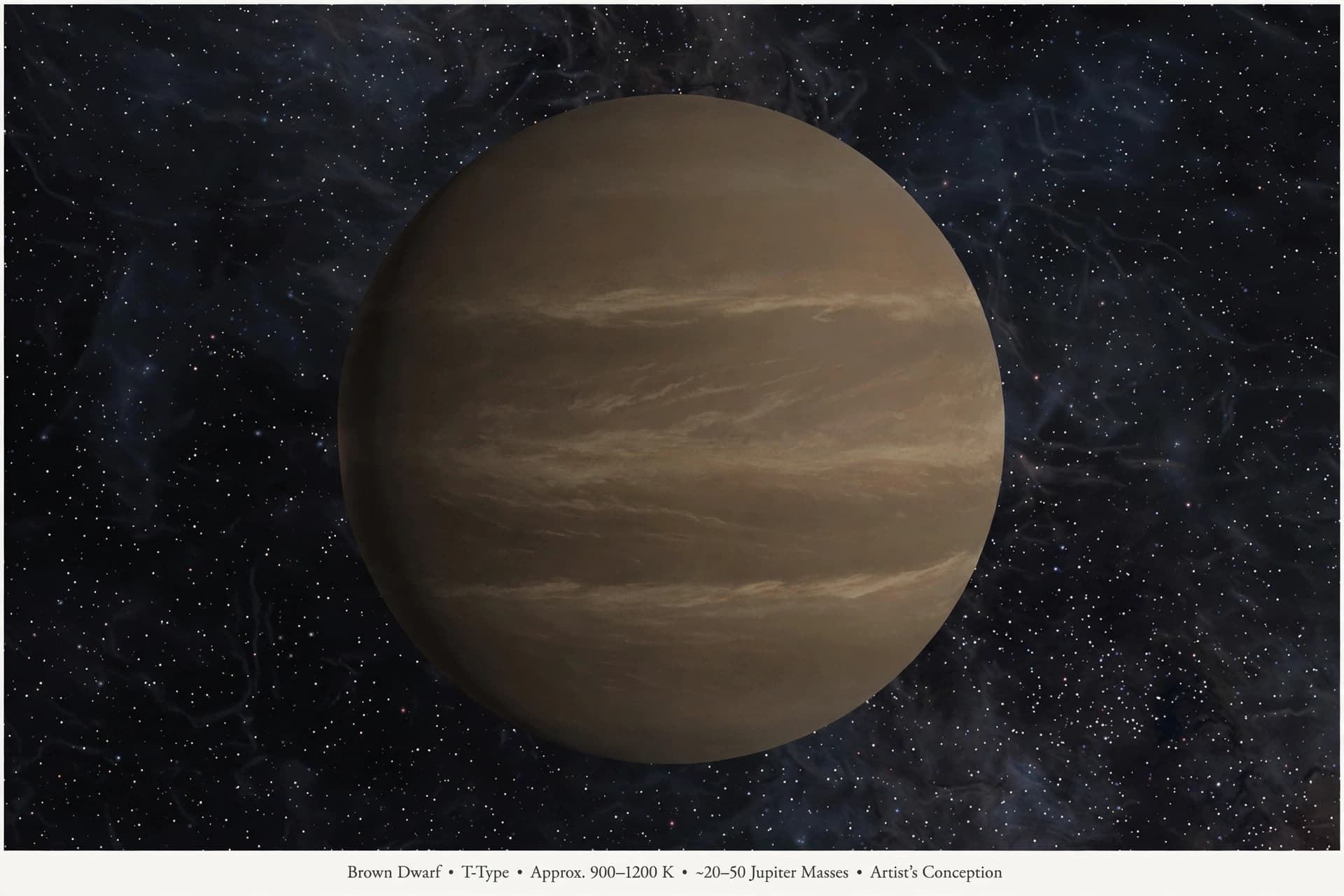
The object is WISE 0855, the coldest known brown dwarf—a body too massive to be called a planet but too small to ignite the nuclear fusion that powers stars . Located in the constellation Hydra, it has roughly twice Jupiter's mass and nearly the same size, with a temperature of about 265 Kelvin, or minus 8 degrees Celsius . It glows faintly with leftover heat from its formation, a dim ember in the cosmic dark.
Using the James Webb Space Telescope, a team led by Brittany Miles of the University of Arizona's Steward Observatory observed WISE 0855 for 11 hours, collecting a spectrum of its light every 15 minutes . The result was the most detailed time-series portrait ever taken of this frigid world—and the first direct evidence that its water clouds are not static but variable, growing thicker and thinner as the object rotates .
The data revealed two distinct processes operating simultaneously. The first is the cloud variation itself: as WISE 0855 spins, different patches of its atmosphere rotate into view, each with slightly different cloud cover and temperature. The second is convection—the same process that drives weather on Earth and Jupiter. Heat from deep inside the brown dwarf churns gases upward, carrying carbon monoxide and phosphine from lower layers into the observable atmosphere . These chemical signals fluctuate in a rhythmic, wave-like pattern, separate from the cloud changes.
"For the first time, we've been able to confirm that water clouds are becoming thinner and thicker on a nearby world," Miles said. "Before JWST, we only had photometry, which mixed up the effects of clouds, chemistry, and temperature all together. Now we can actually distinguish them" .
The discovery matters beyond WISE 0855 itself. Brown dwarfs occupy a strange middle ground between planets and stars, and their atmospheres share fundamental physics with gas giants like Jupiter. If the processes governing clouds, convection, and chemistry are universal, then what astronomers learn from this cold, free-floating world can be applied to the exoplanets now being studied with increasing precision .
"There is a spectrum of behaviors—not a hard line between brown dwarfs and planets," Miles said. "Jupiter and this object look distinctly different, but they have similar weather patterns" .
The team plans further observations to better understand WISE 0855's rotation and the three-dimensional structure of its atmosphere. For now, the finding offers a reminder that weather—the churn of clouds and the rise of warm gases—is not unique to Earth. It is a phenomenon written into the physics of worlds, whether they orbit a star or drift alone through the dark.
AI Image Disclaimer: The visuals accompanying this article were generated by artificial intelligence for illustrative purposes only and do not depict the actual astronomical observations.
Sources: University of Arizona, The Astrophysical Journal, Gizmodo en Español, The New Indian Express, India Today
Published by Banx Network. This article is part of the Banx decentralized media programme, powered by the BXE token on the XRP Ledger.