For more than a century, British Columbians have performed a small ritual each autumn: turning the clocks back, gaining an hour, and accepting the early arrival of dusk as the price of winter. This year, the ritual ends. On Sunday, November 1, clocks in British Columbia will not change. The province has moved to permanent daylight time, and the consequence—quiet, cumulative, and not entirely welcome—is that winter mornings will be darker than most living residents have ever known.
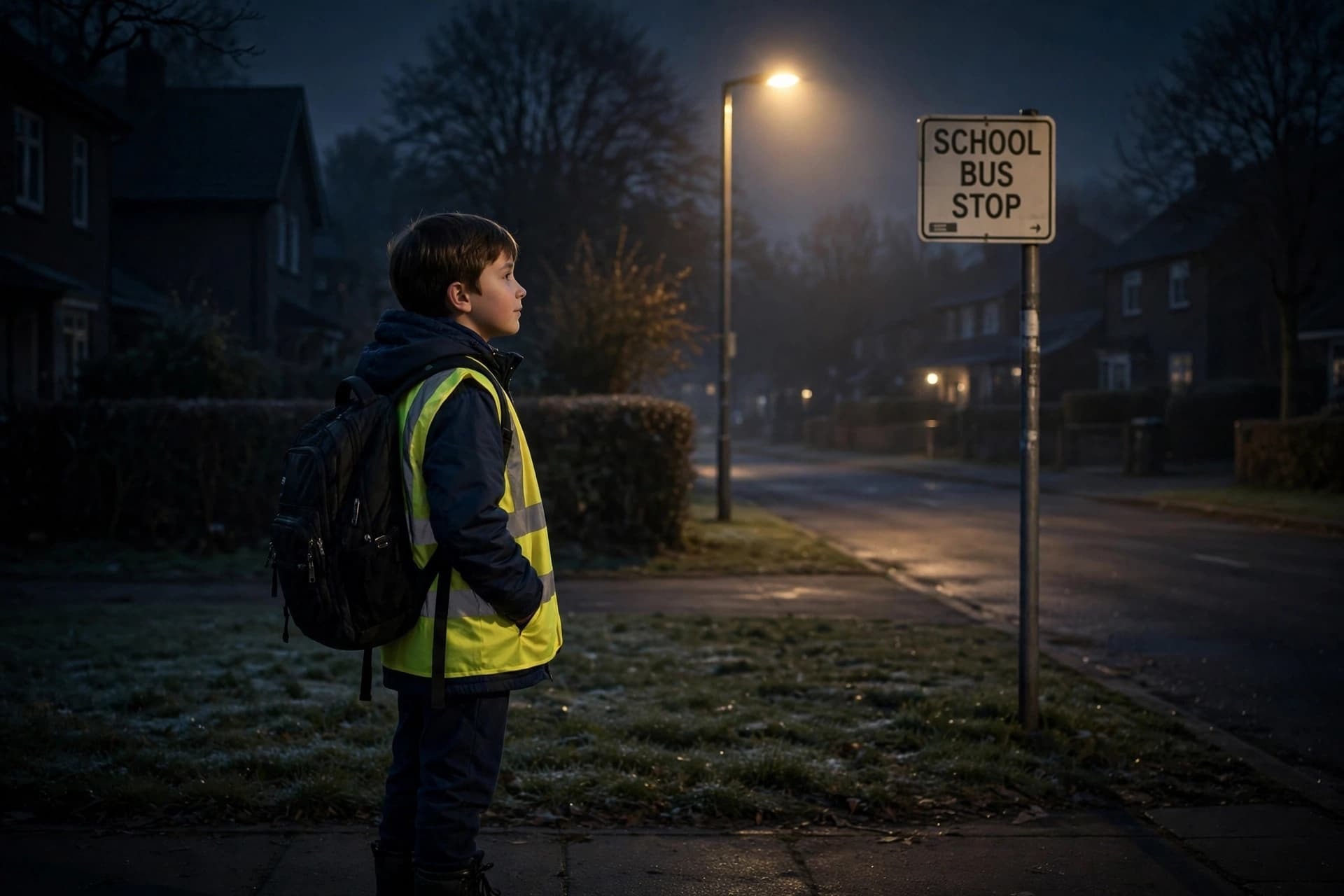
In parts of the South Coast, sunrise will come as late as 9:08 a.m. . For families with children who walk, bike, or wait for buses before school, the morning commute will unfold in full darkness for weeks. Schools and police agencies across the province have begun preparing for this reality, launching visibility campaigns and distributing reflective gear to students . The Sooke, Victoria, and Saanich school districts are partnering with the Capital Regional District on an initiative called "Let's Get Visible," encouraging bright clothing and reflective accessories for the walk to school .
The safety concern is grounded in data. ICBC reports that minors are more than twice as likely to be involved in a crash during their school commute than at other times of day . The winter months were already dangerous for pedestrians in the Lower Mainland; in December 2025, 59 pedestrian-involved crashes occurred during the 6-to-9 a.m. window, a figure that exceeded April and May combined . Permanent daylight time extends that darkness deeper into the morning, when children are most vulnerable.
Health experts have raised a second set of concerns, quieter but perhaps more far-reaching. Dr. Raymond Lam, a professor of psychiatry at the University of British Columbia and co-author of an analysis in the Canadian Medical Association Journal, has argued that permanent standard time would have been the healthier choice. On permanent daylight time, he said, the mismatch between biological clocks and solar time becomes chronic rather than temporary . Later sunrises can disrupt sleep patterns, with consequences for alertness, mood, and productivity. Dr. Alex Choi, a medical health officer for Vancouver Coastal Health, noted that without morning light, the body struggles to regulate its internal sense of time, and that children and youth may be particularly affected .
The decision to abandon the clock change was not made in haste, though its critics argue it was made without sufficient attention to these consequences. A 2019 public engagement survey found that 93 percent of the more than 220,000 respondents favored permanent daylight time . Premier David Eby announced the move in March, framing it as a gift of "an extra hour of sunshine for families" . What the survey did not ask—and what the government's critics have pointed out—is whether respondents would have preferred permanent standard time, an option that was not presented .
There is a history here that bears remembering. The United States tried permanent daylight time in 1974, during an energy crisis. The experiment was abandoned after one season, amid concerns about children traveling to school in darkness and reports of fatalities . Russia, China, and Chile have also reversed similar policies, citing health and safety concerns . British Columbia is not bound by the choices of other jurisdictions, but the pattern is worth noting.
For now, the province is moving forward with a policy that many residents wanted and that some experts worry about. Schools are handing out reflectors. Police are urging drivers to slow down and watch for pedestrians in the dark . The first winter will be a test of whether the promised brighter evenings are worth the darker mornings—and whether the habits of a century can be unlearned without cost. The answer will arrive not in a single moment, but gradually, morning by morning, as the sun rises later and later and the province learns what it has chosen.
Image Disclaimer: The image accompanying this report was created with AI generation tools and is not a photograph of any real location or person.
Sources: CBC News, The Province, CTV News, CityNews Vancouver, Langley Advance Times
Published by Banx Network. This article is part of the Banx decentralized media programme, powered by the BXE token on the XRP Ledger.