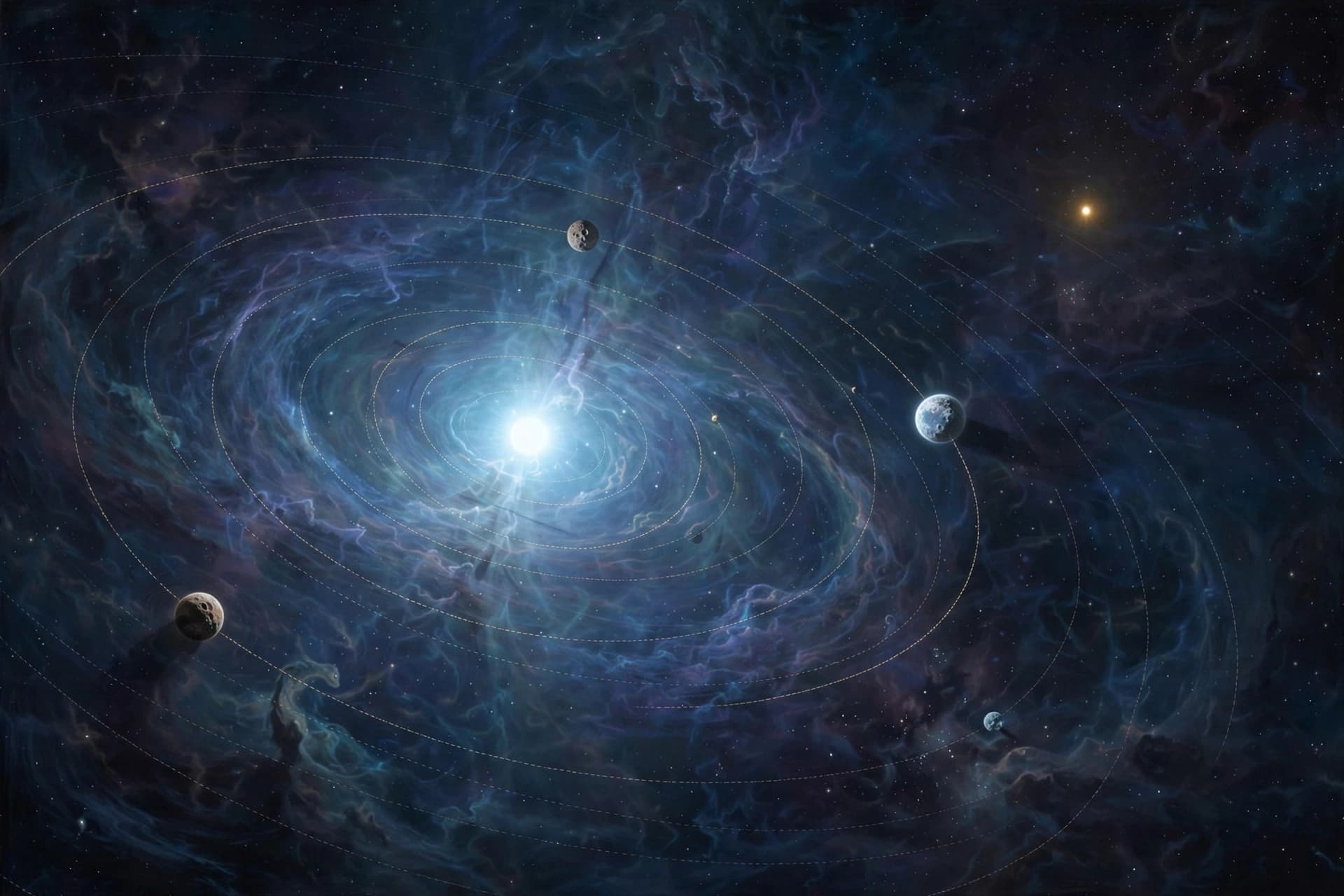
For centuries, the solar system has served as a kind of celestial metronome, its planets tracing the same measured orbits year after year, century after century, in a pattern so regular that Isaac Newton himself saw in it the hand of a divine clockmaker. The stability of this arrangement has long been a comfort, a promise that the architecture of our cosmic neighborhood would endure on timescales that make human history seem like a single breath. A new study published in The Astrophysical Journal Letters suggests that this comfort has been misplaced—not because the planets will fall apart tomorrow, or even in a billion years, but because the mechanism of their eventual dissolution is closer and more violent than anyone had calculated .
The study, led by researchers at the California Institute of Technology, examined what will happen to the outer planets—Jupiter, Saturn, Uranus, and Neptune—after the Sun exhausts its nuclear fuel and transitions into a white dwarf . Previous estimates had placed the stability of their orbits at around a quintillion years, a span so vast that the universe itself might not last long enough to witness their disruption. The eventual cause was thought to be a chance encounter with a passing star, a gravitational nudge from beyond that would send the planets wandering into the dark .
The new research complicates this picture. The Sun, it turns out, will not shed its mass smoothly as it dies. Instead, it will eject material in violent, random bursts—events the researchers call “stochastic kicks”—that impart small but accumulating recoils to the Sun itself . Each kick displaces the orbits of the planets by a tiny amount, and over thousands of such events, the cumulative effect is a solar system that begins to shake itself apart far sooner than expected. The study found that the outer planets could be thrown into chaos roughly one billion years after the Sun becomes a white dwarf, a reduction of a billion-fold from previous estimates .
The findings are not merely a recalibration of a distant future. They also suggest that in approximately 40 percent of the simulations, planetary disruption occurred even earlier, while the Sun was still in its red giant phase . The authors write that their results “return the solar system’s dissolution to astrophysically familiar territory,” relocating its cause not to the slow seep of chaos or the chance encounter with a passing star, but to the Sun itself, “which in dying does not merely enlarge the planetary system it built—it shakes it, and more often than not, spills it” .
For those inclined to worry, the practical implications remain comfortably distant. Before the Sun becomes a white dwarf, it will first swell into a red giant, a transformation that will render Earth uninhabitable and may consume it entirely. Mercury and Venus will almost certainly be engulfed. Mars, sitting farther out, might survive the red giant phase, but it will not escape the eventual unraveling that follows . The timeline of this dissolution—billions of years after the Sun’s death—is so far removed from human experience that it resists meaningful contemplation. The Earth will have been lifeless for eons before the first planet is thrown from its orbit.
What the study offers, then, is not a warning but a revision of the cosmic narrative. The solar system was never a permanent fixture, nor even a particularly long-lived one by astronomical standards. It was a temporary arrangement, held together by a gravitational balance that the Sun’s own dying breaths will eventually disrupt. The planets that have circled our star for billions of years will one day be scattered into the darkness, their orbits no longer bound to the Sun that created them. That this will happen sooner than we thought is, in the grand scheme, a matter of degree rather than kind.
The research was conducted using high-performance supercomputers and hundreds of advanced N-body simulations, with no artificial intelligence tools involved . The researchers programmed a virtual model of the solar system and ran it through countless iterations, testing different scenarios for how the Sun might lose its mass. The consensus that emerged was that the smooth, gradual shedding assumed by earlier models was the exception, not the rule. Stars, it seems, do not die gently. They shudder and shed and kick, and the planets that depend on them for stability are, in the end, at the mercy of their star’s final convulsions .
AI Image Disclaimer: The visual elements in this article were created using AI generation tools and are intended for illustrative purposes only.
Sources: Euronews, The Independent, AAS Nova, The News International, The Astrophysical Journal Letters
Published by Banx Network. This article is part of the Banx decentralized media programme, powered by the BXE token on the XRP Ledger.