In the quiet architecture of a molecule, carbon-hydrogen bonds are the scaffolding—ubiquitous, sturdy, and notoriously reluctant to change. Chemists have long dreamed of modifying them directly, of reaching into a finished structure and reshaping it without first building elaborate molecular handles. That dream, called C–H functionalization, has remained stubbornly out of reach for sustainable production, because the precious metal catalysts it requires—palladium, among them—were consumed in the process, unrecoverable, scattered like seeds on stony ground.
A collaboration between EPFL and ETH Zurich, within the National Centre of Competence in Research Catalysis, has now offered a different ending to that story. Researchers led by Jérôme Waser and Javier Pérez-Ramírez have developed a palladium catalyst that can be recovered, regenerated, and reused after C–H functionalization, the reaction that constructs carbon-carbon bonds central to pharmaceuticals and fine chemicals . The work was published in the Journal of the American Chemical Society.
The catalyst is a single-atom design, with palladium atoms dispersed across a solid support and isolated from one another. This arrangement preserves their activity while allowing the solid catalyst to be recovered by simple filtration . The path to that simplicity was not straightforward. The team first discovered that palladium was not bound tightly enough on many supports, leading to loss of the precious metal during reaction. Carbon nitride—a cheap organic support—proved uniquely able to hold it in place .
Stability, once achieved, brought a new problem: activity plummeted. The reaction slowed to a crawl. The researchers found that adding a small amount of a phosphine compound activated the catalyst without compromising its stability, and the C–H functionalization proceeded in yields up to 83 percent . Then came the question of recyclability. After the first reaction, the catalyst's activity dropped sharply. Using X-ray absorption spectroscopy at the Paul Scherrer Institute, the team traced the loss to iodide binding strongly to the palladium atoms and blocking their catalytic sites. With that knowledge, they designed washing treatments that restored reactivity for up to five cycles, achieving a cumulative turnover number above 200—an order of magnitude higher than the best previous catalyst .
The method has limits. The catalyst cannot be reused indefinitely, and repeated regeneration alters the support. But as a proof of concept, it demonstrates that single-atom catalysts can perform demanding C–H functionalization while retaining the precious metal, and that understanding deactivation can open practical routes to regeneration . "It was possible only by combining the expertise in organic reactions of the EPFL group with the expertise in heterogeneous catalyst design of the ETHZ group," Waser said .
What the work offers, beyond the numbers, is a shift in possibility. A reaction that once consumed its catalyst now returns it, diminished but not spent, ready for another cycle. In the slow, patient work of making chemistry more sustainable, that is not a small thing.
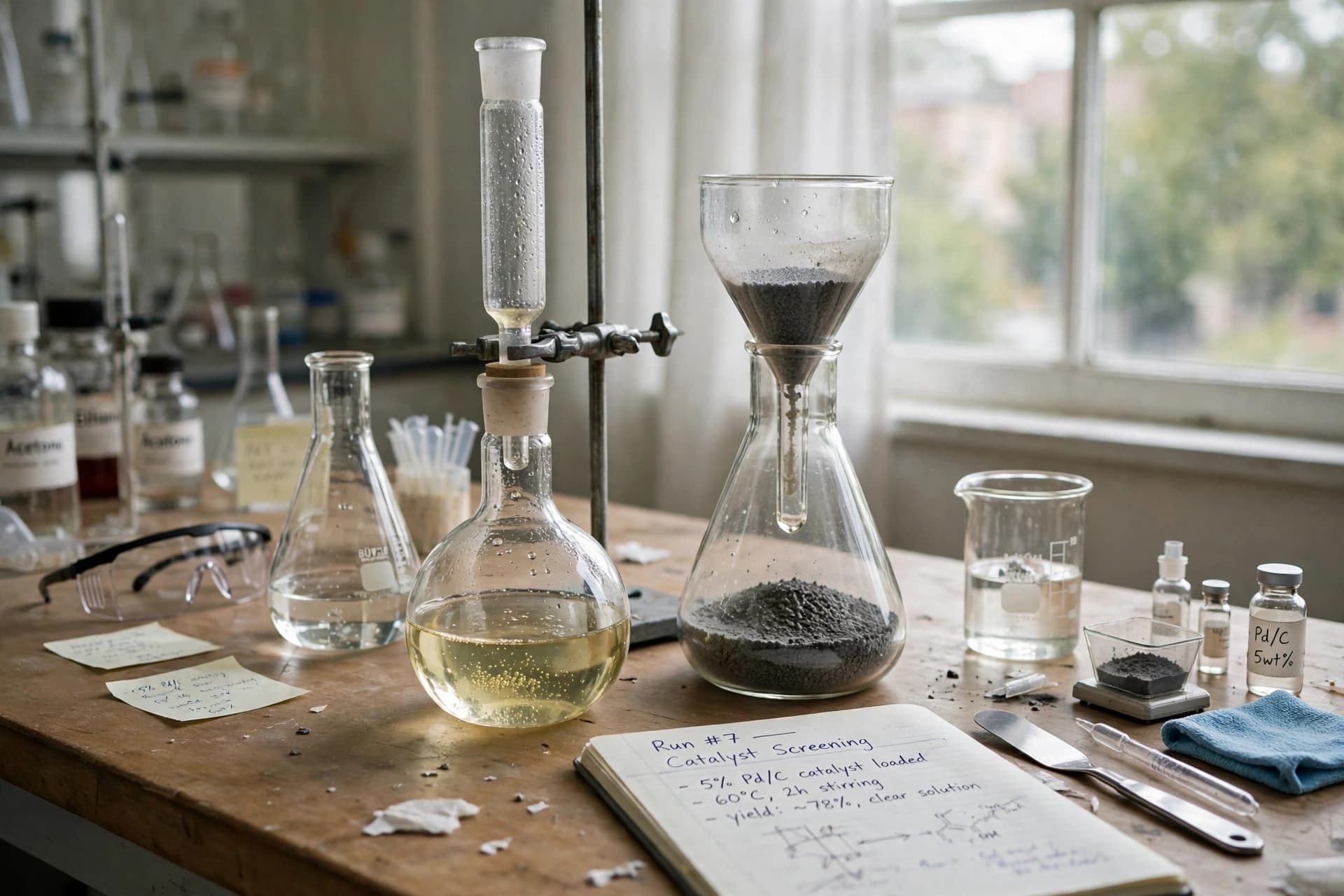
The images in this article are AI-generated and are not photographs of the laboratory or researchers described.
Sources: EPFL, Journal of the American Chemical Society
Published by Banx Network. This article is part of the Banx decentralized media programme, powered by the BXE token on the XRP Ledger.