There is a particular wonder in discovering a creature that seems to belong to several worlds at once—a mammal ancestor that swam like a platypus, hunted like an otter, and possessed a throat so advanced that it could do something no known predecessor had done before. Its name is Megacauda sungei, meaning “big tail,” and its fossilized remains tell a story of evolutionary innovation that would, in time, shape the course of mammalian life.
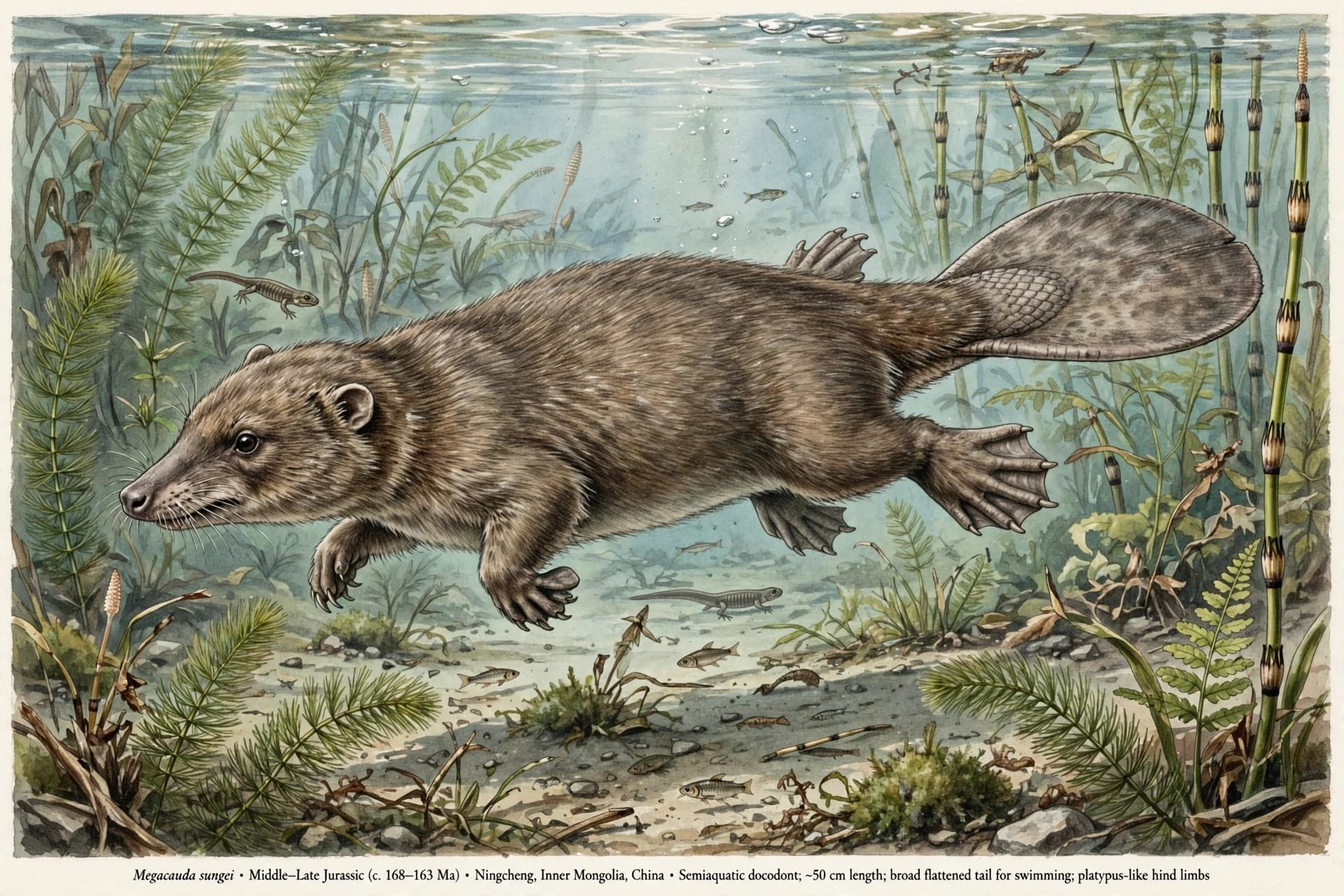
A team led by Zhe-Xi Luo at the University of Chicago has described the 165-million-year-old fossil in the journal Nature, revealing a semi-aquatic mammaliform that lived alongside dinosaurs in what is now Inner Mongolia . Measuring about 40 to 50 centimeters long and weighing one to two kilograms, Megacauda was the largest known mammaliform of its time—a relative heavyweight in an era when most mammal ancestors weighed only a few grams .
What sets Megacauda apart is not its size or even its swimming ability, but what was preserved in its throat. The fossil includes a remarkably complete set of hyoid bones—the structures that link the mouth and throat to the esophagus and larynx—arranged in a U-shaped saddle suspended from the skull . This anatomy, comparable to that of a modern opossum, would have allowed Megacauda to swallow chewed food in controlled lumps rather than gulping down large bites like a crocodile .
The evolutionary significance of this adaptation cannot be overstated. All modern mammals, including humans, possess this same throat structure. It enables us to swallow efficiently, to drink through a straw while breathing, and—crucially—for infants to suckle milk . Luo calls it “an incredibly important evolutionary innovation,” one that allowed early mammals to develop specialized teeth and diversify into a tremendous range of diets, from carnivores and insectivores to herbivores and omnivores .
The fossil also preserves evidence of Megacauda’s aquatic lifestyle. Its pelvis, hind limbs, and tail suggest it propelled itself through water with a broad, flattened tail and hind limbs reminiscent of a platypus . Tiny vertebrate bones found in its stomach indicate it likely preyed on small animals like salamanders that lived in the same environment .
The path to this discovery was not straightforward. Found by local farmers in Inner Mongolia, the fossil was acquired by the Paleontological Museum of Liaoning and later examined by researchers from China, the United States, and Germany. During the COVID-19 pandemic, study co-author Chang-Fu Zhou transported the specimen to multiple labs for CT scanning and X-ray fluorescence imaging, allowing scientists to visualize its delicate internal structures in fine detail .
For Luo and his colleagues, Megacauda is more than a single remarkable find. It is a window into a time when mammal ancestors were experimenting with different ways of life—swimming, climbing, burrowing—long before the extinction of the dinosaurs would clear the way for their descendants to inherit the Earth. The ability to chew and swallow, to nurse young with milk, to control food with a throat rather than relying on gravity: these were the quiet innovations that made that inheritance possible.
AI Image Disclaimer: The visual content accompanying this article was created using artificial intelligence and is intended for illustrative purposes only, not as a scientific reconstruction.
Sources: University of Chicago News, CBS News, New Scientist, Research in Germany
Published by Banx Network. This article is part of the Banx decentralized media programme, powered by the BXE token on the XRP Ledger.