The moon has never been an easy neighbor. It is close enough to tempt us and far enough to punish every miscalculation, a place where a landing site chosen poorly can mean the difference between a mission and a memorial. For decades, planning a trip there has required years of painstaking analysis, the slow accumulation of images and measurements and educated guesses. But as space agencies prepare to return, a new kind of tool is emerging—one that does not replace human judgment but sits beside it, sifting through the data at a pace no team of scientists could match.
At Ohio State University, a PhD candidate named Gokce Inal has developed an artificial intelligence framework called LUMINA, designed to help mission planners evaluate potential lunar landing sites, identify hazards, and locate scientifically valuable geological features . The system builds on an earlier model called LLaVA-LE, which could describe lunar terrain and answer questions about it. LUMINA goes further: it can plan multistep analyses, assess landing sites, and explain the reasoning behind its recommendations.
What makes LUMINA notable is not that it is autonomous, but that it is deliberately not autonomous. Inal describes it as a decision-support system, meant to work in tandem with human experts rather than in place of them. "Most AI tools are passive tools," she said. "You ask a question and get an answer, but we're moving toward an active scientific assistant that can work through a problem alongside the experts" . The distinction matters. Space exploration is not a domain where the consequences of error are abstract, and the researchers behind LUMINA seem to understand that a tool which cannot explain itself is of limited use when lives and budgets are at stake.
The lunar surface presents a particular set of challenges for this kind of work. Landing sites must be flat enough to be safe, close enough to resources like water ice to be useful, and scientifically interesting enough to justify the journey. These criteria can conflict, and weighing them requires judgment. LUMINA's contribution is to process the overwhelming volume of imagery and geospatial data that modern missions generate, producing not just answers but reasoned commentary. Preliminary results show a strong ability to make complex lunar observations and generate mission commentary for candidate sites .
The broader context for this work is NASA's Artemis program, which aims to establish a sustained human presence on and around the moon. Artemis represents a shift from the brief visits of the Apollo era to something more permanent, and permanence requires infrastructure, resource identification, and careful site selection. The researchers note that their system could be adapted to other planetary bodies as well, including Mars and asteroids, because the underlying challenge—making sense of unfamiliar terrain at scale—is not unique to the moon .
There is a temptation, when discussing AI in space exploration, to imagine a future in which machines make all the decisions and humans merely approve them. The Ohio State team explicitly resists that framing. Alper Yilmaz, a co-author on the research, described LUMINA as "another set of eyes that can verify and question things and help us communicate better" . The phrase is modest, but it points to something important: the value of an AI system in this context may lie less in its intelligence than in its patience, its ability to look at the same data repeatedly without fatigue, and its capacity to surface details that human attention might miss.
The work was presented at the 58th Annual Meeting of the Division for Planetary Sciences of the American Astronomical Society, and the team plans to continue testing LUMINA on new high-quality lunar data as it becomes available . The trajectory is incremental, as most scientific trajectories are. There is no single moment when the tool becomes indispensable; there is only the gradual accumulation of evidence that it helps.
The moon remains what it has always been: a harsh and indifferent place, beautiful from a distance and unforgiving up close. The question is not whether we will return, but how carefully we will prepare. Tools like LUMINA suggest that preparation is becoming more sophisticated, more data-driven, and perhaps a little more collaborative between human and machine. That is not a revolution. It is an improvement, and for the purposes of exploration, an improvement may be enough.
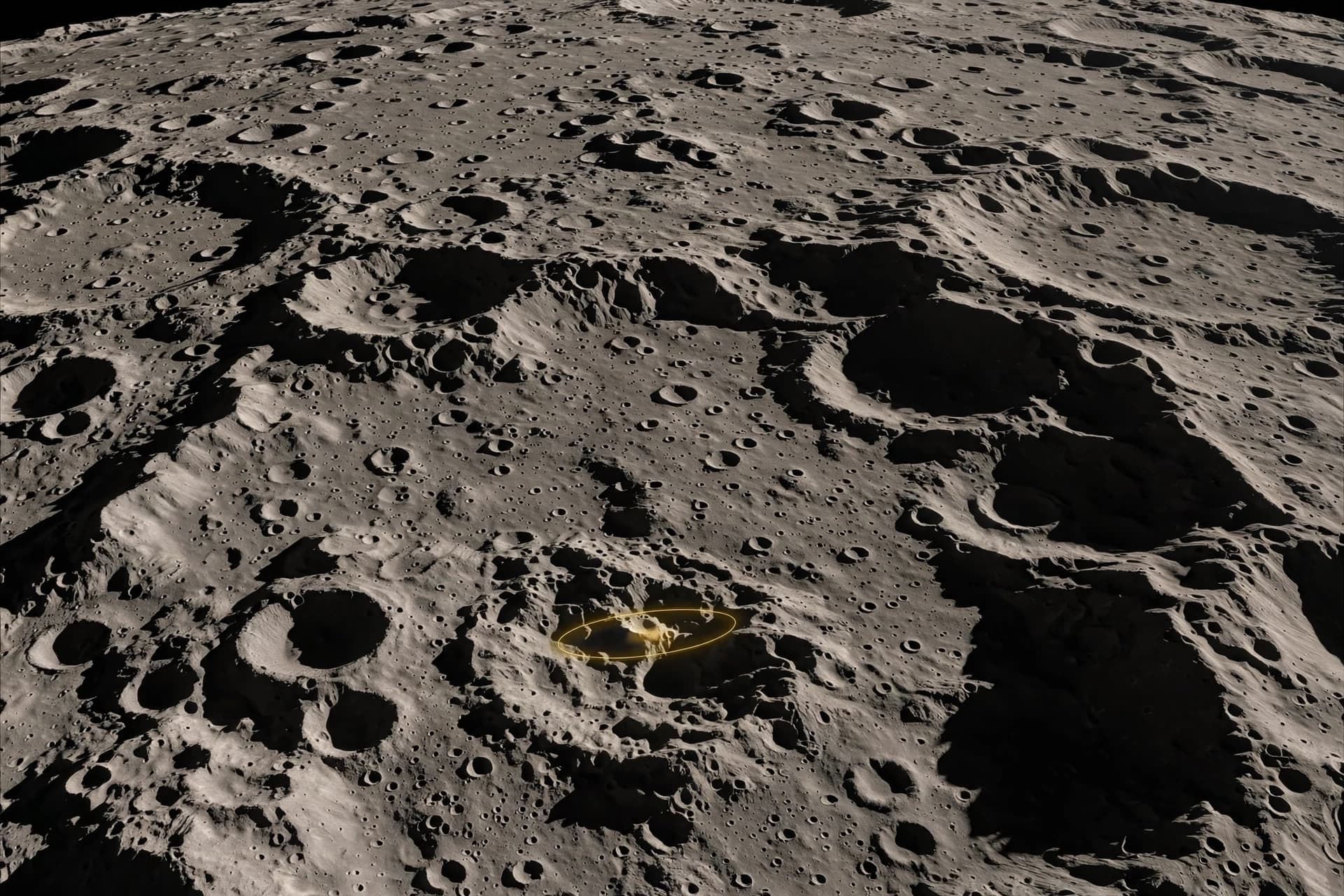
Image note: The images in this article are AI-generated illustrations and do not depict actual lunar data or the LUMINA system in operation.
Sources: Ohio State University News, American Astronomical Society
Published by Banx Network. This article is part of the Banx decentralized media programme, powered by the BXE token on the XRP Ledger.