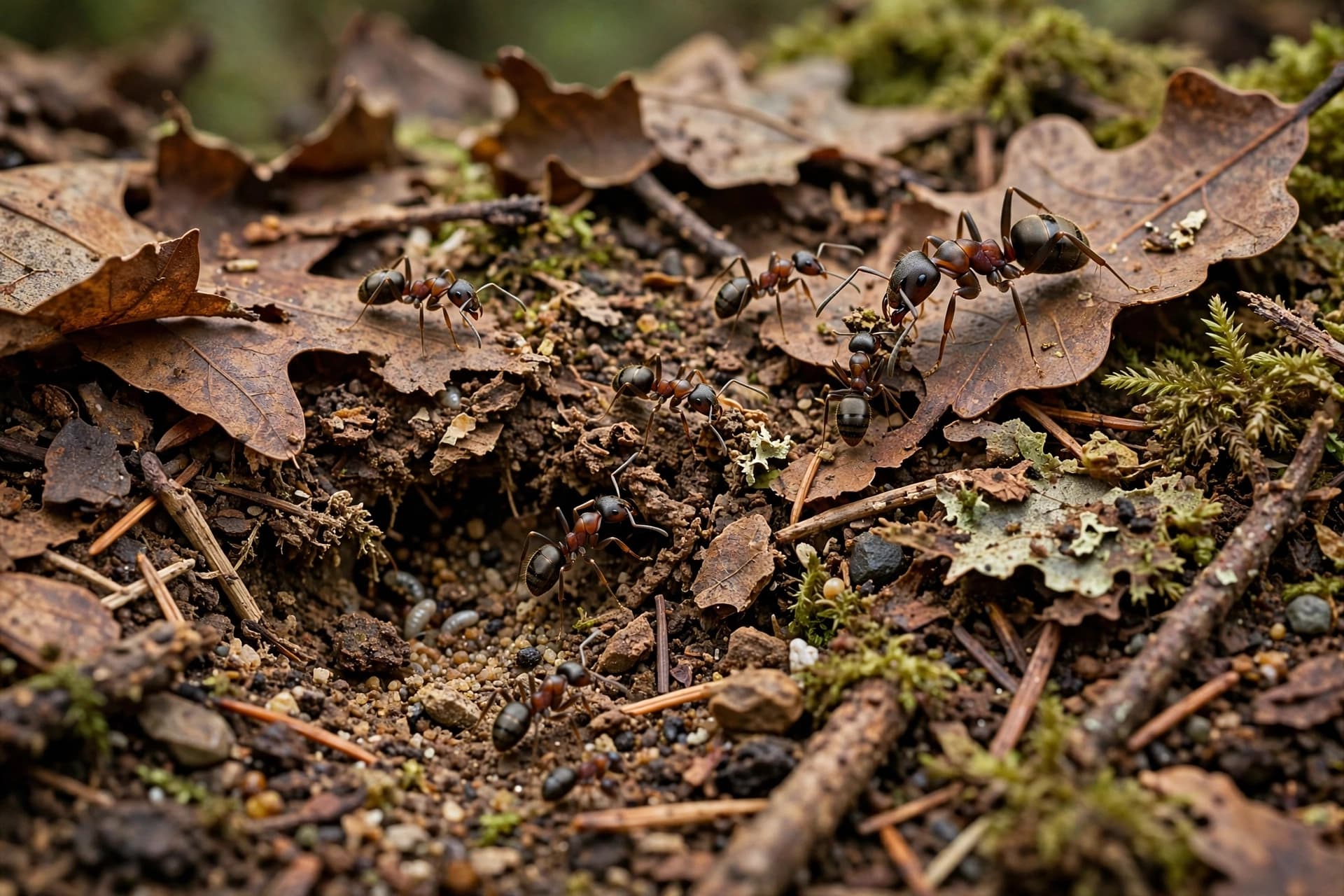
There is a rule of thumb in biology that seems almost too obvious to question: bigger, better-armored individuals should fare better in the struggle for survival. A thicker shell, a stronger exoskeleton, a more robust body—these are the traits that protection is made of. But ants, those small architects of collective life, have a way of making rules look like suggestions.
A study published in Science Advances has found that certain ant species have evolved thinner exoskeletons in favor of larger colony sizes, a trade-off that appears to help them adapt to new environments with limited resources . The research, led by entomologists at the University of Maryland and the University of Cambridge, used CT scans of 880 ant specimens representing more than 500 species to create digital 3D reconstructions of the insects' bodies .
The exoskeleton, or cuticle, is the ant's suit of armor. It provides structural support, protects against predators and disease, and shields the insect from environmental harms. But building it is costly. The elements required—nitrogen, zinc, manganese—are not always abundant, and investing in thick armor means diverting resources away from other priorities . What the scans revealed was a striking range: the cuticle accounted for between roughly 6 and 35 percent of an ant's total body volume across the species studied.
When the researchers looked for patterns, they found one. Species with thinner cuticles tended to have larger colony sizes. Instead of investing heavily in individual protection, these ants appear to have opted for quantity over quality—producing "cheaper" workers in greater numbers . The strategy makes a certain sense in the logic of social insects. A larger colony can forage more effectively, defend its nest with more bodies, and divide labor across a wider range of tasks. The collective becomes the shield.
The study also found that species with thinner cuticles tended to diversify into new habitats more frequently. Requiring less nitrogen to build their bodies could make them more versatile, better able to colonize environments where nutrients are scarce . "There's this question in biology of what happens to individuals as societies they are in get more complex," said Evan Economo, a co-author of the study. "The individuals may themselves become simpler because tasks that a solitary organism would need to complete can be handled by the collective" .
What remains unresolved is the direction of causation. Did thinner cuticles enable larger colonies, or did larger colonies relax the pressure on individual armor? The study does not offer a definitive answer, and the evolutionary history of these traits is likely tangled. What it does suggest is that the rules of survival are not universal. For a solitary creature, a thick exoskeleton is an asset. For an ant in a colony of thousands, it may be a cost that is better spent elsewhere.
The finding adds to a growing understanding of ants as evolutionary experimenters. They have shrunk and regrown their brains, enslaved other species, and built supercolonies that stretch for thousands of kilometers. Sacrificing armor for numbers is simply another entry in a long ledger of unconventional strategies. The rule they broke was never really a rule at all—just an assumption that individuals matter more than the collective. Ants have been arguing otherwise for millions of years.
Visuals in this article were created using AI and are for illustrative purposes only.
Sources: Smithsonian Magazine, Science Advances
Published by Banx Network. This article is part of the Banx decentralized media programme, powered by the BXE token on the XRP Ledger.