1. The Arctic is becoming a new centre of global competition
For decades, the Arctic was often viewed as a remote region of ice, scientific research stations and small settlements. Today, it is becoming an increasingly important arena for international competition.
Eight countries have territory within the Arctic region: the United States, Canada, Russia, Denmark through Greenland, Norway, Sweden, Finland and Iceland. Their interests range from national security and energy production to mineral extraction and control of emerging shipping routes.
Climate change is accelerating this transformation. The Arctic is warming approximately four times faster than the global average, changing sea-ice conditions and making parts of the region more accessible to commercial and military activity. 1
But this is not simply a story about melting ice. It is about the strategic value of geography, natural resources and infrastructure in an increasingly competitive global economy.
2. Greenland: the prize attracting international attention
Few places illustrate the Arctic's growing importance better than Greenland.
An autonomous territory within the Kingdom of Denmark, Greenland occupies a strategically important position between North America and Europe. Its location matters for military surveillance, missile warning systems and monitoring activity across the North Atlantic.
It also possesses significant mineral potential.
Greenland has known deposits of rare earth elements, graphite, iron ore, copper, zinc, uranium and other resources. Its rare earth deposits have attracted particular attention because these materials are essential to industries such as electric vehicles, renewable energy, electronics and defence technology. 2
The challenge is turning geological potential into commercially viable production.
Much of Greenland is covered by ice, while its settlements, roads, ports and industrial infrastructure are limited. Developing mines requires substantial investment in transport, electricity, processing facilities and skilled labour.
There are also environmental and political considerations. Mining projects can face local opposition, regulatory hurdles and concerns about radioactive materials associated with certain mineral deposits.
This makes Greenland valuable, but not an easy resource opportunity.
The United States has shown considerable interest in the island, with President Donald Trump repeatedly raising the possibility of American control. Those ambitions have raised concerns about Danish sovereignty, Greenlandic self-determination and the unity of NATO.
The strategic importance of Greenland is therefore about much more than its mineral deposits. It is also about military geography and influence over the North Atlantic. 3
3. Russia's Arctic advantage
Russia is arguably the most geographically established power in the Arctic.
It possesses an enormous Arctic coastline, extensive energy infrastructure and a long history of operating in extreme northern conditions. Its Arctic region is important to the country's oil and gas industries, military strategy and access to international markets.
Russia has invested in ports, airfields, military facilities and icebreakers, including nuclear-powered vessels capable of operating in difficult polar conditions.
The Northern Sea Route, which runs along Russia's northern coastline, is central to Moscow's ambitions.
The route could provide a shorter maritime connection between parts of Europe and Asia than traditional journeys through the Suez Canal. It could also help Russia transport energy and other commodities to international buyers.
However, the route is not a straightforward replacement for established shipping corridors. Ice conditions, seasonal restrictions, insurance costs, limited infrastructure and the need for specialised vessels all affect its commercial viability.
Russia's invasion of Ukraine has also reshaped its international relationships. Western sanctions have restricted access to certain technologies and markets, while Moscow has expanded its economic cooperation with Asian partners, particularly China.
This has made the Arctic increasingly important to Russia's long-term economic and strategic planning. 4
4. China's interest in the Polar Silk Road
China is not an Arctic country, but it has made clear that the region forms part of its long-term economic and strategic interests.
In 2018, Beijing described itself as a near-Arctic state and outlined ambitions to participate in Arctic development through its Polar Silk Road initiative.
The concept connects China's wider Belt and Road ambitions with potential northern shipping routes, energy projects and access to natural resources.
For China, the Arctic offers several opportunities:
Trade: Alternative shipping routes could reduce dependence on traditional maritime corridors.
Energy: Arctic oil and gas projects could provide additional sources of supply.
Minerals: Access to critical raw materials could support industrial and technological development.
Infrastructure: Investment in ports, shipping, research and logistics could strengthen China's regional presence.
China has also developed economic relationships with Russia, including involvement in major energy projects.
However, its ambitions face significant obstacles. Western governments are increasingly cautious about strategic Chinese investment in critical infrastructure, while the region's harsh environment makes large-scale development expensive.
China's Arctic strategy is therefore likely to remain a combination of commercial investment, scientific research and diplomatic engagement rather than an attempt to control Arctic territory.
5. The race for critical minerals
Energy is only one part of the Arctic opportunity. Its mineral resources could become increasingly important as countries attempt to secure supplies of materials essential to modern industries.
Rare earth elements are among the most strategically important.
They are used in permanent magnets, electric motors, wind turbines, electronics and defence systems. Demand for these materials is closely connected to the global transition towards electrification and advanced manufacturing.
The Arctic region contains deposits of rare earths and other valuable minerals, including nickel, cobalt, copper, graphite and platinum-group metals.
Sweden's Kiruna mining region, for example, has attracted attention because of its potential to contribute to Europe's rare earth supply chain. Greenland is another potential source of strategically important minerals. 5
The wider geopolitical issue is supply-chain dependence.
Countries that rely heavily on imported critical minerals can become vulnerable to export restrictions, trade disputes and political pressure. Developing alternative sources could help the United States and European countries reduce their dependence on concentrated supply chains.
Nevertheless, discovering mineral deposits is not the same as producing commercially useful materials.
Mining, refining and processing require significant capital, technical expertise and infrastructure. Some projects may take many years to become operational, while others may never become economically viable.
The Arctic could become an important part of future mineral supply chains, but it is unlikely to provide an immediate solution to global shortages.
6. Could Arctic shipping change global trade?
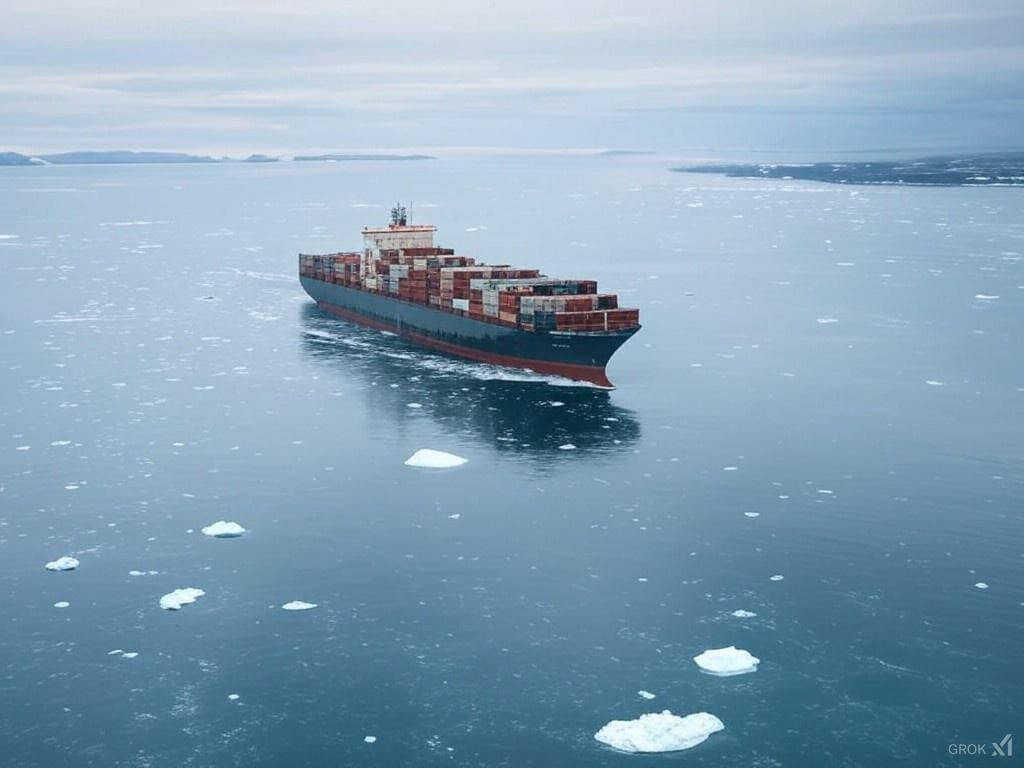
One of the most significant potential economic developments is the expansion of northern shipping routes.
There are two major routes attracting attention.
The Northern Sea Route follows Russia's Arctic coastline, connecting the North Atlantic and Pacific regions.
The Northwest Passage runs through the Canadian Arctic Archipelago, offering another potential connection between the Atlantic and Pacific.
Both routes could reduce journey distances between certain Asian, European and North American destinations.
For shipping companies, shorter journeys can mean reduced fuel consumption, lower transit times and potentially more efficient supply chains.
However, the commercial reality is complicated.
Ships operating in Arctic waters may require specialised construction, additional insurance and icebreaker assistance. Ports and emergency-response facilities are also limited in many areas.
Furthermore, sea ice remains unpredictable. A route that is navigable during one period may become dangerous or inaccessible under different conditions.
Recent developments demonstrate both the opportunity and the limitations. The Northern Sea Route has attracted increased attention as geopolitical disruptions affect traditional shipping corridors. Yet research published by the Carnegie Endowment in September 2026 highlighted the route's high costs and dependence on unusual geopolitical circumstances. 4
The Arctic is unlikely to replace the Suez Canal or become a universally reliable global shipping corridor in the immediate future. It could, however, become an increasingly useful alternative for certain seasonal and specialised cargo movements.
7. The military dimension: a new strategic frontier
As economic interest increases, so does the importance of Arctic security.
The region provides access to the North Atlantic, contains strategically important military installations and sits close to major nuclear powers.
Russia has maintained and developed military infrastructure across its Arctic territory. Meanwhile, NATO countries have strengthened their northern defence capabilities following Finland and Sweden joining the alliance.
In February 2026, NATO launched Arctic Sentry, an activity designed to strengthen its deterrence and defence across the Arctic and High North. 1
The competition is not limited to conventional military forces.
Undersea communication cables, satellite infrastructure, energy installations and shipping networks are becoming increasingly important. Damage or disruption to these systems could have consequences far beyond the Arctic itself.
The European Union's updated Arctic strategy, announced in October 2026, reflects these concerns. Its proposals include stronger monitoring and protection of undersea communications infrastructure, improved maritime surveillance and investment in Arctic connectivity. 6
The region is moving away from its traditional reputation as an area of relatively low geopolitical tension.
8. The environmental cost of the Arctic gold rush
There is an uncomfortable contradiction at the centre of the Arctic's economic transformation.
The same environmental changes making the region more accessible are also threatening its ecosystems and communities.
The Arctic is home to wildlife adapted to extremely cold conditions, including polar bears, seals, walruses and numerous migratory bird species. Its marine ecosystems are particularly sensitive to changes in temperature, pollution and habitat disruption.
Increased shipping could introduce underwater noise, fuel pollution and the risk of accidents. Oil spills in remote polar waters would be particularly difficult to contain.
Mining also carries significant risks. Industrial activity can disturb fragile landscapes, contaminate water supplies and affect communities that depend on local ecosystems.
There is an additional climate concern: increased access to fossil fuel resources could encourage further oil and gas development, potentially adding to global emissions.
Economic development will therefore require careful environmental regulation, scientific monitoring and meaningful involvement from Indigenous communities and local populations.
The Arctic is not an empty territory waiting to be exploited. It is an inhabited region with established communities, cultures and ecosystems.
9. Who will win the Arctic gold rush?
The Arctic competition will not necessarily produce one dominant winner.
Russia possesses geographical advantages, existing infrastructure and extensive experience operating in the region. The United States has significant military capabilities and strategic interests in Alaska and Greenland. Canada and the Nordic countries have important territorial interests, while China is seeking economic access and influence.
European countries are also looking to strengthen their position through mineral partnerships, infrastructure investment and security cooperation.
For investors, the opportunities could emerge across several industries:
Critical mineral exploration and processing.
Icebreakers and specialised shipping.
Ports, logistics and transport infrastructure.
Satellite communications and surveillance.
Energy production and transmission.
Environmental monitoring and engineering.
However, investors should distinguish between long-term potential and immediate commercial returns. Arctic projects often involve high development costs, regulatory uncertainty, environmental obligations and geopolitical risk.
The companies most likely to benefit may not simply be those extracting resources. Infrastructure providers, specialist engineering firms and technology companies could also play important roles.
10. The Arctic's importance will extend far beyond the region
The Arctic gold rush is ultimately part of a much larger shift in global economics and geopolitics.
As countries compete for critical minerals, secure energy supplies, alternative trade routes and strategic infrastructure, the High North is becoming increasingly difficult to ignore.
But the region's future will not be determined by natural resources alone. It will depend on whether governments can balance economic development with environmental protection, respect for sovereignty and regional security.
The Arctic could become a major centre of international trade and investment over the coming decades. It could also become a more militarised and politically divided region.
The central question is whether the world's powers can cooperate sufficiently to manage their competing interests.
The Arctic may be opening up, but that does not mean it is there for the taking.
Sources
NATO — Arctic Security
CSIS — Greenland, Rare Earths, and Arctic Security
The Guardian — Greenland: New Shipping Routes, Hidden Minerals and a Frontline Between the US and Russia?
Carnegie Endowment — International Demand for Russia's Arctic Shipping Route Is Unlikely to Last
Steptoe — The Arctic's Value Is Increasing in an Age of Geoeconomic Competition
Associated Press — EU Unveils a New Arctic Push as Global Warming and Security Threats Reshape the Region
UK House of Commons Library — UK Defence: Renewed Interest in the Arctic
Published by Banx Network. This article is part of the Banx decentralized media programme, powered by the BXE token on the XRP Ledger.