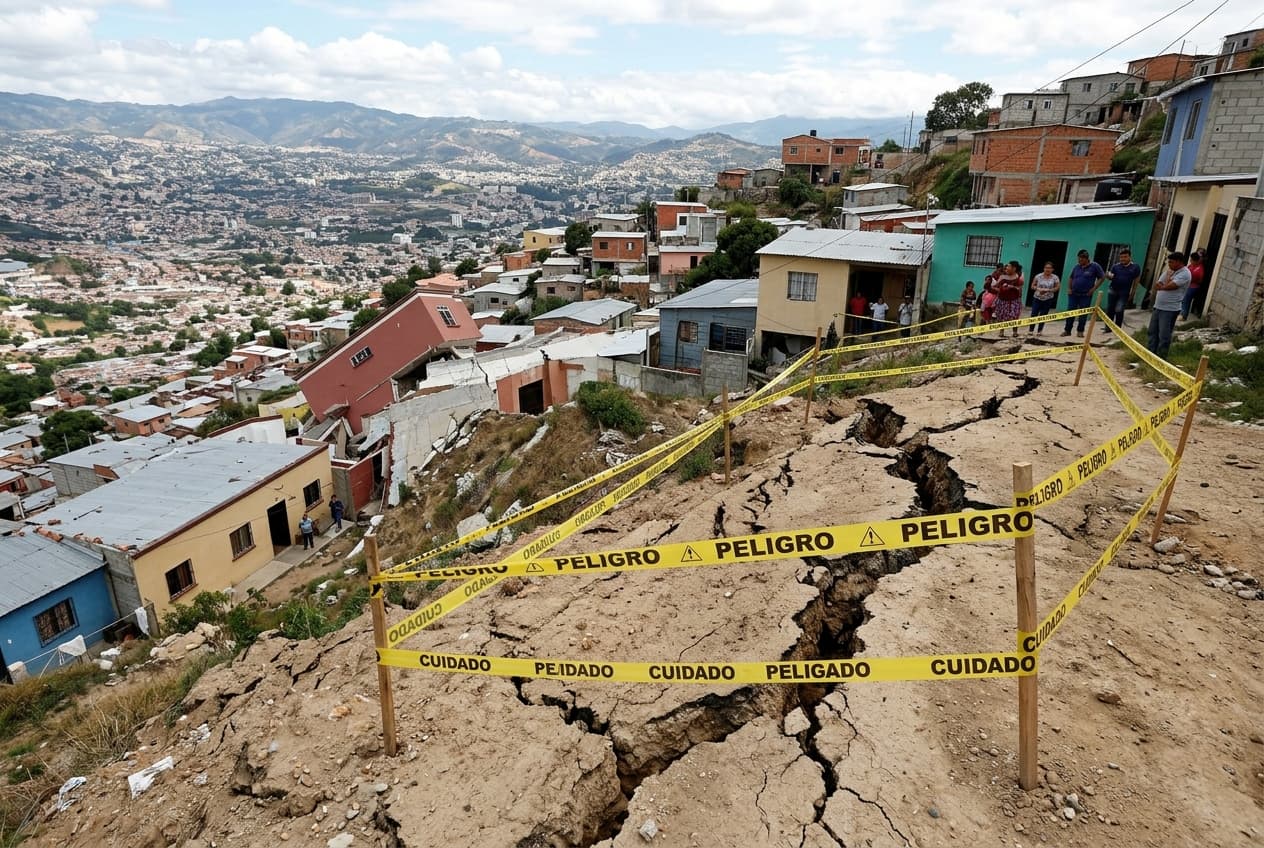
Tegucigalpa, Honduras—A saturated hillside gave way in a high-risk neighborhood of Tegucigalpa today, burying a home and killing three members of the same household. The landslide occurred during the early morning hours as weeks of relentless seasonal rainfall finally destabilized the steep, unreinforced clay slope above the structure. Tons of waterlogged earth and heavy boulders crashed down the incline, completely crushing the dwelling's cinder-block walls.
Neighbors who heard the deafening roar of falling earth rushed to the scene with shovels and buckets to begin digging out the structure before emergency services arrived. Firefighters and civil defense brigades deployed heavy hydraulic tools and sniffer dogs to navigate the deep mud field. Rescue workers recovered three bodies from beneath collapsed concrete roof slabs and mud after hours of continuous digging.
First responders confirmed all three victims belonged to the same family residing in the lower section of the structure. Paramedics treated two additional family members who managed to escape through a rear window for minor lacerations and acute shock. High-density residential construction along steep urban ravines in Tegucigalpa leaves thousands of households exposed to sudden, catastrophic slope failures.
Municipal disaster authorities immediately ordered the evacuation of twelve surrounding homes along the compromised ridge. "The soil profile was completely liquefied by continuous subterranean seepage," stated Jorge Aldana, a city civil defense inspector on site. "The structural foundations had no retaining support capable of resisting this volume of earth movement."
Tegucigalpa’s mountainous topography and rapid informal urbanization have created widespread vulnerability to rainfall-induced landslides. Unplanned drainage, deforestation along upper hill slopes, and lack of municipal retention infrastructure routinely lead to fatal collapses during annual rain cycles. Central government agencies struggle to relocate thousands of families living in designated high-risk geological zones across the capital.
Emergency workers established a temporary shelter at a nearby community center to house displaced families whose homes remain threatened by secondary earth movements. Social services personnel provided food, blankets, and psychological support to surviving relatives gathered near the perimeter wire. Municipal engineers used drone equipment to survey the upper cliff face for deep fissures and active soil creep.
Police units secured the perimeter to prevent residents from re-entering damaged structures to retrieve personal property. Heavy excavators arrived late this afternoon to remove thick mud deposits from the primary neighborhood access alleyway.
Local leaders called on municipal administrators to accelerate long-promised slope stabilization projects across vulnerable hillside barrios. Rains continue to fall in intermittent bursts across the central highlands, keeping emergency units on maximum alert across the department.
Search-and-rescue teams concluded primary recovery operations at nightfall while civil defense officers maintain a strict perimeter around the slide zone. Geotechnical inspectors remain on site to monitor real-time ground stability sensors installed along the ridge.
Published by Banx Network. This article is part of the Banx decentralized media programme, powered by the BXE token on the XRP Ledger.