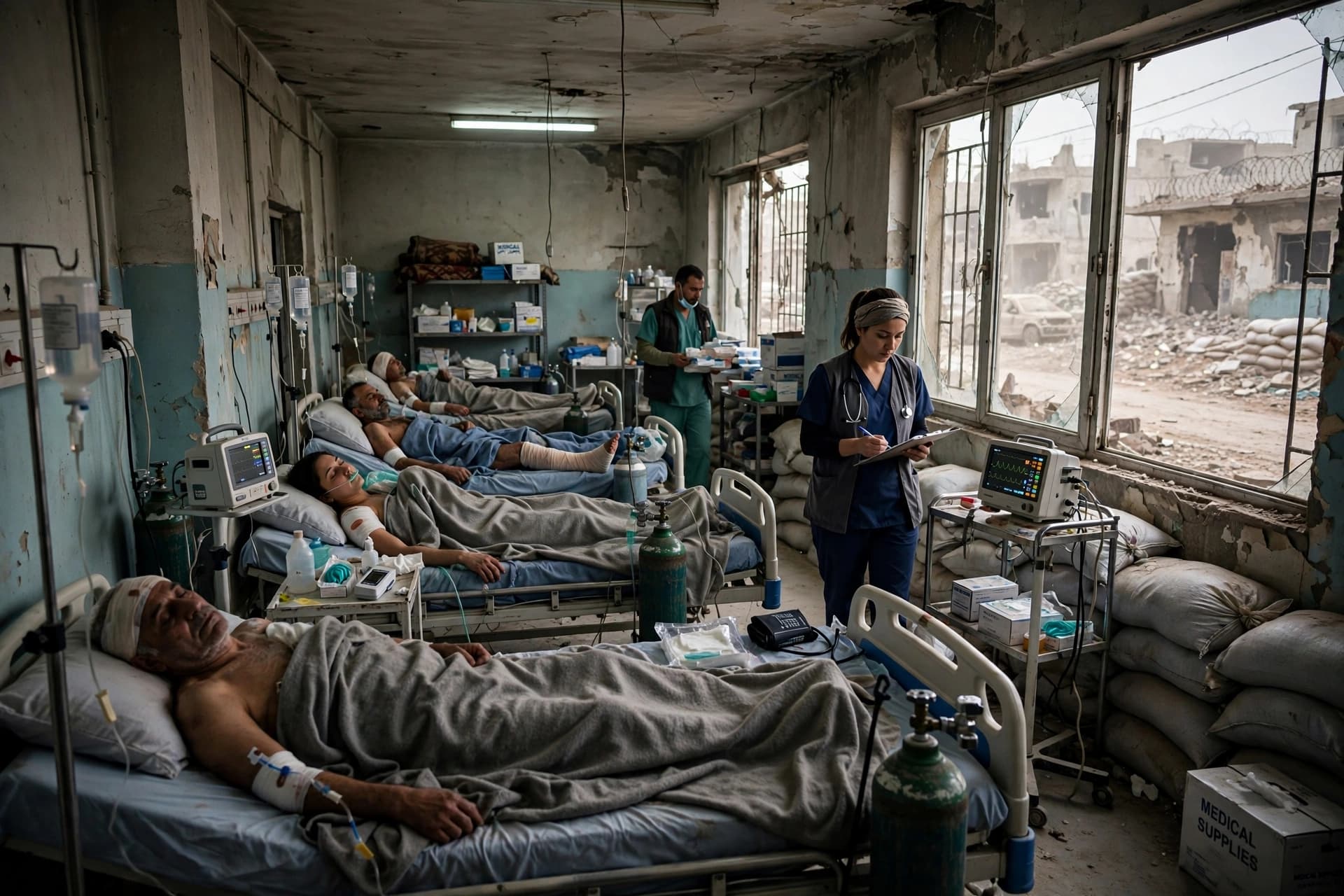
There is a particular cruelty in a siege, a violence that works not through the single catastrophic strike but through the slow closing of doors. In Taiz, Yemen's third-largest city, the Houthis have encircled the urban center, blocking exits and supply routes, and the consequences are measured not only in casualties but in the arithmetic of depletion: twelve hospitals with four days of fuel, oxygen falling ninety-one units short each day, 115 of 127 essential medicines at a week's stock or less, and fourteen surgical consumables at zero . The city is not being bombed into submission. It is being squeezed.
The siege tightened this week. Houthi fighters blocked all exits from Taiz and carried out overnight attacks, according to military sources from both sides. Twenty-two pro-government fighters were killed, and the Houthis lost at least forty, with reinforcements sent in . The health ministry warned of a "humanitarian catastrophe," with medicine, medical equipment, and fuel "on the verge of running out" . The UN human rights chief, Volker Türk, said the siege has placed civilians at "grave risk" and called for immediate humanitarian access and safe passage for those wishing to leave .
The human cost is accumulating in ways that statistics only partly capture. On Tuesday, Houthi strikes on a residential area killed two teenage girls and wounded six others, according to the Associated Press . A resident named Zainab Ali returned to find her home destroyed. "We are a family of orphans, and we do not know what to do," she said . The Yemeni Network for Rights and Freedoms documented forty-three violations in Taiz over twenty-four hours, leaving five civilians dead and seventeen injured, and damaging homes, vehicles, a hospital, and a mosque . Displacement has passed two hundred thousand people across ten governorates, with Taiz hosting fifty-seven percent of them .
The siege of Taiz is not occurring in isolation. It is part of a broader escalation that began in July, when airstrikes on Sanaa International Airport shattered a 2022 ceasefire. On Monday, a Houthi missile strike on the al-Alam training camp in Shabwa killed seventy-three new recruits, all between eighteen and twenty years old, and wounded more than two hundred . The Shabwa death toll rose through the week as search teams found more bodies and the missing were accounted for. Fourteen remained unaccounted for as of Tuesday .
The humanitarian system is straining to respond. The Joint National Response Plan for October through December is costed at thirty-one million dollars, of which WHO has secured only 3.8 million . Trauma and essential health supplies have arrived in Aden—enough to treat six hundred severe injuries and provide essential care for up to forty thousand people for three months—but the gaps are structural. Fuel, oxygen, and medicines cannot reach Taiz hospitals without safe access and alternative supply routes, and those routes do not currently exist .
There is a political dimension that resists resolution. The Houthis have framed their campaign as a fight against a Saudi-backed government, and they have launched attacks on Saudi Arabia itself, prompting Britain to expand military support for the kingdom . The United States has said it is not prepared to send troops. The internationally recognized government has vowed to continue what it calls Operation Dawn of Yemen until the Houthi coup is ended . The language on all sides is maximalist, and the civilians of Taiz are caught between maximalist positions.
For the dialysis patients, the intensive care patients, and the newborns in incubators who depend on uninterrupted power and oxygen, the siege is not a strategic contest. It is a countdown. The hospitals have four days of fuel. The medicine is nearly gone. The doors are closed. And the world, which has watched Yemen's suffering for more than a decade, is being asked once again to pay attention before the countdown reaches zero.
AI Image Disclaimer: The visuals in this article are AI-generated and are intended for illustrative purposes only.
Sources: Associated Press, ReliefWeb, Bangladesh Sangbad Sangstha (AFP), Saba Net, Xinhua
Published by Banx Network. This article is part of the Banx decentralized media programme, powered by the BXE token on the XRP Ledger.