Key Highlights
- New research reveals some asteroids near white dwarfs resist tidal disruption.
- Study challenges existing models of planetary system evolution.
- Findings provide insights into the chemical signatures of exoplanets.
Researchers have uncovered a surprising phenomenon regarding the behavior of asteroids near white dwarfs, the remnants of stars that have exhausted their nuclear fuel. Traditionally, it was believed that these dense stellar remnants would shred nearby asteroids into dust due to their immense gravitational pull. However, a recent study published in The Astrophysical Journal Letters indicates that certain asteroids are defying this expectation, surviving in orbits that should have led to their destruction long ago.
The study, led by astronomers from the University of Warwick, analyzed a selection of white dwarfs exhibiting rocky debris in their atmospheres. The prevailing theory posits that this debris originates from asteroids that venture too close to the white dwarf, where they are torn apart by tidal forces. Yet, the new findings suggest that some of the debris may come from larger, more resilient bodies that have managed to withstand the tidal disruption process, at least temporarily.
The researchers attribute the resilience of these asteroids to their size and density. It appears that these larger bodies possess enough mass to resist being pulled apart by the white dwarf's gravity. Additionally, their orbits may be more stable than previously thought, potentially influenced by the gravitational effects of nearby planets or companion stars. This revelation implies that the destruction of planetary systems is a more intricate and varied process than current models suggest.
The implications of this research extend beyond the immediate study of white dwarfs. The atmospheres of these stars serve as valuable laboratories for understanding the composition of exoplanets. As debris from asteroids falls onto a white dwarf, it carries with it the chemical signatures of its origins. If some of this debris comes from asteroids that have survived longer than expected, it could alter our understanding of the diversity and evolution of planetary systems.
For the researchers, these findings underscore the unpredictable nature of the universe. The models we create to understand celestial phenomena are approximations of a reality that is often more complex than we can fully grasp. The existence of these stubborn asteroids offers critical insights into the processes that shape planetary systems over billions of years, and they may provide clues about the fate of our own solar system as the Sun approaches its end.
As the Sun transitions into a red giant and ultimately sheds its outer layers to become a white dwarf, the fate of asteroids in our solar system may mirror that of the stubborn asteroids observed in this study. This research serves as a reminder that the universe is dynamic and ever-changing, with even the smallest celestial bodies capable of resisting destructive forces.
In summary, the study of these resilient asteroids not only challenges existing models of planetary system destruction but also enhances our understanding of the chemical signatures that inform us about the composition of distant worlds. As astronomers continue to explore these phenomena, they may uncover further surprises that reshape our understanding of the cosmos.
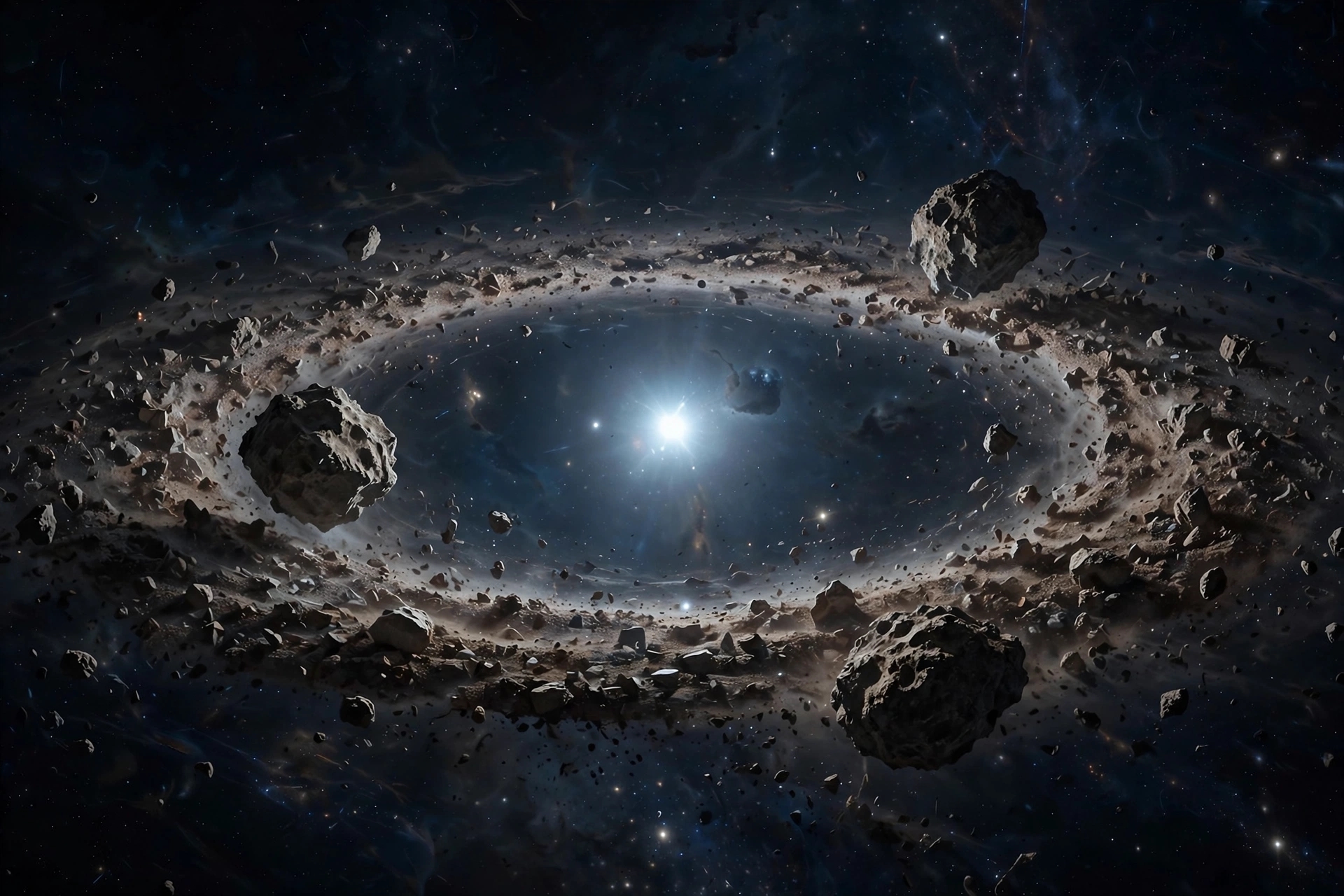
AI Image Disclaimer: The visuals in this article are generated by artificial intelligence and are for illustrative purposes only; they do not depict the actual white dwarfs, asteroids, or researchers involved.
Published by Banx Network. This article is part of the Banx decentralized media programme, powered by the BXE token on the XRP Ledger.