Key Highlights
- Storms caused widespread ferry cancellations across British Columbia's South Coast.
- BC Ferries resumed some services by mid-afternoon, but disruptions continued.
- Environment Canada issued warnings for heavy rain and strong winds affecting travel.
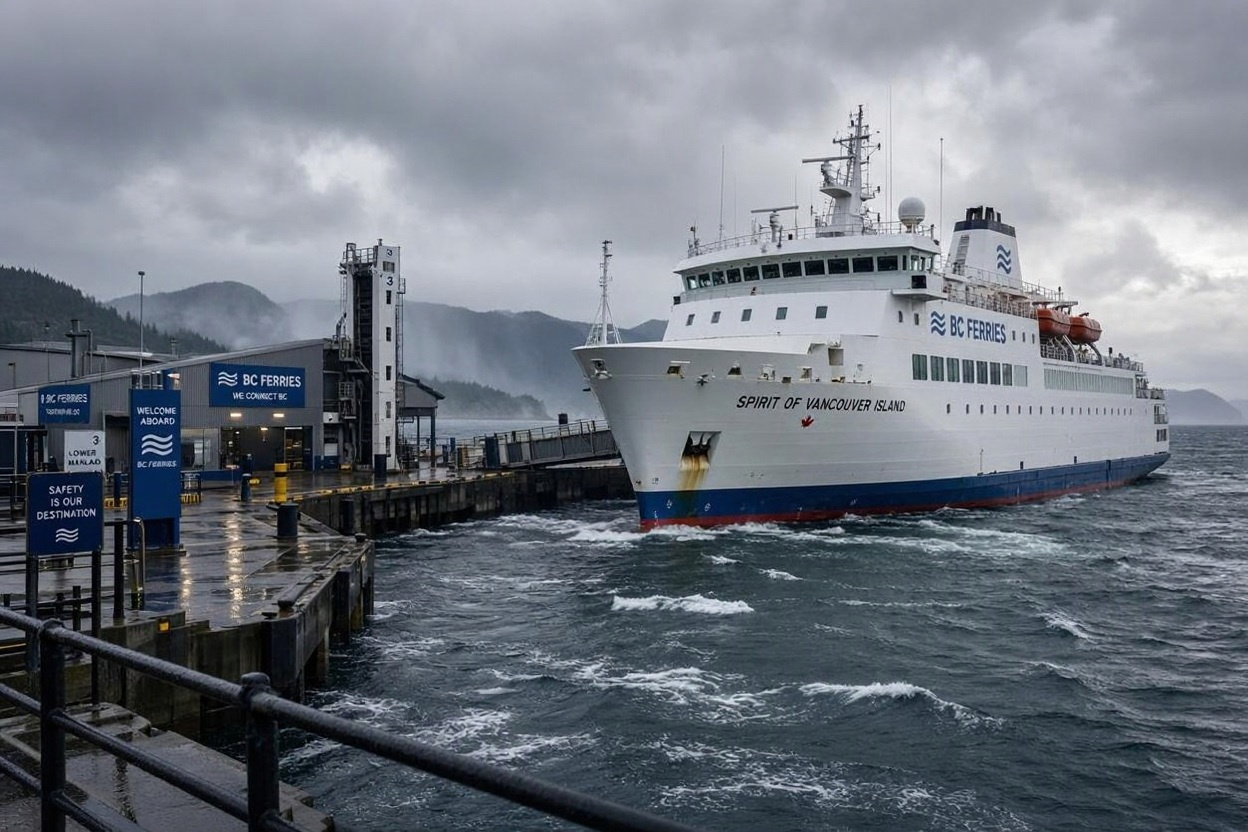
Severe weather conditions have led to significant disruptions in ferry services across British Columbia's South Coast, as a series of storms swept through the region. On Friday morning, BC Ferries announced the cancellation of numerous sailings between Metro Vancouver, Vancouver Island, and the southern Gulf Islands due to high winds reaching approximately 70 km/h. The cancellations began early, with the first routes affected around 7 a.m., leading to a cascade of service interruptions throughout the morning.
The affected routes included key connections such as Horseshoe Bay to Departure Bay, Tsawwassen to Swartz Bay, and Tsawwassen to Duke Point. The situation was exacerbated when BC Ferries' website experienced outages, leaving travelers without crucial information during a time of uncertainty. The website was restored by 2 p.m., but by then, many passengers were already feeling the impact of the cancellations.
Ferry travel is often seen as a lifeline for communities separated by water. Unlike air travel, where passengers are confined to terminals, ferry cancellations leave individuals stranded at the water's edge, facing an impassable strait. The Strait of Georgia, while not vast, can become treacherous in adverse weather, prompting BC Ferries to prioritize safety over schedules. The decision to cancel sailings reflects a careful assessment of the conditions at sea, balancing operational logistics with passenger safety.
By mid-afternoon, BC Ferries announced that some services would resume, with sailings between Tsawwassen and Swartz Bay scheduled to restart at 3 p.m. Other routes, including Tsawwassen-Duke Point and Horseshoe Bay-Departure Bay, were also set to resume shortly thereafter. However, BC Ferries warned that car decks were expected to be full for most of the remaining Friday sailings, indicating that the effects of the storm would linger even as services began to normalize. Additionally, the Hullo passenger-only ferry canceled most of its Friday sailings, with only a couple of exceptions.
Environment Canada issued warnings for heavy rainfall across Metro Vancouver and Vancouver Island, predicting up to 80 millimeters of rain on the mainland and over 100 millimeters in certain areas of Vancouver Island. This storm is not an isolated incident but part of a series of weather events that could continue to disrupt travel and daily life in the region. For island communities, these ferry disruptions can have far-reaching consequences, affecting supply chains, medical appointments, and the essential connectivity that ferry services provide.
As the storm continues to impact the region, BC Ferries has begun to restore some level of service, but the ongoing weather warnings suggest that travelers should remain cautious. The rhythm of ferry travel—loading, crossing, and unloading—has tentatively resumed, yet the threat of further disruptions remains as the weather evolves.
Published by Banx Network. This article is part of the Banx decentralized media programme, powered by the BXE token on the XRP Ledger.