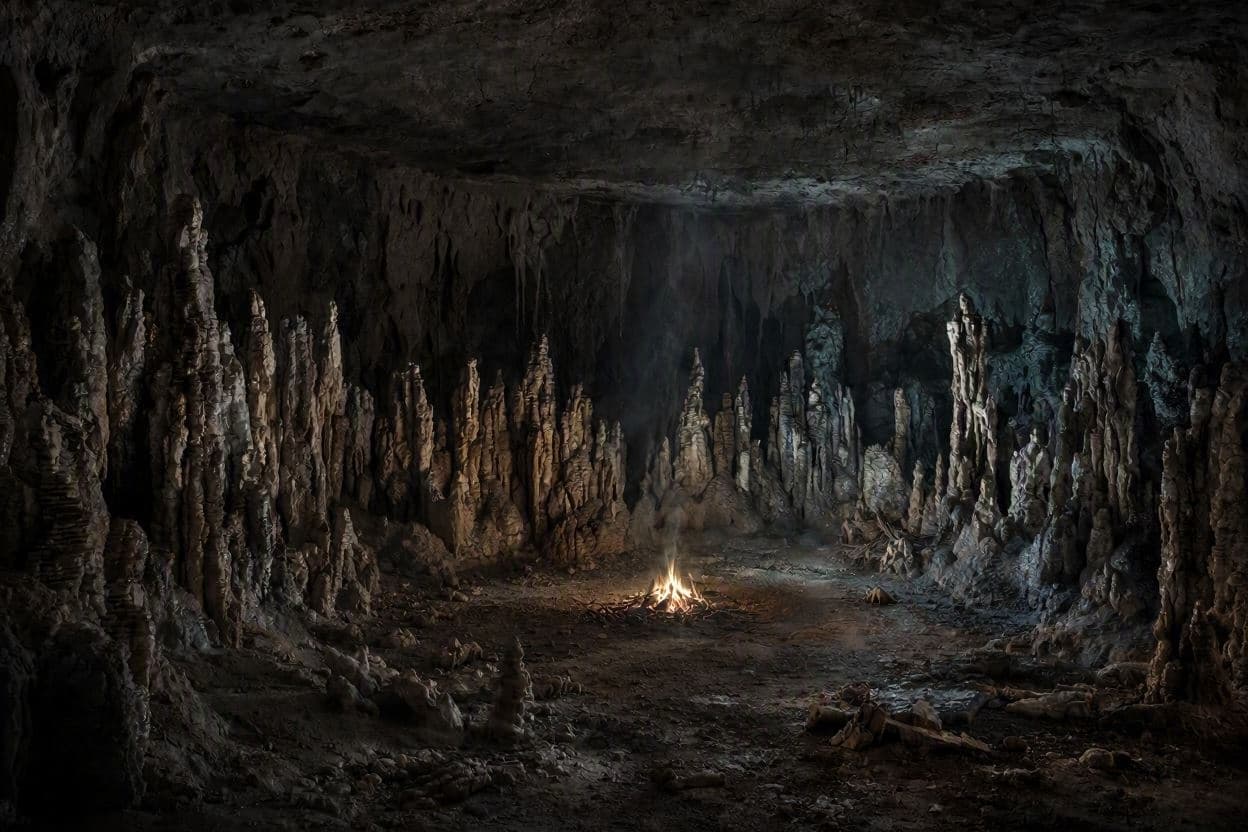
Deep within the darkness of Bruniquel Cave in southwestern France, far from the entrance and any natural light, stand structures that defy simple explanation. Built 176,000 years ago, these semicircular walls made of broken stalagmites are among the oldest known constructions in the world. Their existence challenges long-held views of Neanderthals as primitive beings, offering compelling evidence of their cognitive complexity, social organization, and symbolic capacity.
The structures consist of hundreds of stalagmite fragments, carefully arranged in rings and piles. Some fragments show signs of burning, suggesting the use of fire, while others are stacked with precision that implies planning and cooperation. To build these walls, Neanderthals had to venture deep into the cave, navigate in total darkness, and work together to move heavy stones. This level of coordination and intent points to a sophisticated society with shared goals and cultural practices.
For many years, Neanderthals were viewed as less intelligent than modern humans, lacking the ability for abstract thought or complex construction. The discovery at Bruniquel Cave, first published in 2016 and continuing to inspire research, disrupts this narrative. It suggests that Neanderthals possessed the mental faculties to conceive of and execute large-scale projects, possibly for ritualistic or communal purposes. The why behind the construction remains a mystery, but the how is clear: it required intelligence.
The dating of the structures, achieved through uranium-series dating of the calcite, places them firmly in a period when Neanderthals were the sole hominins in Europe. This excludes the possibility that early modern humans were responsible, attributing the work directly to Neanderthal hands. It stands as a testament to their ingenuity and adaptability, showing that they were capable of modifying their environment in significant ways.
These structures also hint at a symbolic or spiritual dimension to Neanderthal life. The effort required to build them, far from any practical living space, suggests they held special meaning. Perhaps they were sites for rituals, gatherings, or markers of identity. While we cannot know for sure, the presence of such constructions invites us to consider Neanderthals as beings with inner lives, beliefs, and social bonds similar to our own.
The preservation of the cave has allowed these structures to survive intact, offering a rare glimpse into the deep past. Researchers continue to study the site, looking for additional clues such as tool marks or organic residues that might reveal more about the builders’ intentions. Each finding adds depth to our understanding of Neanderthal culture, painting a picture of a rich and complex existence.
As we reflect on these ancient walls, we are reminded of the shared heritage of all human-like species. The intelligence displayed by Neanderthals bridges the gap between us and them, fostering a sense of kinship across time. In the silent depths of Bruniquel Cave, their legacy stands firm, a monument to a mind that was far from primitive.
AI Image Disclaimer: The visual content in this article is AI-generated to depict the underground cave structures and archaeological context.
Sources: Nature, Scientific American, National Geographic
Published by Banx Network. This article is part of the Banx decentralized media programme, powered by the BXE token on the XRP Ledger.