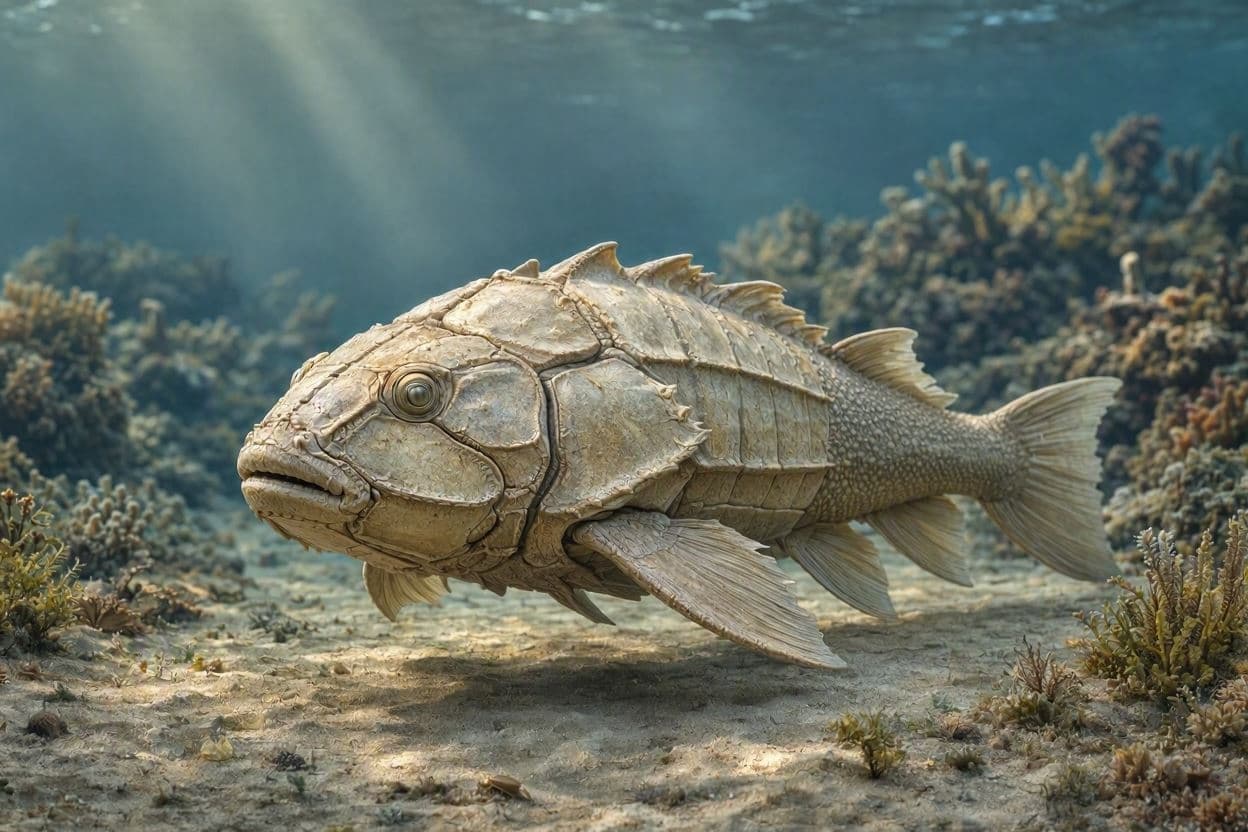
In the ancient seas of the Devonian period, around 385 million years ago, a diverse array of armored fish ruled the waters. Among them were the placoderms, a group of extinct jawed fishes known for their bony plates and formidable presence. Recent paleontological research has revealed that these ancient predators evolved two distinct mechanical strategies for crushing prey, showcasing an early example of evolutionary specialization in feeding mechanisms.
The study, focusing on fossils found in sites such as the Gogo Formation in Western Australia, examined the jaw structures of different placoderm species. One group developed robust, molar-like teeth capable of generating immense pressure, ideal for breaking hard shells of crustaceans and mollusks. Another group evolved a different mechanism, using a shearing motion to slice through softer tissues. This divergence suggests that competition for food resources drove rapid anatomical innovation.
These findings provide valuable insights into the ecology of ancient marine environments. The ability to exploit different food sources allowed placoderms to occupy various niches, reducing direct competition and promoting biodiversity. It also highlights the complexity of early vertebrate evolution, demonstrating that sophisticated feeding strategies emerged much earlier than previously thought. The diversity of jaw mechanics mirrors the adaptive radiation seen in later groups, such as mammals and birds.
For scientists, understanding these ancient mechanisms helps reconstruct the food webs of the Devonian seas. By analyzing wear patterns on fossilized teeth and jaw joints, researchers can infer diet and behavior, painting a vivid picture of life millions of years ago. This detective work bridges the gap between static fossils and dynamic living organisms, bringing the past to life.
The implications extend beyond paleontology. Studying how ancient animals solved mechanical problems can inspire modern engineering and robotics. Biomimicry, the practice of emulating nature’s designs, often looks to evolutionary solutions for efficiency and durability. The crushing and shearing mechanisms of placoderms offer lessons in material strength and force distribution that could inform the design of industrial tools.
As new fossils are discovered and analyzed, our understanding of these armored giants continues to grow. Each specimen adds a piece to the puzzle, revealing the intricate history of life on Earth. The placoderms, though long extinct, leave behind a legacy of innovation that resonates through the ages.
In the end, the story of these ancient fish is a testament to the power of adaptation. In a world of changing environments and competing species, the ability to innovate was key to survival. Their jaws, frozen in stone, tell a tale of resilience and creativity that continues to fascinate scientists and enthusiasts alike.
AI Image Disclaimer: The visual content in this article is AI-generated to depict the themes of paleontology and ancient marine life.
Sources: Nature, Smithsonian Magazine, University of Michigan News
Published by Banx Network. This article is part of the Banx decentralized media programme, powered by the BXE token on the XRP Ledger.