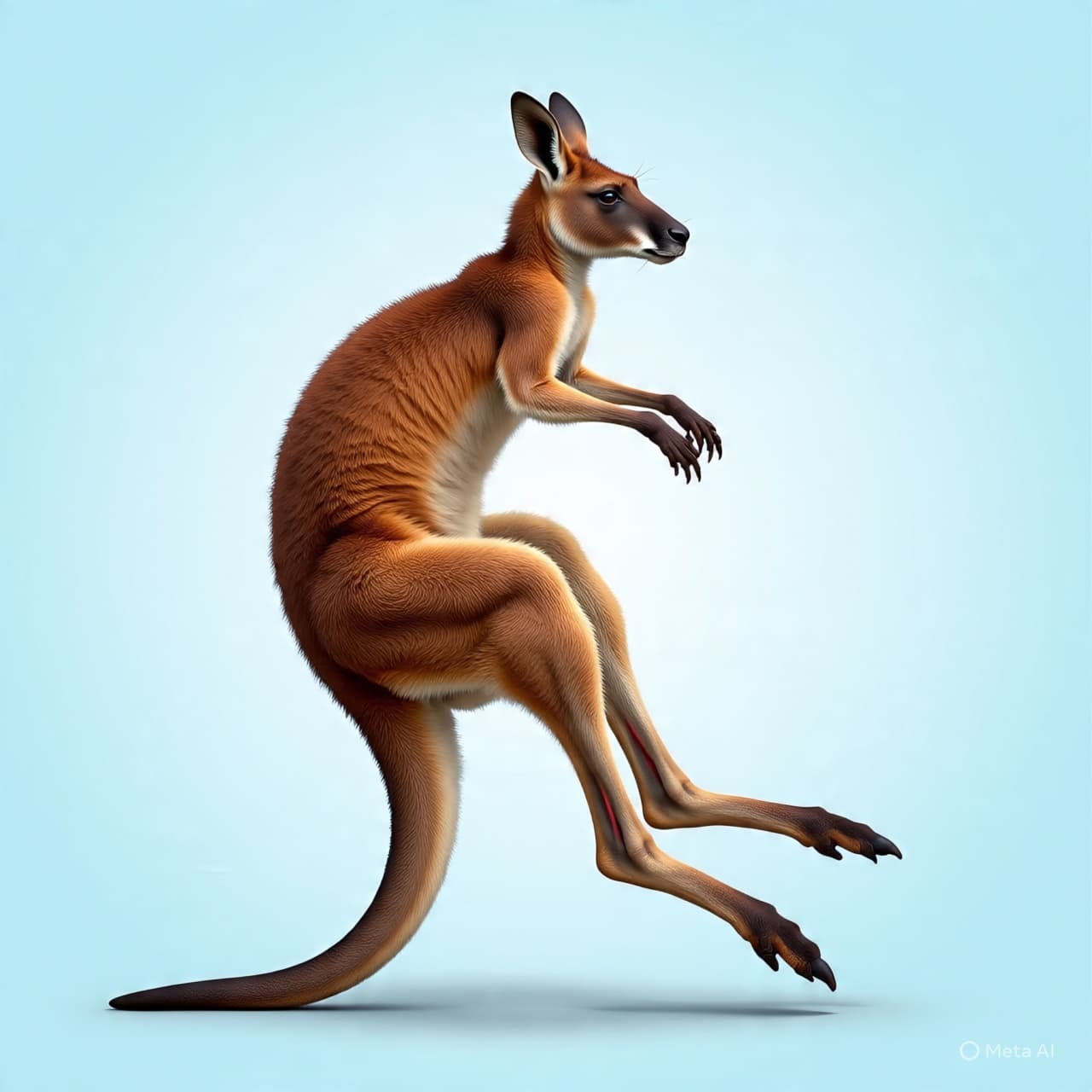
In the quiet fields where the sun lifts silver dust from red soil, kangaroos bound like living poems of motion — each leap a sentence in an ancient language of survival. They do not gallop like horses, nor stride like humans; they speak in arcs and springs. Yet beneath their rhythm, scientists have long pondered a curious question: how can a creature go faster without the expected rise in energy cost? In recent studies, researchers have uncovered that in the graceful poetry of the kangaroo’s hop lies a subtle adjustment of posture that whispers answers about energy and efficiency.
As kangaroos pick up speed, they do not simply push harder against the Earth — they shift how they hold themselves. Biomechanics researchers, using three-dimensional motion capture and force-plate data, found that at higher speeds kangaroos crouch slightly more in their hindlimbs, particularly around the ankle and toe joints. This change in stance may seem small, but its effects are profound. By changing the angle of their joints, the geometry of the tendons and muscles — especially the Achilles tendon — changes too, increasing elastic stress and allowing more energy to be stored and released like a natural spring.
In essence, the kangaroo’s limbs act less like pistons demanding more muscle work and more like tuned springs that save and return energy with each contact on the ground. Because of this, the energetic cost of moving doesn’t climb as speed increases — a trait unusual in the animal kingdom, where speed commonly demands ever greater metabolic investment.
Still, this dance of physics and biology has its limits. The same mechanisms that allow energy efficiency at speed could constrain how large kangaroos can grow, because very high tendon stresses risk injury. For now, though, this discovery fills an intriguing chapter in our understanding of locomotion — showing us that, sometimes, evolution’s poetry writes in posture as much as power.
In the broader world of biology, this insight gently reinforces how form and function evolve together, not in isolation but in conversation with the demands of environment and movement. As researchers continue to unpack the layers of locomotor biomechanics in kangaroos and other macropods, these elegant marsupials remind us that energy efficiency is not just about strength, but about the artful optimization of every step — or hop.
AI Image Disclaimer (Rotated Wording) Visuals are created with AI tools and are not real photographs.
Source Check
Phys.org — science news aggregator summarizing peer-reviewed research. eLife — peer-reviewed scientific journal publishing the original study. PubMed / NCBI — records for the research article abstract. Terra Daily — science news site summarizing findings. Earth.com — science & nature news platform discussing the mechanisms.
Published by Banx Network. This article is part of the Banx decentralized media programme, powered by the BXE token on the XRP Ledger.