There is a particular charm in the understudy who performs beautifully on the night before the star takes the stage. For two years, the NSF–DOE Vera C. Rubin Observatory has been preparing for its decade-long survey of the southern sky, and at its heart sits the largest digital camera ever built for astronomy. But before the main instrument could begin its work, a smaller engineering camera had to prove that the observatory's eyes could see. What it saw, as it turns out, was something worth pausing over .
The camera is called ComCam, short for the LSST Commissioning Camera. With a mosaic of nine CCD sensors and a total of 144 megapixels, it is a modest instrument by the standards of the 3,200-megapixel LSST Camera now mounted on the Simonyi Survey Telescope. ComCam's field of view covers an area about twice that of the full Moon, and during a seven-week engineering campaign from October to December 2024, it captured roughly 16,000 exposures . Its purpose was practical: to test the observatory's hardware and software, to exercise the image processing pipelines, and to ensure that the systems would function when the far larger camera took over.
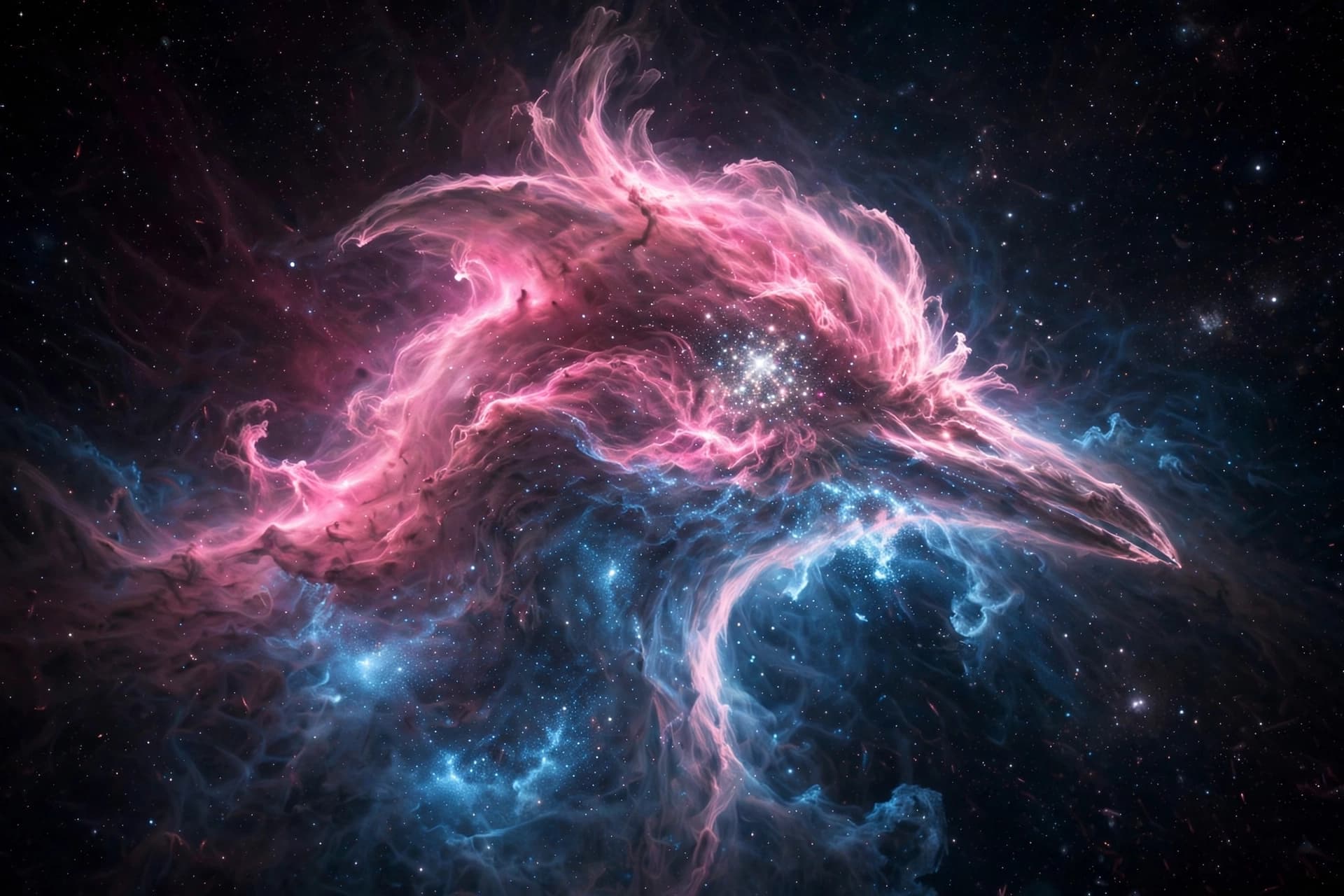
One of those exposures, released this week in recognition of the two-year anniversary of ComCam's testing, features the head of the Seagull Nebula. The image shows IC 2177, a star-forming region about 3,700 light-years from Earth, between the constellations Monoceros and Canis Major . The nebula's pink and blue hues are not decorative. The pink is ionized hydrogen gas, energized by the ultraviolet radiation of young, massive stars; the blue is dust reflecting the light of other young stars in the area. At the top of a dark ridge sits HD 53367, a triple star system whose radiation helps sculpt the surrounding cloud .
What makes the image notable is not merely its beauty but its provenance. ComCam was never meant to produce science-ready images of this quality. It was a test instrument, a way to check that the telescope's optics, the observatory's software, and the data pipelines could work together. The fact that it produced an image described as the deepest and sharpest view of this region to date, at least until the LSST Camera collects more data, is a testament to the care with which the entire system was designed . The Seagull Nebula image also gave Rubin's image processing team early experience with the complex structures found in star-forming regions, experience that would prove useful when the larger camera began returning its own data.
ComCam's work is now complete. It no longer sits on the telescope; instead, it serves as a test stand in the summit clean room, supporting software testing and the regular cycling of vacuum pumps and refrigeration compressors . There is something quietly fitting about this afterlife. The instrument that helped the observatory learn to see now helps keep its systems in working order, a supporting role in the ongoing life of a machine designed to map the universe.
The release of the Seagull Nebula image is a reminder that the path to discovery is often paved with smaller, less celebrated steps. The LSST Camera, with its 3.2 gigapixels and its ability to image the entire southern sky every few nights, will capture unimaginable volumes of data. But before it could do so, a 144-megapixel camera had to look at a cloud of gas and dust and prove that the whole enterprise was possible. The image it returned is not just a pretty picture. It is a document of readiness, a quiet confirmation that the eyes of the observatory were open and seeing clearly.
---
Image Disclaimer: The visuals in this article were created using artificial intelligence and are not actual astronomical photographs.
Sources: Gemini Observatory/NOIRLab, Newswise, Rubin Observatory
Published by Banx Network. This article is part of the Banx decentralized media programme, powered by the BXE token on the XRP Ledger.