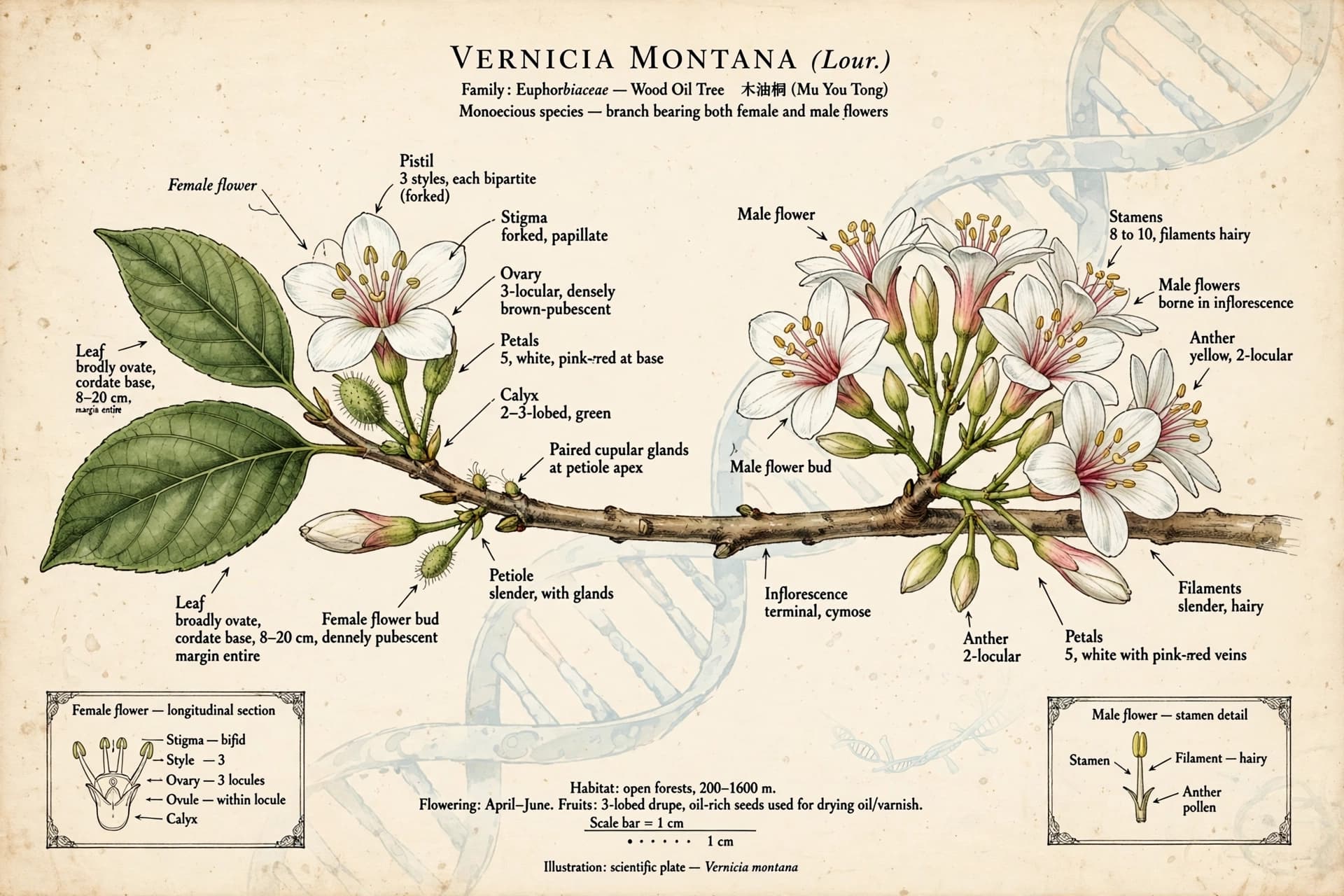
In the quiet architecture of a genome, some of the most consequential decisions are made not by the invention of something new, but by the rearrangement of what already exists. A sequence flips. A region duplicates. A stretch of DNA that once faced one direction now faces the other. And somewhere in that structural shuffle, a tree decides—or rather, its biology decides for it—whether to bear male flowers or female ones. This is not metaphor. It is the finding of a new study on Vernicia montana, a woody oilseed tree native to China, whose sex-determining region has now been resolved at a level of detail previously unavailable .
Researchers from Huanggang Normal University, Central South University of Forestry and Technology, and the Hubei Academy of Agricultural Sciences constructed a chromosome-level, haplotype-resolved female genome of V. montana using PacBio HiFi sequencing and Hi-C scaffolding . By integrating population-scale resequencing of 178 natural individuals, they identified a highly localized sex-associated signal on chromosome ChrB02, defining a W-specific sex-determining region of approximately 61.4 kilobases .
What makes this region remarkable is not the presence of a novel "master sex gene"—a finding that challenges conventional expectations. Instead, the SDR exhibits a complex mosaic of structural features: duplications, fragmented syntenic blocks, inversions, and multiple haplotype-specific sequences that cannot be aligned between the two haplotypes . Flanking regions remain highly conserved, with over 99% sequence identity, yet the SDR itself is a landscape of rearrangements .
Only two protein-coding genes were found at the SDR boundaries: VmBASS4.2 and VmCET2.2, each with a homologous allele on the other haplotype . Notably, VmBASS4.2 showed pronounced developmental dynamics and broad reproductive expression, positioned adjacent to major structural rearrangements within the SDR. When overexpressed in Arabidopsis thaliana, transgenic plants exhibited reduced stigma receptivity and increased floral and silique abortion, suggesting a dosage-sensitive role in reproductive development—but not as a novel sex-determination gene per se .
The authors propose that sex determination in V. montana is driven not by the emergence of a new gene, but by local inverted-repeat-mediated structural remodeling that reshapes the regulatory landscape of pre-existing boundary genes . This inverted-repeat-mediated SDR evolution model offers a framework linking local structural architecture to regulatory divergence during the early evolution of homomorphic sex chromosomes in plants .
The practical implications extend to forestry and breeding. V. montana is widely cultivated for ornamental purposes and high-quality tung oil production. The female-specific PCR markers validated in this study enable early sex identification, allowing breeders to select trees of desired sex without waiting years for flowering . More broadly, the findings challenge the "master gene" paradigm and open new avenues for studying sex determination in other dioecious species—a reminder that in evolution, rearrangement can be as creative as invention.
---
AI Image Disclaimer: Images in this article are AI-generated and serve illustrative purposes only.
Published by Banx Network. This article is part of the Banx decentralized media programme, powered by the BXE token on the XRP Ledger.