
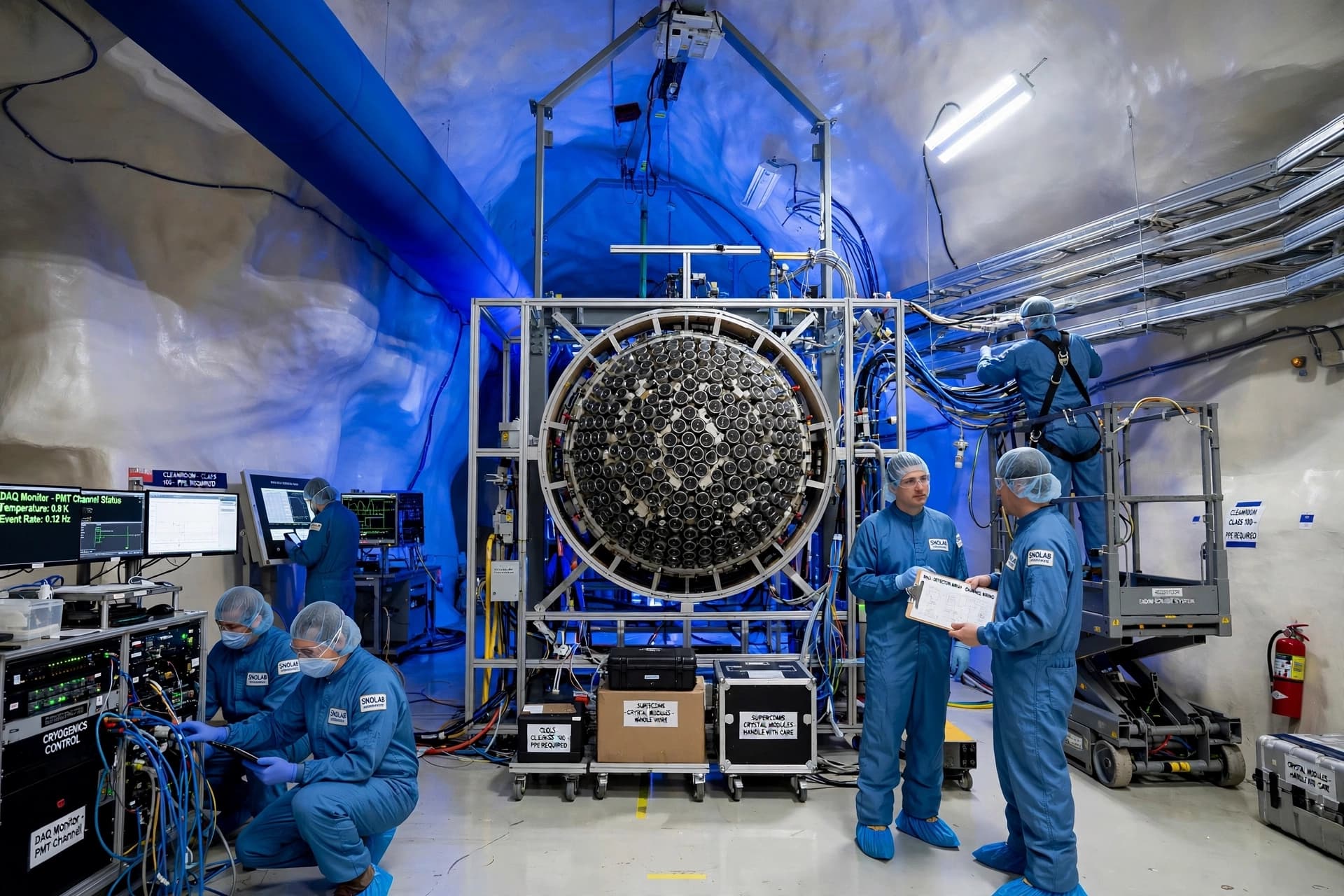
There is a particular kind of legacy that travels not through institutions but through people—through mentors and students, through the passing of enthusiasm from one generation to the next, through the belief that the hardest problems are worth pursuing. For SNOLAB, the underground physics laboratory in Sudbury, Ontario, that legacy has now been recognized by the highest honor in science. One of this year's Nobel Prize winners in Physics, Dr. Francis Halzen, served as a doctoral mentor to Dr. Jodi Cooley, the executive director of SNOLAB.
The Royal Swedish Academy of Sciences awarded the 2026 Nobel Prize in Physics to Halzen for his "decisive contributions to the IceCube Neutrino Observatory and the discovery of high-energy neutrinos of astrophysical origin" . Halzen is a professor at the University of Wisconsin-Madison, which is also Cooley's alma mater. In a press release from SNOLAB, Cooley described the recognition as deeply personal. "Francis was one of my Ph.D. mentors, and I cannot overstate how proud I am to see his contributions recognized with the Nobel Prize," she said. "Even as a graduate student, I remember Francis's eternal excitement about the science. He had a remarkable ability to make you believe that the hardest problems were worth pursuing, and that optimism helped shape an entire generation of researchers in neutrino astronomy" .
Cooley's own research career was shaped by that mentorship. As a graduate student, she conducted research on the AMANDA-II neutrino detector, the pioneering experiment that laid the foundation for IceCube. She traveled twice to the South Pole during the austral summer to help calibrate and maintain the detector . IceCube, a cubic-kilometer detector buried in the Antarctic ice, has since demonstrated that high-energy neutrinos can reveal some of the universe's most extreme environments, opening a new window on the sky and establishing neutrino astronomy as a fundamental tool for discovery .
The connection between SNOLAB and IceCube is not merely historical. SNOLAB is currently testing an array of Digital Optical Modules for the IceCube experiment, a test designed to help researchers better understand the background noise profile of the new modules . Halzen also serves on the Canada Foundation for Innovation's Major Scientific Initiatives Standing Expert Committee for SNOLAB. "He combined extraordinary scientific vision with an infectious enthusiasm for discovery, inspiring generations of scientists to pursue the bold idea that neutrinos could reveal a previously hidden universe," Cooley said. "At SNOLAB, we share that same spirit of exploration. Although our experiments are located two kilometers underground rather than embedded in Antarctic ice, we are united by a common goal: creating extraordinary detectors in extraordinary environments to study some of the most fundamental questions in physics" .
SNOLAB's own history is deeply intertwined with Nobel recognition. The Sudbury Neutrino Observatory, the predecessor to SNOLAB, was awarded the 2015 Nobel Prize in Physics for resolving the solar neutrino problem . The laboratory's experiments continue to push the boundaries of how we observe and understand the universe, from neutrino science to dark matter searches. The 2026 prize is a reminder that the work done in Sudbury is part of a global community—a community linked by shared questions, shared instruments, and the shared belief that the universe can be understood. The Nobel is a recognition of one man's contributions. The legacy it represents is one that continues to grow.
AI Image Disclaimer: The visual elements in this article were created using AI generation tools and are intended for illustrative purposes only.
Sources: SNOLAB, Sudbury News, Royal Swedish Academy of Sciences
Published by Banx Network. This article is part of the Banx decentralized media programme, powered by the BXE token on the XRP Ledger.

.jpg&w=3840&q=75 "September 2026 Was the Second-Warmest on Record, With Global Temperatures Above 1.5°C for a Second Month")