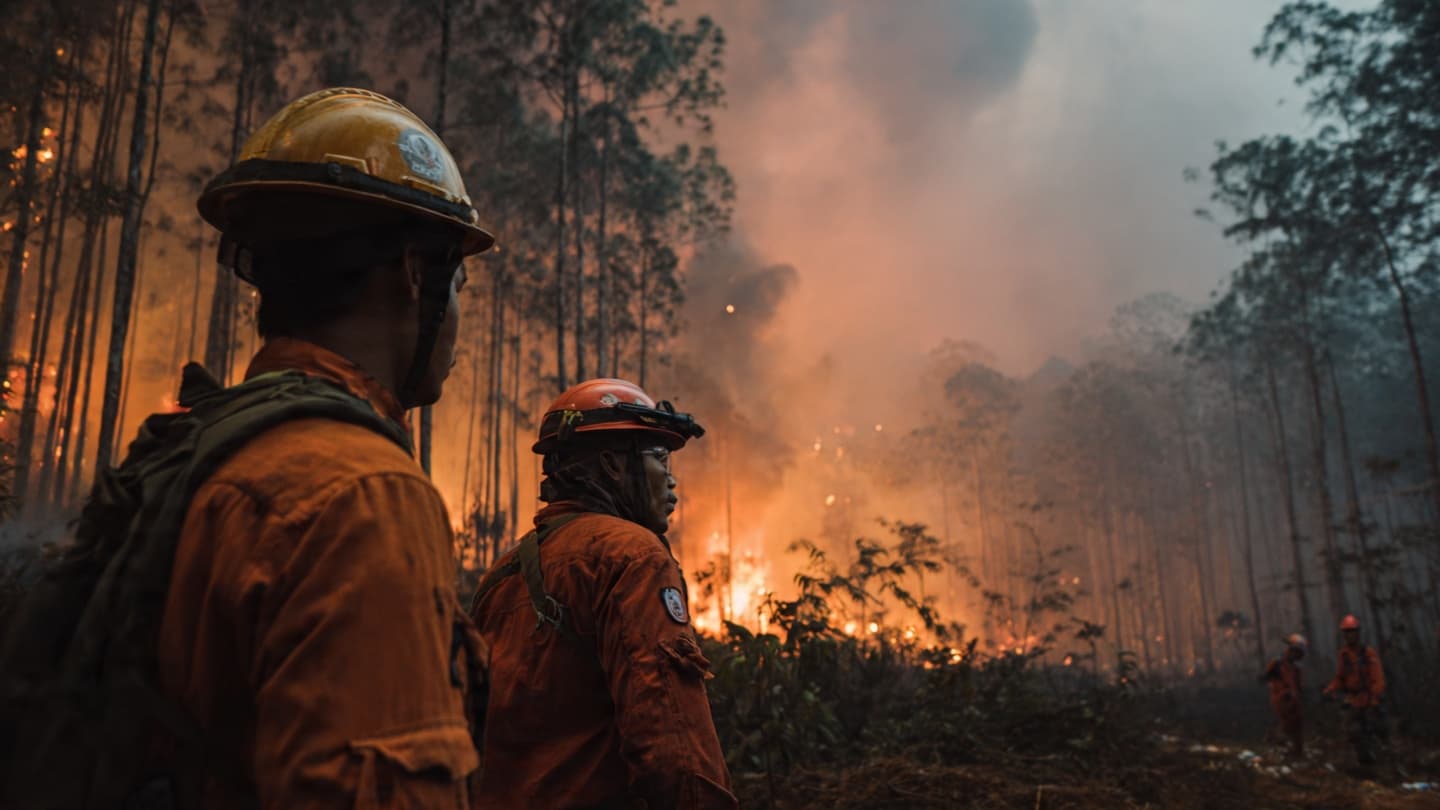
Across Kalimantan, the September air has taken on a different texture. Where the horizon would normally stretch clearly beneath the tropical sky, smoke has begun to soften the distance, carrying with it the familiar signs of another difficult fire season.
Wildfires have spread near Indonesia’s new capital, Nusantara, prompting renewed attention from authorities as smoke affects surrounding communities. Reuters reported that fires have expanded across parts of Kalimantan and Sumatra during a period when the country is closely monitoring the development of the dry season.
The fires are not simply a matter of distant forests. Smoke can move across communities, schools, roads, and workplaces, turning an environmental event into something felt throughout ordinary routines. In several affected areas, authorities have taken measures intended to reduce exposure to unhealthy air.
The timing has also placed additional attention on Nusantara, Indonesia's developing new capital. The city sits within a region where forests, plantations, infrastructure projects, and settlements exist alongside one another, creating a landscape in which environmental conditions can quickly become connected to economic and social activity.
Indonesia has experienced recurring forest and land fires during dry periods, with the most serious episodes capable of producing haze that crosses regional boundaries. This year's developments have again raised concerns about how prolonged dry conditions can interact with land management and fire prevention.
The smoke also has consequences for education. Earlier reports indicated that haze forced large numbers of Indonesian students into remote learning, demonstrating how an environmental disturbance can reach far beyond the areas where flames are actually burning.
For communities near affected areas, the immediate concern is often less about the distant origin of a fire and more about what the air feels like each morning. Visibility can decline, outdoor activity becomes more difficult, and authorities may advise residents to limit exposure and use protective masks.
The economic implications can gradually widen as well. Transportation, agriculture, tourism, construction, and other activities can all be affected when smoke becomes persistent. In a region undergoing major infrastructure development, interruptions to daily movement can add another layer of uncertainty.
Authorities continue to monitor fire locations and air conditions as the season develops. The situation around Nusantara remains part of a broader national effort to contain forest and land fires before they grow into a larger haze event.
For now, the fires near Indonesia's new capital have placed smoke and environmental conditions back into the national conversation. The coming weeks will determine whether the current outbreaks remain localized or develop into a wider regional haze problem.
AI Image Disclaimer: The visuals in this article were created with AI technology as conceptual representations and are not real photographs.
Sources: Reuters BNPB Indonesia Meteorology, Climatology, and Geophysical Agency Ministry of Environment and Forestry of Indonesia
Published by Banx Network. This article is part of the Banx decentralized media programme, powered by the BXE token on the XRP Ledger.