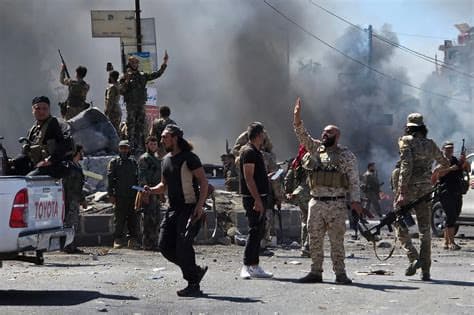
The afternoon over the South China Sea carried a hush more chilling than the usual roar of jets and rotors. On Sunday, two separate aircraft from the USS Nimitz—one a helicopter, the other a fighter jet—crashed within half an hour of each other during routine operations from the carrier. The first, a MH‑60R Sea Hawk helicopter of the “Battle Cats” squadron, went down around 2:45 p.m. local time; all three crew members were rescued. About thirty minutes later, at approximately 3:15 p.m., a F/A‑18F Super Hornet fighter jet, assigned to the “Fighting Redcocks” of Strike Fighter Squadron 22, crashed after its two crew members ejected and were likewise rescued.
The official statement by the U.S. Pacific Fleet noted that all five personnel are “safe and in stable condition,” and both incidents are under investigation. President Donald Trump, speaking en route aboard Air Force One, called the back-to-back crashes “very unusual,” and flagged “bad fuel” as a possible cause while ruling out foul play.
The timing and location amplify the moment’s significance. The carrier is on its final deployment before decommissioning, traversing contested waters amid rising tensions in the region. The dual loss—although thankfully without loss of life—raises broader questions about safety, readiness, and the burden of sustained operations in high-risk environments. Analysts note that when two aircraft from a single strike group plunge in quick succession, it prompts scrutiny not just of weather or mechanical failure but of systemic strain
From a strategic lens, the incident casts a spotlight on the vulnerability of U.S. naval aviation in the Indo-Pacific. While no adversary action is currently flagged, the event underscores how even routine operations carry accidental risks—risks amplified by the geography of the South China Sea and the proximity of multiple military actors. Moreover, China’s foreign ministry promptly offered “humanitarian assistance” and used the moment to criticize U.S. military activity in the region, asserting that such operations “increase the risk to maritime activity” and “undermine regional peace and stability.”
Images by AI images generator, for illustration only.
source : AP NEWS, New York post.
Published by Banx Network. This article is part of the Banx decentralized media programme, powered by the BXE token on the XRP Ledger.