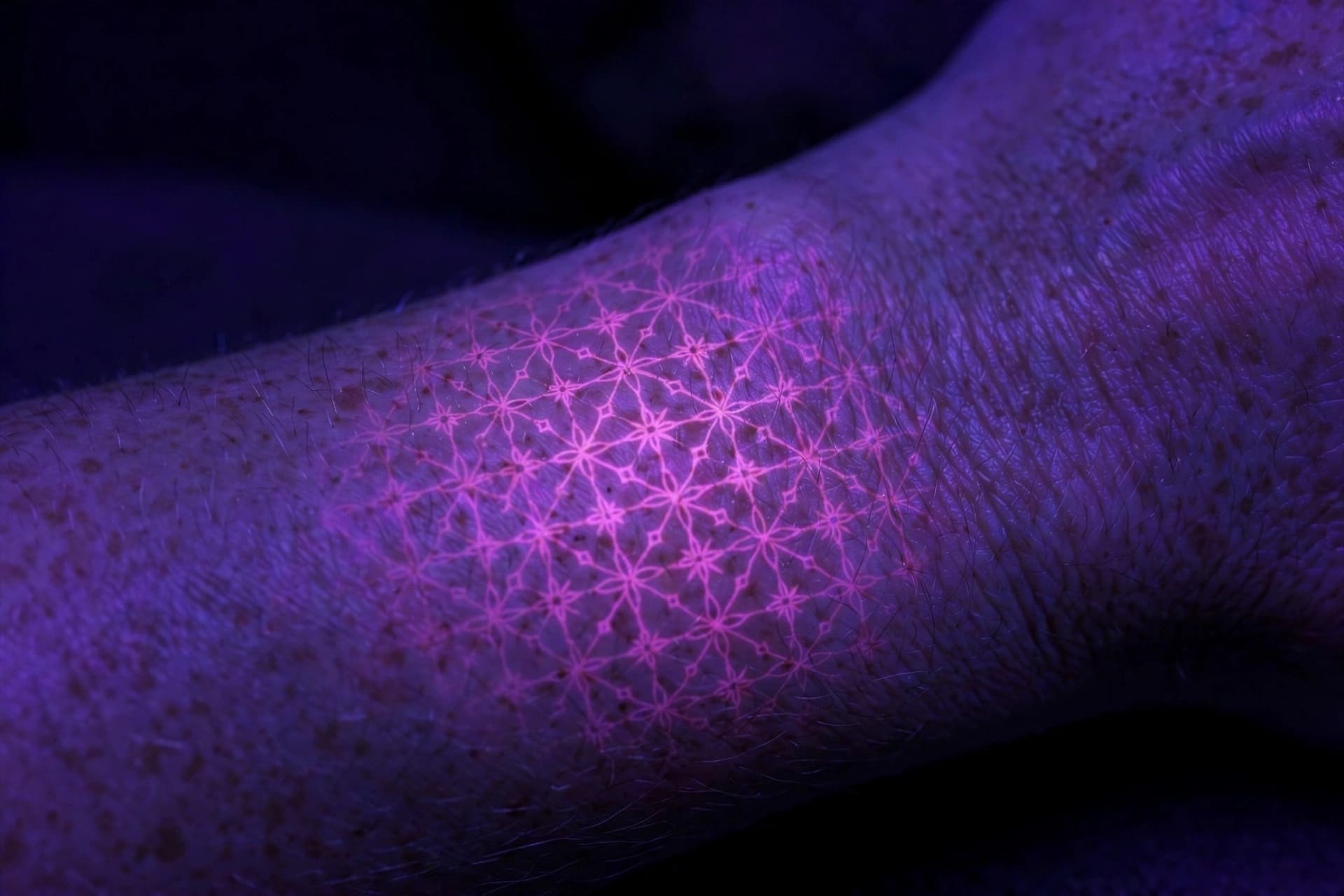
There is something quietly radical about a tattoo that can disappear. For millennia, the mark made on skin has been understood as permanent—a commitment, a memorial, a declaration that does not negotiate with time. Now, researchers at the University of Colorado Boulder have developed an experimental ink system called PhotoTat that can be made visible under ultraviolet light and erased under bright visible light, leaving the skin looking untouched . The pigment remains implanted in the dermis, but its appearance becomes something closer to a setting than a scar.
The technology, reported in the journal Matter & Light, uses three photochromic dyes—blue, magenta, and yellow—each encapsulated in nanoparticles of polymethyl methacrylate, a transparent polymer also used in certain medical implants . The particles measure between 100 and 500 nanometers, within the range of conventional tattoo pigments. When exposed to 365-nanometer ultraviolet light, the dye molecules change shape, becoming flatter and visible. When bright visible light hits them, the reaction reverses, and the colors fade .
The team, led by nanoscientist Carson Bruns, tested the inks on silicone skin models and excised pig skin. They demonstrated that simple designs could be written with stencils or a UV stylus, and that multicolor images could be transferred using patterned red, green, and blue light to selectively erase different dye channels . A portable laser projector produced the best color reproduction, though full multicolor images were demonstrated only in models, not living human skin .
Bruns himself became a test subject. He received the experimental inks in his leg in 2023, and as of the study's publication, the tattoos had remained switchable for up to 2.2 years . "I love body art because of how personal it is," Bruns said . He described the tattoos as "my laboratory notebook"—a living record of an experiment that continues to unfold.
The practical limitations remain significant. Sunlight contains both ultraviolet and visible wavelengths, making outdoor concealment difficult without sunscreen; applying SPF 30 restored the nearly invisible state within minutes in skin models . The blue dye tends to leave a permanent purple residue after repeated switching, and the system lacks a true cyan and a white channel . Safety in humans has not been established beyond Bruns's own experience, and the inks are not available in tattoo parlors .
The potential applications extend beyond body art. Medical tattooing—markers used to guide radiotherapy to specific areas—could benefit from inks that fade after treatment, sparing patients from carrying permanent reminders of illness . Cosmetic tattooing might offer similar reversibility. Jake Violi, a chemist at UNSW Sydney, called the development "exciting" for these reasons .
A tattoo that can be erased is not simply a tattoo that can be removed. It is a tattoo that can be rewritten, that can hold multiple images in sequence, that can shift from visible to invisible and back again. The skin becomes a surface that remembers, but also forgets, and then remembers anew. Whether that possibility will one day be available beyond the laboratory remains uncertain, but the proof of concept now lives on the leg of a scientist who wanted to see what his own creation could do.
AI Image Disclaimer: The images accompanying this article are AI-generated and are intended for illustrative purposes only.
Sources:
· Nature · Matter & Light · The Brighter Side of News · Scitw
Published by Banx Network. This article is part of the Banx decentralized media programme, powered by the BXE token on the XRP Ledger.