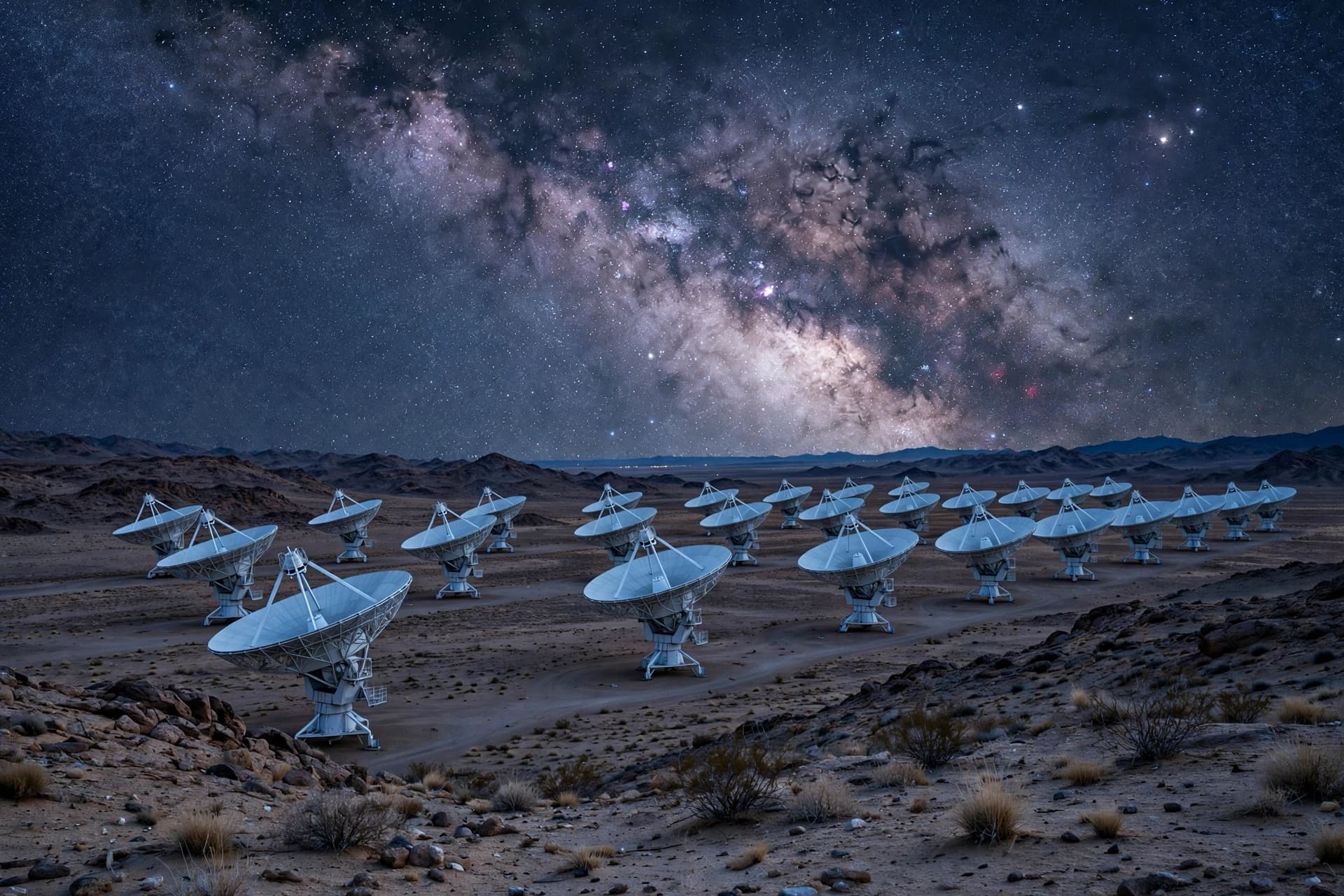
In the quest to understand our place in the cosmos, scientists are turning their eyes to the invisible forces that shape planets far beyond our solar system. The Square Kilometre Array (SKA), a next-generation radio telescope currently under construction, may soon possess the sensitivity to detect magnetic fields on distant exoplanets. This capability would open a new window into the habitability and atmospheric protection of worlds orbiting other stars. It is a leap forward in our ability to characterize alien environments.
Magnetic fields play a crucial role in shielding planets from harmful stellar radiation and solar winds. Without them, atmospheres can be stripped away, making life as we know it unlikely. By detecting these fields, astronomers can assess whether an exoplanet has the necessary defenses to sustain liquid water and potentially life. Protection is key to survival.
The SKA will achieve this by observing low-frequency radio emissions generated when charged particles interact with a planet’s magnetic field. These emissions, similar to those produced by Jupiter in our own solar system, are faint but detectable with the SKA’s immense collecting area. Sensitivity reveals the unseen. Technology expands vision.
Current telescopes struggle to detect such weak signals from light-years away, but the SKA’s design promises a significant improvement in sensitivity. Located in Australia and South Africa, the array will consist of thousands of dishes and antennas working together as a single instrument. Scale brings power. Collaboration yields results.
Detecting magnetic fields will also help distinguish between different types of exoplanets, such as rocky Earth-like worlds and gas giants. This classification is essential for prioritizing targets in the search for biosignatures. Focus enhances efficiency. Strategy guides discovery.
For astrobiologists, this development is exciting. It adds another layer to the criteria for habitability, moving beyond just temperature and distance from the star. A comprehensive view of planetary health requires multiple data points. Complexity demands thoroughness.
The project involves international cooperation, with scientists from around the world contributing to its development and future operations. Shared goals unite diverse communities in the pursuit of knowledge. Unity accelerates progress.
In the end, the potential of the SKA to detect exoplanet magnetic fields is a testament to human ingenuity. It brings us closer to answering the age-old question: Are we alone? As the telescope comes online, the universe waits to reveal its secrets. Curiosity drives us forward.
AI Image Disclaimer: The images accompanying this article are AI-generated artistic interpretations of radio telescopes and exoplanets, not actual photographs of the SKA site or specific detected exoplanets.
Sources: Square Kilometre Array Observatory Nature Astronomy Phys.org
Published by Banx Network. This article is part of the Banx decentralized media programme, powered by the BXE token on the XRP Ledger.