There is a quiet poetry in the fact that the most famous comet in human history will not return for another thirty-five years, yet it sends us postcards every year without fail. Those postcards arrive not as ice and dust but as brief, brilliant scratches of light against the dark—fragments of Halley's Comet burning up in our atmosphere, a celestial echo that reaches us long after the comet itself has gone.
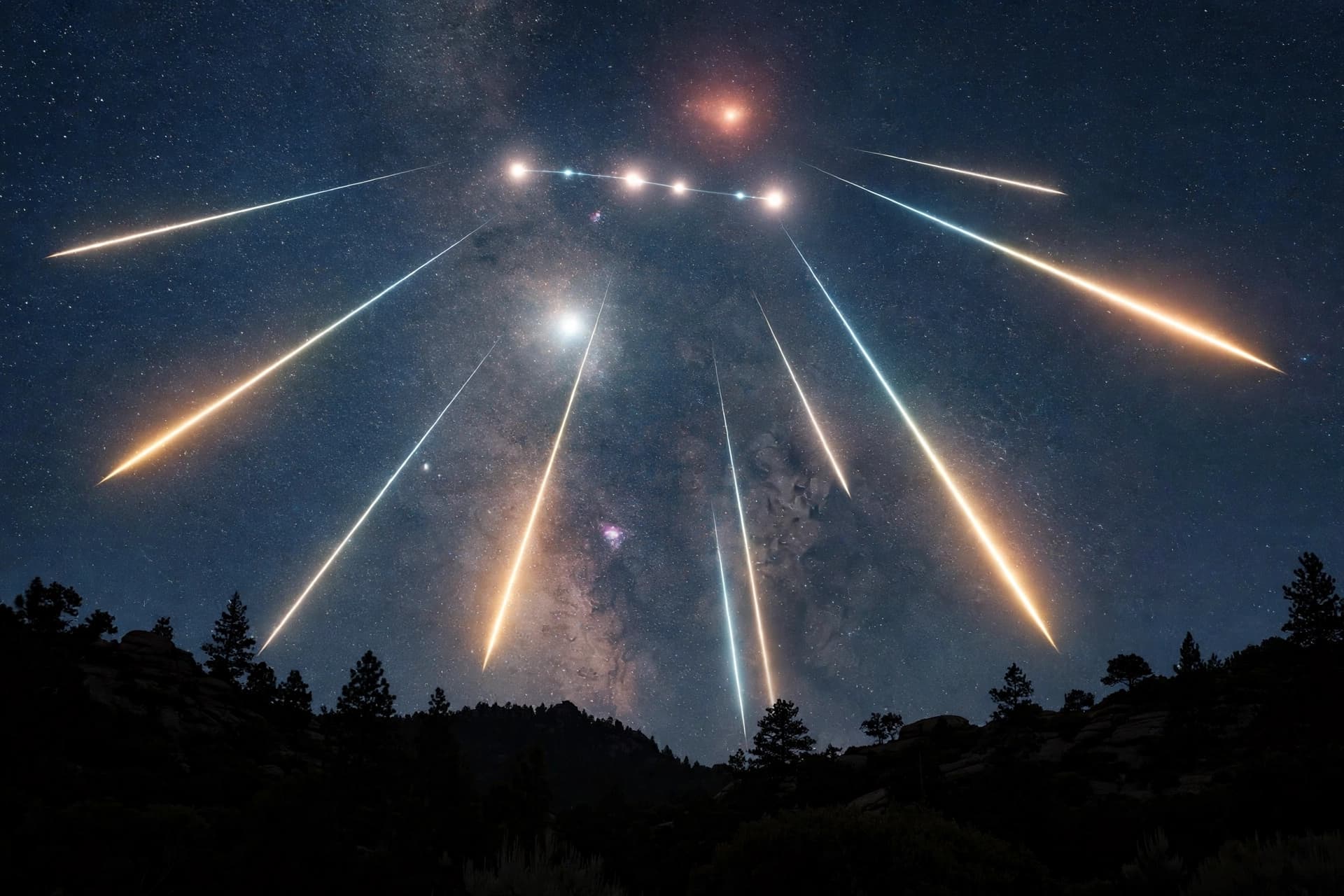
The Orionid meteor shower is expected to peak on the night of October 21 and the early hours of October 22, offering skywatchers a chance to see between ten and twenty meteors per hour under good conditions . These are not ordinary meteors. They are debris shed by Halley's Comet during its previous passages through the inner solar system, particles that enter Earth's atmosphere at roughly 237,000 kilometers per hour—fast enough to leave glowing trails that linger for a moment after the flash . The comet itself last visited in 1986 and will not return until 2061.
The timing of the peak is favorable for observers willing to set an early alarm. The best viewing window comes after midnight and before dawn on October 22, when the radiant point in the constellation Orion climbs higher in the sky . The moon, roughly seventy percent illuminated during the peak, will set in the early morning hours, darkening the sky just as the meteor rate reaches its maximum . For those who can find a dark location away from city lights, the reward is a display that has been observed for millennia—records of the Orionids stretch back centuries, making this one of the oldest documented meteor showers.
What makes the Orionids particularly striking is their speed. At sixty-six kilometers per second, these particles are among the fastest of any annual shower, surpassed only by a handful of others . That velocity translates into meteors that appear as sharp, quick streaks rather than slow, lingering fireballs. Some leave persistent trains—faint glowing trails that remain visible for a second or two after the meteor itself has vanished. These are the signatures of Halley's Comet, a visitor that has shaped human understanding of the heavens since at least 240 BCE.
There is no need for telescopes or binoculars. The Orionids are best observed with the naked eye, lying back and scanning as much of the sky as possible. Astronomers recommend looking forty-five to ninety degrees away from the radiant, where meteors appear longer and more spectacular . Patience matters: the eyes need twenty to thirty minutes to fully adapt to darkness, and the shower rewards those who wait. A thermos of something warm and a blanket are the only equipment required.
For those who miss the peak, the shower remains active for several days before and after, though at reduced rates. The Orionids are one of two annual showers produced by Halley's Comet—the other, the Eta Aquarids, arrives in May. Together, they form a biannual reminder that the solar system is not empty space but a shared neighborhood, littered with the trails of ancient travelers.
The comet will return in 2061. For now, its dust is enough—a few nights of scattered light, a reminder that even the most distant objects can reach us, if only as a brief and beautiful interruption of the dark.
AI Image Disclaimer: The images in this article were generated by artificial intelligence and are intended for illustrative purposes only.
Sources: RRI (citing Space.com), Volzhskaya Pravda
Published by Banx Network. This article is part of the Banx decentralized media programme, powered by the BXE token on the XRP Ledger.