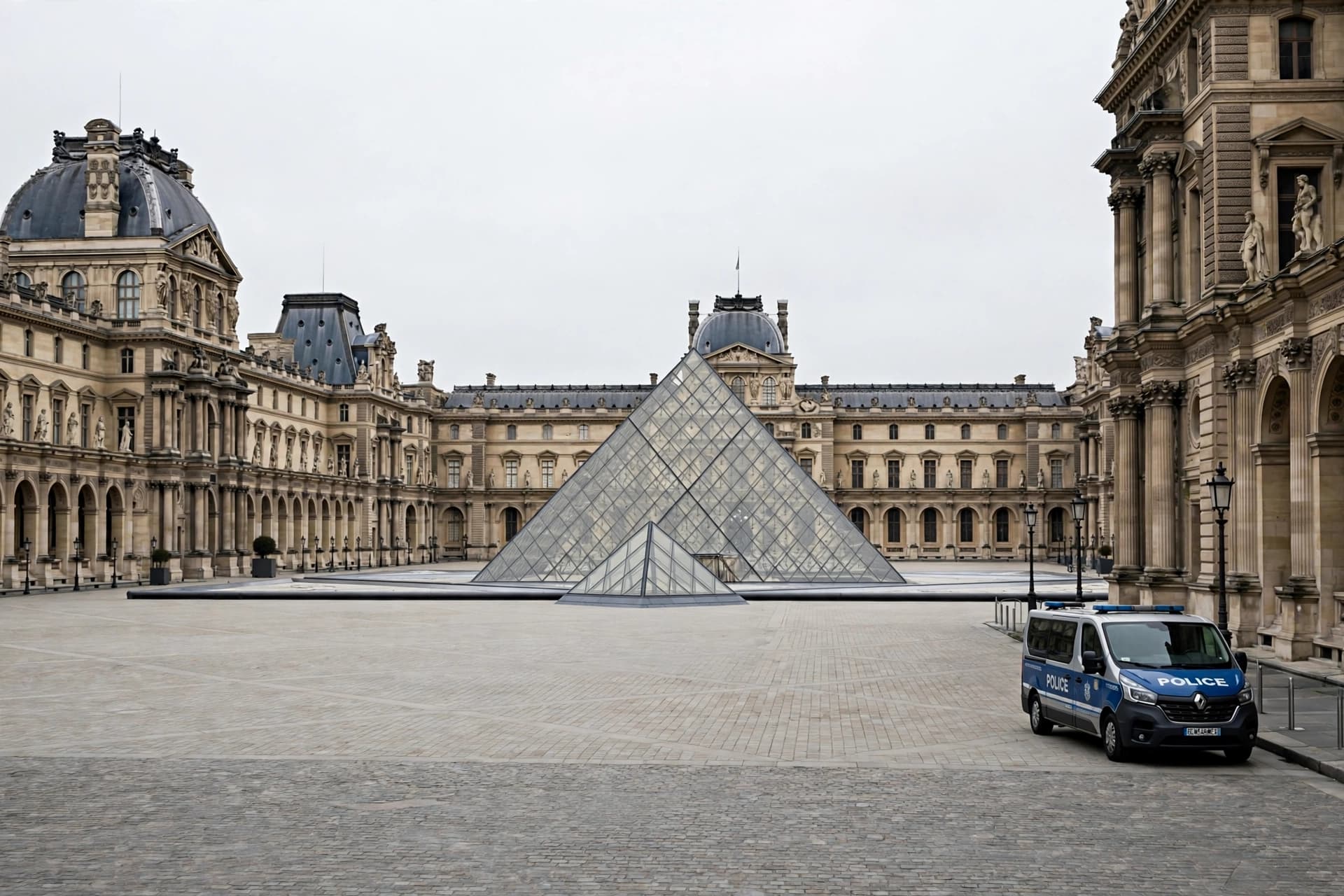
The Louvre is not a place one expects to find closed on a Saturday. Its galleries, which hold the Mona Lisa and the Winged Victory and centuries of human striving, are ordinarily filled with the murmur of visitors from around the world. But this Saturday, the doors will remain shut. So will the Orsay, the Picasso, and the Grand Palais. The reason is not a strike by museum workers or a maintenance issue, but something more diffuse and more volatile: the fear of violence in the streets of Paris, and a government determined to prevent it .
Some 70,000 law enforcement officers will be deployed across France on Saturday, according to Interior Minister Laurent Nuñez, along with helicopters, armored vehicles, and water cannons. Elite police units will secure public buildings. The operation is described as "highly mobile," designed to respond to unrest as it emerges rather than standing guard at fixed points . The deployment follows last weekend's protests, which devolved into what the Associated Press called France's most violent unrest in years: fires set, public buildings stormed, shop windows smashed, looting, and clashes with police .
The protests are nominally about the cost of living. Students, the CGT labor union, and activists from the "yellow vest" movement—whose demonstrations against social injustice shook France in 2018 and 2019—are expected to join . But Nuñez warned that radical far-left groups have issued calls on social media for violence and vandalism, and that messages encouraging looting are being spread by rioters. "We will be absolutely uncompromising," he said . In Lyon, Nice, Montpellier, and parts of Marseille, protests have been banned outright. Nightly curfews have been extended in some areas of Paris until Monday morning .
The Culture Ministry's decision to close the museums was framed as a precaution: "visitor safety, staff protection and the preservation of artworks" . Art Basel Paris, one of the world's most prestigious contemporary art fairs, had opened to the public on Friday but canceled its weekend program, a decision organizers said was "not taken lightly" . Saloni Doshi, an art collector who traveled from India for the fair, told the AP she understood. "It's hard that something like this has to happen," she said, "but state activities and people's freedom have to continue" .
There is a particular dissonance in the closure of museums during a protest about the cost of living. The Louvre is a symbol of France's cultural inheritance, a place that belongs in principle to everyone and in practice to those who can afford the ticket and the travel. The yellow vests, when they emerged in 2018, were protesting a fuel tax that they said punished those who lived far from cities and depended on their cars. The current unrest, whatever its specific triggers, carries the same underlying friction: a sense among some citizens that the institutions of the republic are not serving them, and a determination among the authorities that the expression of that grievance will not be allowed to become destruction.
The protests planned for Saturday are expected to be larger than last week's. A separate demonstration in Orléans, against the far-right National Rally party's congress, is also being closely watched, with 20,000 to 30,000 demonstrators expected . Marine Le Pen, the party's leader and a front-runner in next spring's presidential election, accused left-wing groups of trying to "disrupt a political party's democratic congress" .
For now, the museums are closed, the officers are deployed, and the city is holding its breath. The Mona Lisa will remain behind glass, undisturbed, while the streets outside decide what kind of Saturday this will be.
AI Image Disclaimer: Images in this article were generated by artificial intelligence and are for illustrative purposes only.
Sources: Associated Press, The Canadian Press, Deutschlandfunk, ANTARA News
Published by Banx Network. This article is part of the Banx decentralized media programme, powered by the BXE token on the XRP Ledger.