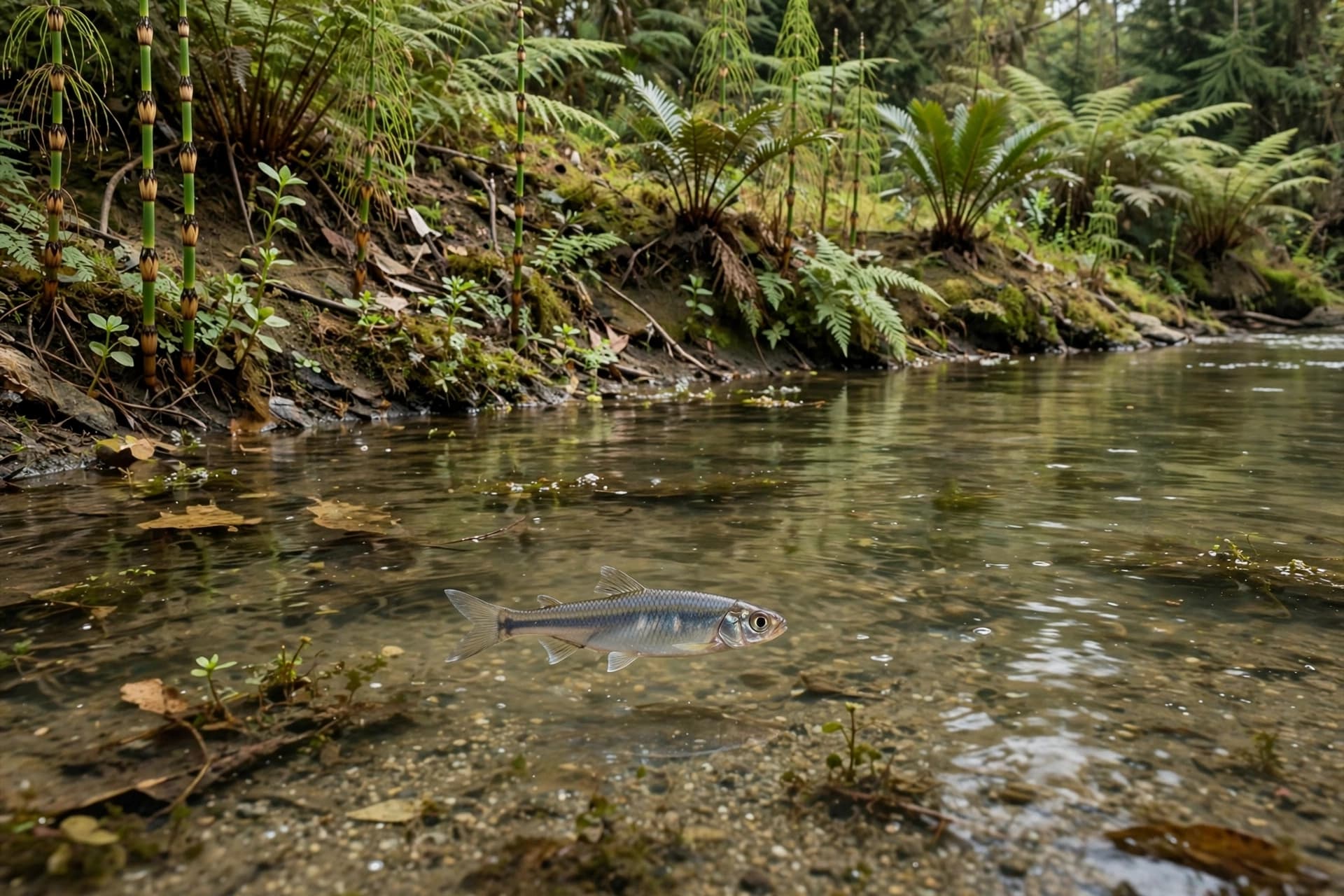
There is a particular pleasure in finding a small thing that carries a large story, a fossil no bigger than a finger that unlocks the history of a group of animals now living in rivers and lakes on every continent except Antarctica. In southwestern Alberta, researchers have discovered the skeleton of a fish about five centimeters long, preserved in the Late Cretaceous rock of the Dinosaur Park Formation, roughly seventy million years old. It is a new species, named Acronichthys maccagnoi, and it is the oldest known North American member of the otophysans—the supergroup that includes catfish, carp, minnows, and tetras, and that today accounts for nearly two-thirds of all freshwater fish species .
The fossil fills a gap that had frustrated paleontologists for years. Otophysans are distinctive for their hearing apparatus, a modification of the first four vertebrae that connects the swim bladder to the inner ear and transmits vibrations, functioning something like a human ear. This structure, called the Weberian apparatus, is visible in the fossil with the naked eye . Lisa Van Loon of Western University used synchrotron beamlines and micro-CT scans at the Canadian Light Source and the Advanced Photon Source to capture detailed three-dimensional images of the delicate skeleton without damaging it .
The discovery also revises the evolutionary story of these fish. For more than a century, scientists believed that otophysans originated in freshwater on the ancient supercontinent Pangea, before it broke apart. But there was a gap of about a hundred million years between the breakup of Pangea and the first appearance of otophysans in the fossil record, a gap that the freshwater-origin hypothesis could not easily explain . The new research, published in Science, suggests a different path: otophysans originated in the ocean and transitioned to freshwater at least twice, after the continents had already begun to separate. The estimated divergence time for the marine-to-freshwater transition is around 154 million years ago, in the Late Jurassic .
The hearing apparatus may have evolved as part of that transition. Rivers are noisy environments, and freshwater does not transmit sound as efficiently as saltwater. The development of the Weberian apparatus—connecting the swim bladder to the ear—may have helped these fish communicate, detect predators, and locate prey in their new habitat. The fossil shows this structure in an early stage of its evolution, offering a glimpse of how a sensory adaptation can open a new ecological niche .
Neil Banerjee of Western University, a co-author on the study, described the fossil as filling a gap in the otophysan record and providing data on the origin and early evolution of many freshwater fish living today . Don Brinkman of the Royal Tyrrell Museum, another co-author, noted that while dinosaurs have received most of the paleontological attention, the diversity of prehistoric freshwater fish remains poorly understood. The fossil site in Alberta, he said, is giving researchers the key to understanding the origins of groups that now dominate rivers and lakes around the world .
The question of how Acronichthys and its relatives moved between continents remains open. If their ancestors were freshwater fish, they could not have swum across saltwater oceans. The researchers are left trying to understand how a tiny fish from Alberta is related to freshwater species that now live in Africa, South America, and Asia. The answer may lie in ancient land connections, in temporary brackish corridors, or in dispersal events that the fossil record has not yet preserved .
For now, the fossil sits in the collection of the Royal Tyrrell Museum, a small skeleton in a slab of rock, no larger than a human finger. It is not a dinosaur. It did not live a dramatic life or die a dramatic death. But it carries a story that reaches across seventy million years and two-thirds of the freshwater fish on Earth. That is the kind of story that fossils tell, if someone takes the time to look.
Image note: The visuals accompanying this article were created using artificial intelligence and do not depict the actual fossil or the researchers involved.
Sources: Canadian Light Source, Western University, Royal Tyrrell Museum, Science, FISHBIO, Columbus State University
Published by Banx Network. This article is part of the Banx decentralized media programme, powered by the BXE token on the XRP Ledger.