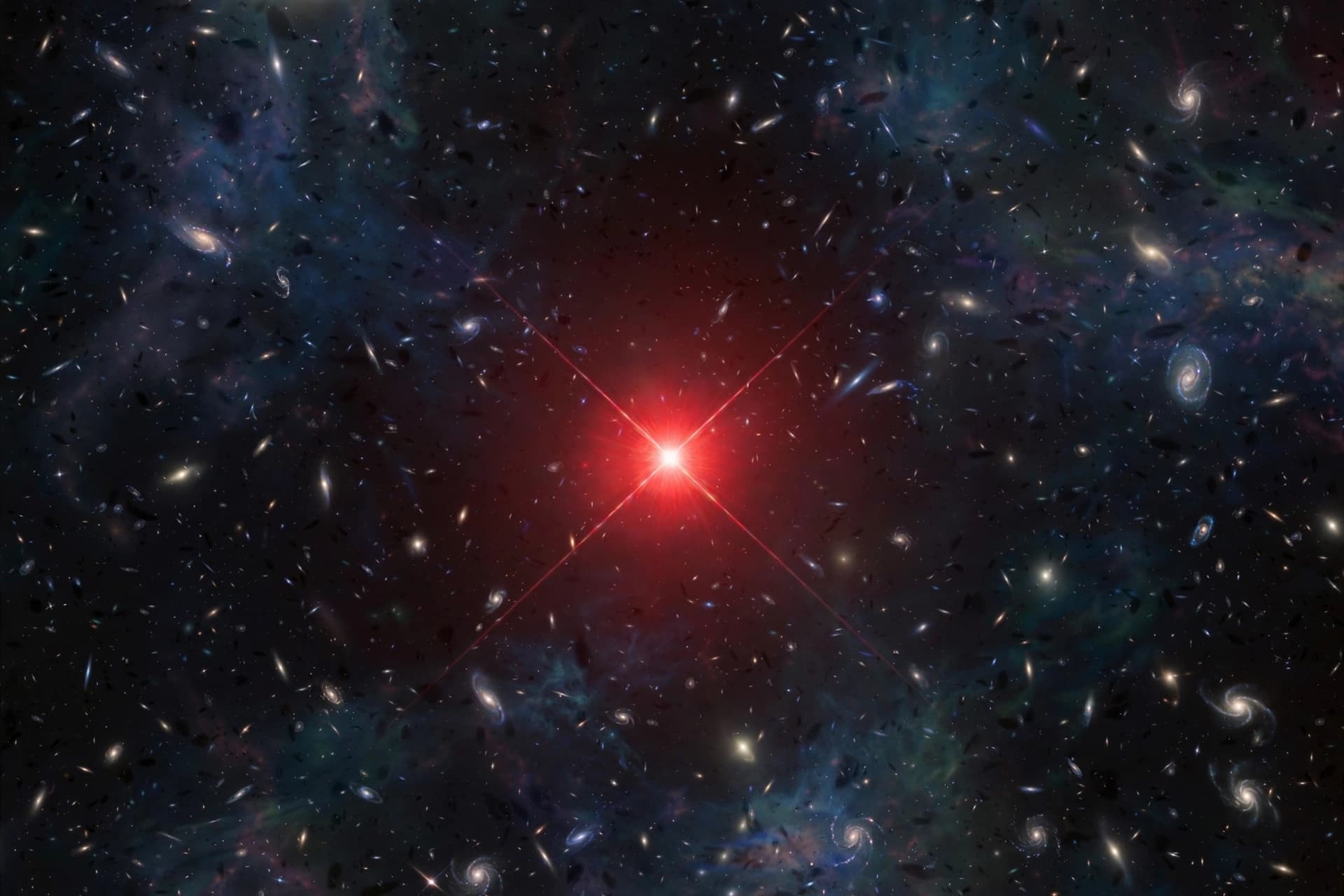
In the deep field of the early universe, where light has traveled for billions of years to reach us, tiny points of red light have puzzled astronomers. These "Little Red Dots," as they are affectionately known, appeared in the first images from the James Webb Space Telescope (JWST) as compact, bright anomalies. Recent analysis has revealed that one of these dots is not a star, but an ancient black hole, offering a glimpse into the cosmic dawn and the formation of the universe’s most massive structures.
The discovery centers on an object observed in the early universe, just a few hundred million years after the Big Bang. Its spectral signature, analyzed using JWST’s advanced instruments, showed characteristics inconsistent with normal stellar activity. Instead, the data pointed to the presence of a supermassive black hole, actively consuming matter and emitting intense radiation. This finding challenges existing theories about how such large black holes could form so quickly after the beginning of time.
Astronomers have proposed that these objects might be "black hole stars," a hypothetical type of astrophysical source where a black hole is embedded within a massive star. This configuration could explain the unusual brightness and compact size of the Little Red Dots. The idea suggests that some of the first stars in the universe may have collapsed directly into black holes without exploding as supernovae, a process known as direct collapse.
The implications for cosmology are significant. If supermassive black holes formed earlier and more rapidly than previously thought, it would require a revision of models describing galaxy evolution. Black holes are believed to play a central role in shaping galaxies, and their early presence could have influenced the distribution of matter and the rate of star formation in the young universe.
JWST’s ability to detect faint infrared light has been crucial in this discovery. The telescope’s sensitivity allows it to peer through dust and gas that obscure visible light, revealing objects that were previously invisible. This capability has transformed our understanding of the early universe, turning mysterious dots into key pieces of the cosmic puzzle.
Researchers continue to study other Little Red Dots to determine if they share similar characteristics. Each new observation adds to the growing body of evidence suggesting that the early universe was more dynamic and complex than previously imagined. The search for answers is ongoing, with each discovery leading to new questions about the nature of space and time.
The collaboration between international teams of astronomers has been essential in interpreting the data. By combining observations from different instruments and comparing them with theoretical models, scientists are able to build a more complete picture of these ancient objects. This collective effort highlights the importance of shared knowledge in advancing scientific understanding.
The identification of an ancient black hole among the Little Red Dots marks a milestone in astronomical research. It reminds us that even in the vastness of space, there are still secrets waiting to be uncovered, and that every point of light may hold a story about the origins of our universe.
AI Image Disclaimer: The visuals in this article are AI-generated conceptualizations of early universe phenomena and do not represent actual raw data images from the James Webb Space Telescope.
Sources: MIT News NASA Scientific American Space.com
Published by Banx Network. This article is part of the Banx decentralized media programme, powered by the BXE token on the XRP Ledger.