In 1935, the Austrian physicist Erwin Schrödinger devised a thought experiment that was never meant to be taken literally. A cat, sealed in a box with a radioactive atom and a vial of poison, would be—according to quantum mechanics—simultaneously alive and dead until someone opened the box. Schrödinger intended it as a critique, a way of showing how absurd quantum theory becomes when applied to everyday objects. Ninety years later, physicists are still feeding the cat, making it bigger and stranger with each experiment, and discovering that the boundary between the quantum and classical worlds is more elusive than he imagined.
The latest record comes from a team led by physicist Hendrik Hegels at the Max Planck Institute of Quantum Optics in Germany. Using a peculiar type of atom known as a Rydberg atom, the researchers created optical Schrödinger cat states at what they describe as "world-record sizes" . The work pushes the limits of how large an object can be while still exhibiting quantum superposition—the ability to exist in two states at once.
Rydberg atoms are ordinary atoms that have been given a tremendous amount of energy, causing one electron to orbit far from the nucleus . This makes the atom enormous by atomic standards, and it behaves in exaggerated ways that make it useful for experiments. One such behavior is the Rydberg blockade: excite one atom into a Rydberg state, and its influence prevents nearby atoms from being similarly excited . The researchers used this effect to make particles of light—photons—influence one another indirectly, a feat that is difficult to achieve because photons do not normally interact.
The experiment began with a cloud of atoms trapped between two mirrors, forming an optical cavity. Two pulses of light were sent into this setup. The first was the "control," prepared in a superposition of two polarizations. The apparatus separated those possibilities onto different paths. One path traveled around the atomic cloud; the other interacted with it, its fate determined by the state of the control pulse. The result was a target light pulse existing in a superposition of two different states—an optical cat state .
The bigger the separation between the two states in a superposition, the more vulnerable it is to decoherence, the process by which interaction with the environment destroys quantum behavior . The German team's achievement lies in creating a cat state with states farther apart than previously possible while preserving the delicate quantum relationship. The researchers hope such experiments can help answer one of physics' most enduring questions: where, exactly, does the quantum world end and the classical world begin?
Physicists in Germany have created record-breaking optical Schrödinger cat states using Rydberg atoms, pushing the boundary between quantum and classical physics further. The work exploits the Rydberg blockade effect to make photons interact indirectly, producing superpositions at unprecedented sizes.
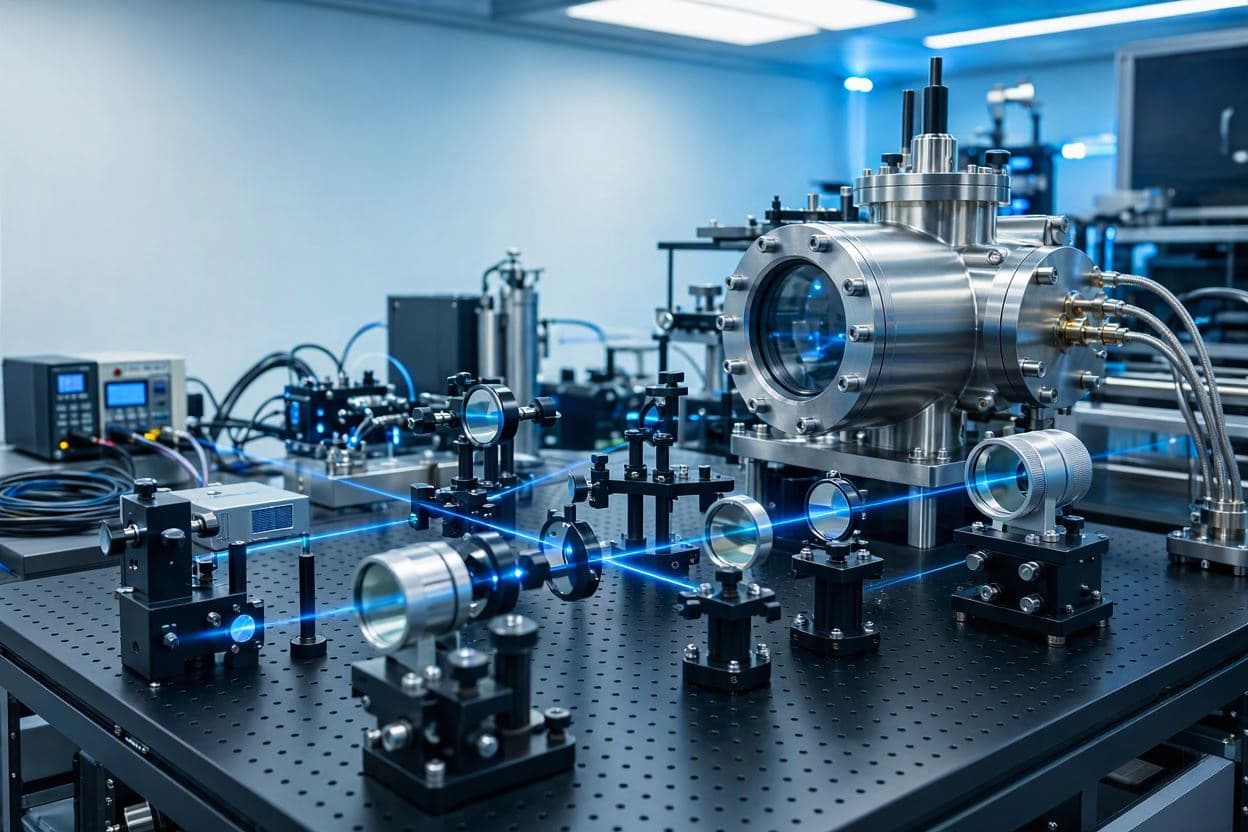
AI Image Disclaimer: Visuals in this article are produced by artificial intelligence for illustrative purposes only and do not represent actual laboratory setups.
Sources: ScienceAlert, Max Planck Institute of Quantum Optics
Published by Banx Network. This article is part of the Banx decentralized media programme, powered by the BXE token on the XRP Ledger.