There is a quiet mystery in the night sky that has puzzled scientists for as long as they have studied the planets. Earth has a moon. Mars has two. Even distant Pluto has companions. But Venus, our closest planetary neighbor, a world so similar to Earth in size and structure that it has been called our twin, has none. It spins alone, wrapped in clouds of sulfuric acid, turning so slowly that a single day lasts longer than its year. Now, new research suggests a reason: Venus may have eaten its moon.
The study, published in The Astrophysical Journal and led by astrophysicist Stephen Kane at the University of California, Riverside, explored the tidal evolution of a hypothetical Venus-moon system. The researchers ran computer models, first testing them against the known evolution of Earth and its moon, then varying the mass of a hypothetical Venusian moon from half to ten times the mass of Earth's Moon, and varying Venus's rotation rate .
The results were strikingly consistent. In most simulations, the moon spiraled inward and crashed into Venus. The more massive the moon, the faster the collision occurred. Kane said he was surprised by the uniformity of the outcomes. "I thought surely the broad range of scenarios I was exploring would lead to a variety of results," he said. "But it all went pretty much in the same direction" .
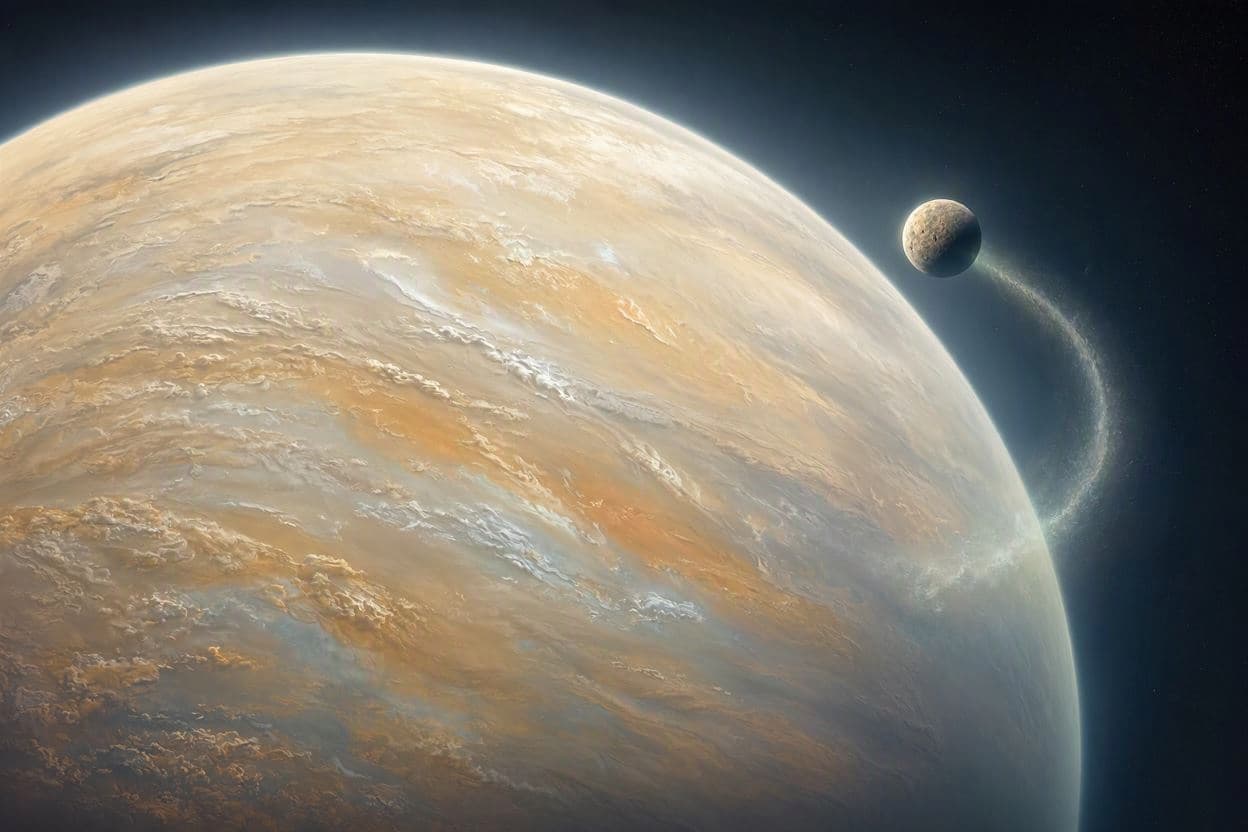
The mechanism lies in the relationship between a planet's spin and its moon's orbit. Earth rotates once every 24 hours, and this relatively fast spin transfers energy to the Moon, causing it to drift away at about four centimeters per year. Venus is different. It takes 243 Earth days to complete one rotation, and it rotates in the opposite direction. Rather than pushing a moon outward, Venus's slow spin and strong gravity would cause any moon to spiral inward, eventually crossing the Roche limit and breaking apart before its debris fell onto the planet .
The research does not prove that Venus ever had a moon. It suggests that if one formed—perhaps through a giant impact early in Venus's history, similar to the event that created Earth's Moon—it could not have survived. The tidal destruction would have occurred within a billion years, early enough that any surface signature would have been erased by later volcanic resurfacing. Venus's surface is globally young, with a crater-retention age of several hundred million years, implying extensive resurfacing well after the last giant impact .
Finding physical evidence of such a collision would be difficult. But scientists hope future missions will help. NASA's DAVINCI+ and VERITAS missions, planned to study Venus's atmosphere and geology, could provide clues. Seismic data, if it can be obtained, might reveal structures deep inside the planet that echo a long-ago impact—similar to the unusual structures detected deep within Earth that may be remnants of the collision that formed our Moon . For now, the finding offers a new way to think about why Earth and Venus, so alike in so many ways, took such different paths.
A new study suggests Venus may once have had a moon that spiraled inward and crashed into the planet, explaining why it has no satellite today. The research used computer models to show that Venus's slow rotation would inevitably destroy any moon.
AI Image Disclaimer: Visuals in this article are produced by artificial intelligence for illustrative purposes only and do not represent actual planetary surfaces.
Sources: The Astrophysical Journal, University of California Riverside, BBC Newsround, Universe Today
Published by Banx Network. This article is part of the Banx decentralized media programme, powered by the BXE token on the XRP Ledger.