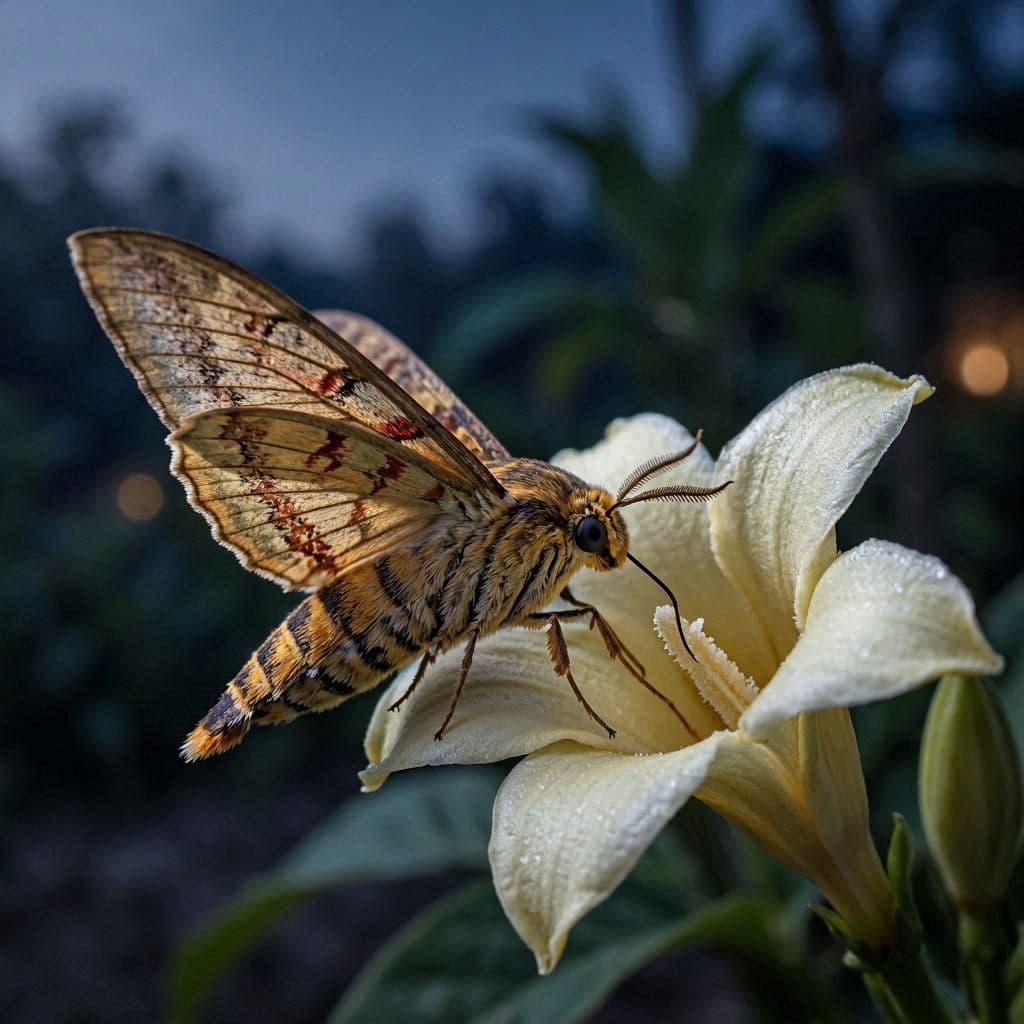
In the quiet hours of the night, when most creatures are asleep, moths flit from flower to flower, guided by senses we are only beginning to understand. A recent study has revealed a surprising capability: some moths can detect the scent of flowers not just with their antennae, but through their wings. This discovery challenges conventional wisdom about insect sensory biology and highlights the complexity of evolutionary adaptation.
The finding suggests that wings are not merely tools for flight but also sophisticated sensory organs. For these nocturnal pollinators, the ability to smell through their wings may provide a broader range of detection, helping them locate nectar sources more efficiently in the dark.
Body: Researchers focused on the hawkmoth, a species known for its hovering flight and long proboscis. By examining the microscopic structure of the wings, they discovered specialized pores connected to nerve endings. These structures, similar to those found in antennae, allow the moth to detect volatile organic compounds released by flowers.
Experiments showed that when the wings were blocked or damaged, the moths had difficulty locating flowers, even if their antennae were intact. This indicates that the wings play a crucial role in olfaction, working in tandem with other sensory inputs to create a complete picture of the environment.
This dual-sensory system offers a significant advantage. While antennae are highly sensitive, they have a limited range. Wings, with their larger surface area, can capture scent molecules from a wider area, allowing the moth to detect flowers from a greater distance. This efficiency is vital for survival in competitive ecosystems.
The evolution of such a trait underscores the importance of pollination for both plants and insects. Flowers have evolved to produce specific scents to attract pollinators, while moths have developed enhanced sensory abilities to find them. This co-evolutionary relationship drives biodiversity and ecosystem health.
Understanding these mechanisms has implications for agriculture and conservation. By knowing how pollinators detect plants, scientists can develop better strategies to support their populations. This is particularly important as pollinator numbers decline due to habitat loss and pesticide use.
The study also opens new avenues for biomimicry. Engineers and designers may look to moth wings for inspiration in creating sensors that can detect chemicals in the air. Nature’s solutions often offer efficient and elegant designs for human technology.
For the general public, this discovery adds a layer of wonder to the common moth. Often overlooked or misunderstood, these insects are revealed to be complex and highly adapted creatures. It encourages a deeper appreciation for the small wonders of the natural world.
Further research will explore whether other insect species possess similar capabilities. It is likely that this trait is more widespread than currently thought, hidden in plain sight on the wings of countless insects.
As we learn more about the sensory worlds of animals, we gain a deeper respect for their intelligence and adaptability. The moth’s wing is not just a sail for the wind but a nose for the night.
Closing: The discovery that moths can smell through their wings reveals the intricate adaptations of nature. It reminds us that there is always more to learn about the creatures that share our world, no matter how small they may seem.
AI Image Disclaimer: The visuals in this article are AI-generated illustrations designed to reflect the delicate structure of moth wings and their sensory functions.
Sources: National Geographic ScienceDaily The Guardian Journal of Experimental Biology
Published by Banx Network. This article is part of the Banx decentralized media programme, powered by the BXE token on the XRP Ledger.