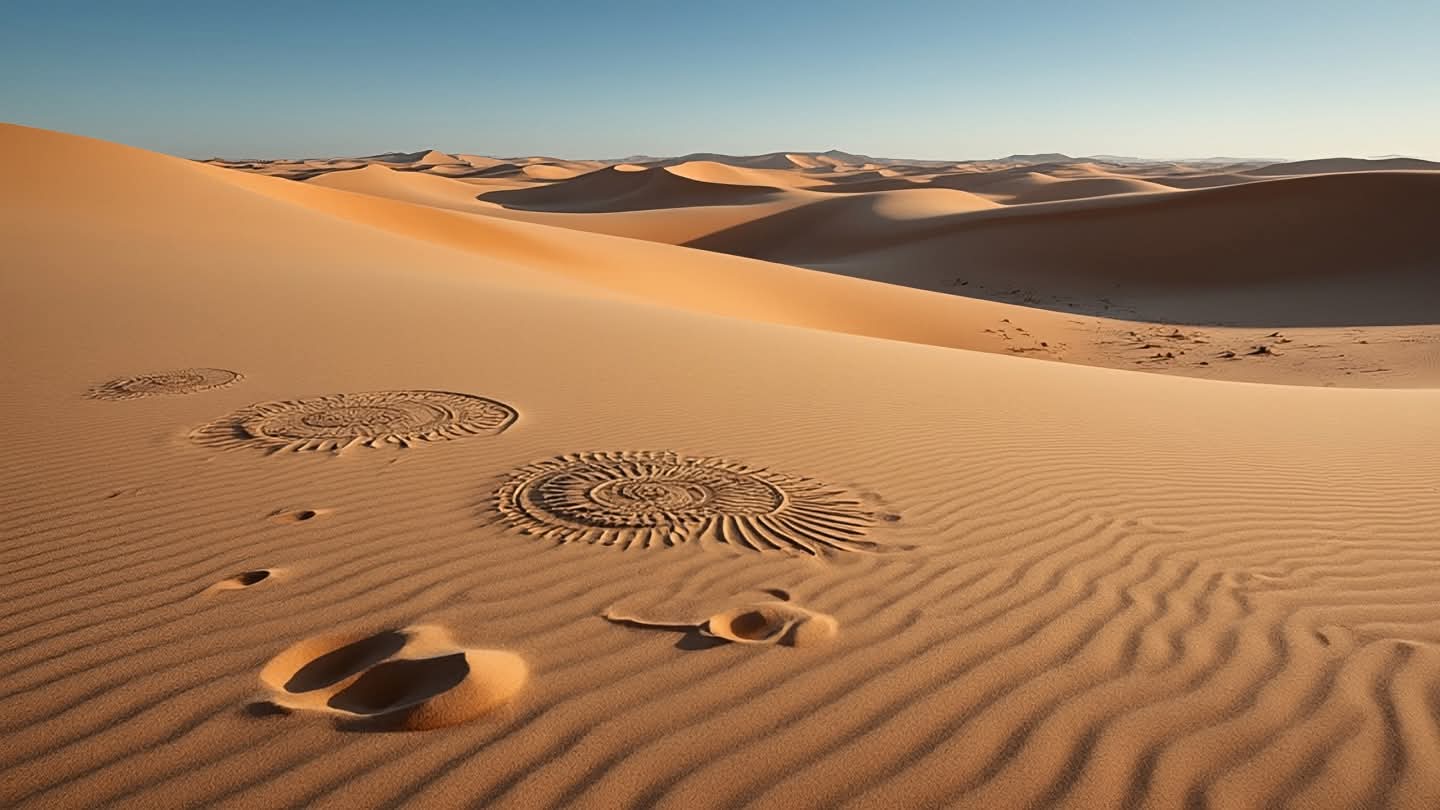
In the arid, sun-scorched expanses of Egypt’s Western Desert, where sand dunes stretch toward the horizon and silence reigns supreme, a discovery has emerged from the dust that rewrites a chapter of natural history. Paleontologists have uncovered an ancient "shark graveyard," a fossil-rich site that reveals a time when this barren landscape was teeming with marine life. This finding serves as a poignant reminder of Earth’s dynamic past, where oceans once covered lands now defined by their dryness, and where predators of the deep left their mark in stone.
The site, located in the Fayum Depression, has yielded hundreds of shark teeth and skeletal fragments, representing multiple species that roamed these waters millions of years ago. During the Eocene epoch, approximately 40 million years ago, this region was part of a shallow sea connected to the Tethys Ocean. The concentration of fossils suggests that this area may have been a nursery or a feeding ground, where sharks gathered in large numbers before being buried by sediment. It is a snapshot of a lost ecosystem, preserved in remarkable detail.
For scientists, the discovery offers valuable insights into the evolution of sharks and the environmental conditions of the past. By studying the types of species present, researchers can reconstruct the food web and understand how these ancient predators adapted to their environment. The diversity of the finds indicates a healthy, vibrant marine ecosystem, contrasting sharply with the desert that exists today. It highlights the dramatic climatic shifts that have shaped the planet over geological time scales.
The excavation process itself is a testament to patience and precision. Working in harsh conditions, the team carefully brushed away layers of sand and rock to reveal the fragile fossils beneath. Each tooth and bone fragment is a puzzle piece, contributing to a larger picture of prehistoric life. The meticulous work ensures that the context of each find is preserved, allowing for accurate analysis and interpretation. It is a labor of love, driven by curiosity and respect for the ancient world.
For the local community and the broader public, the discovery sparks imagination and wonder. It invites people to visualize a sea where there is now only sand, to imagine the splash of fins and the hunt for prey in waters that have long since evaporated. This connection to the deep past fosters a sense of awe and humility, reminding us that our current environment is just one moment in a long, evolving story. It encourages a deeper appreciation for the natural world and its history.
The findings also have implications for understanding climate change. By studying how ecosystems responded to past warming events and sea-level changes, scientists can better predict how modern environments might react to current trends. The shark graveyard is not just a collection of bones; it is a data set that helps us understand the resilience and vulnerability of life on Earth. It provides a historical baseline for comparing present-day ecological shifts.
As the research continues, more secrets are likely to be unearthed. The team plans to conduct further excavations and analyses, hoping to identify new species and refine the timeline of the site. Each discovery adds depth to our knowledge, filling in gaps in the fossil record. The Western Desert, once thought to be devoid of such treasures, is proving to be a rich archive of planetary history.
In the end, the ancient shark graveyard is a bridge between the past and the present. It reminds us that the Earth is constantly changing, and that life adapts in remarkable ways. For Egypt, it is a source of scientific pride and cultural heritage. For the world, it is a reminder of the beauty and complexity of natural history, waiting to be discovered in the most unexpected places.
AI Image Disclaimer: The visual elements in this article are AI-generated illustrations depicting desert landscapes and abstract representations of fossil excavation, designed to reflect the themes of paleontology and history without showing real proprietary excavation sites or specific fragile artifacts.
Sources: Live Science, National Geographic, Phys.org, Smithsonian Magazine
Published by Banx Network. This article is part of the Banx decentralized media programme, powered by the BXE token on the XRP Ledger.