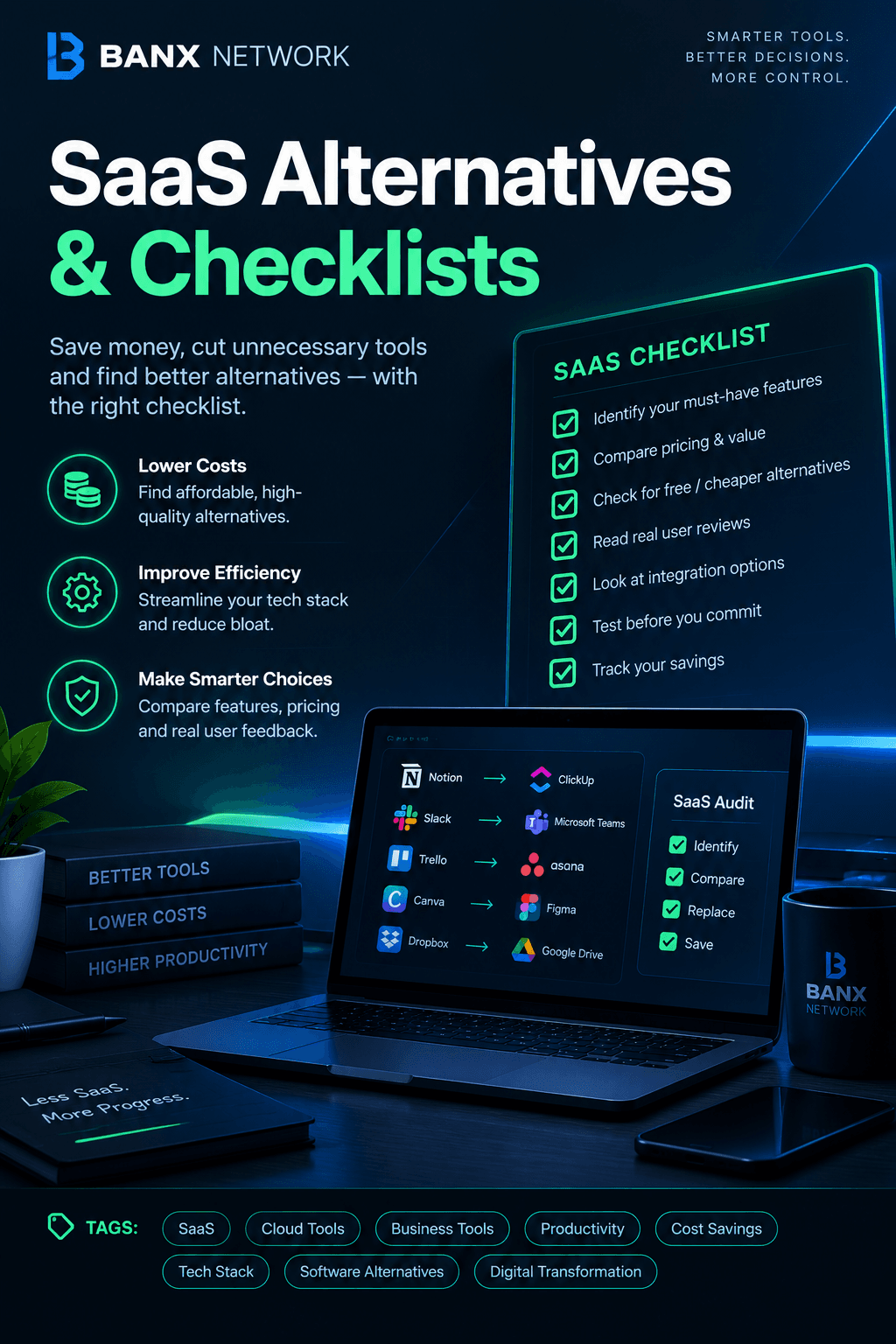
Software subscriptions have become an essential part of modern business, but managing them effectively can be challenging. As teams adopt more cloud applications, businesses can lose visibility over what they are paying for, who is using each tool and whether overlapping products are delivering enough value.
Gartner identified growing SaaS and AI software spend, limited visibility and redundant applications as challenges organisations need to address. Its 2026 research recommends improving visibility and actively managing the SaaS portfolio rather than allowing software purchases to grow independently across departments. [1]
A structured approach to SaaS alternatives and checklists can help businesses make better decisions before committing to another recurring subscription.
Start With a SaaS Audit
Before searching for cheaper alternatives, businesses should establish exactly what they already have.
Create a central list containing:
Software name Monthly or annual cost Number of licences Number of active users Renewal date Department responsible Core functions Integrations Contract terms
This provides a clearer picture of the technology stack and can expose subscriptions that have been forgotten or duplicated.
Microsoft's cost-optimisation guidance recommends collecting and reviewing cost information regularly while comparing actual costs with the value delivered by a workload or service. [2]
Identify Duplicate Functionality
One of the most common sources of unnecessary SaaS expenditure is paying for multiple tools that perform similar jobs.
For example, a company might use separate applications for project management, task tracking, document collaboration and team communication when a smaller combination of platforms could potentially cover the same requirements.
This does not mean every duplicate application should immediately be cancelled. Different products can have genuinely different strengths, integrations or workflows.
Instead, ask:
Does this tool provide a capability that another existing application cannot provide?
If the answer is no, it becomes a candidate for consolidation or replacement.
AWS similarly recommends identifying redundant software licences and understanding actual usage patterns before making optimisation decisions. [3]
Build a SaaS Alternatives Checklist
When evaluating an alternative, price should not be the only consideration.
A useful checklist should include:
1. Core functionality Does the alternative provide the features the business actually needs?
2. Total cost Consider subscription fees, implementation, migration, training and additional user costs.
3. Usage limits Check restrictions on users, storage, automation, integrations and other important features.
4. Integrations Confirm that the replacement works with the company's existing systems.
5. Security Review authentication, access controls, data handling and relevant compliance requirements.
6. Migration requirements Determine whether existing information can be exported and transferred without significant disruption.
7. Scalability Consider whether the alternative will remain suitable as the organisation grows.
8. Contract flexibility Check cancellation terms, renewal dates and price changes before signing a new agreement.
Don't Automatically Choose the Cheapest Alternative
A cheaper subscription is not necessarily a better business decision.
If employees lose important functionality, spend additional time working around limitations or require extensive training, the apparent saving could be offset by operational costs.
Microsoft's cost-optimisation framework emphasises balancing actual costs with business value, efficiency and required functionality rather than simply pursuing the lowest possible price. [2]
The objective should therefore be better value, not simply a lower invoice.
Test Before You Switch
Businesses should consider testing an alternative before migrating an entire team.
A small pilot can reveal issues that are difficult to identify from a pricing page. Select a representative group of users and test the features that matter most to the business.
During the trial, measure:
Time required to complete common tasks User adoption Missing features Integration performance Data migration requirements Administrative workload Actual cost
This creates evidence for the final decision rather than relying entirely on assumptions.
Review Before Every Renewal
A SaaS audit should not happen only when a business is trying to cut costs.
Renewal dates provide a natural opportunity to reassess whether a subscription is still necessary.
AWS recommends implementing a structured process for identifying and decommissioning unused resources, including associated licences, rather than allowing unused assets to remain active indefinitely. [4]
A simple renewal checklist can ask:
Keep: Is the software actively used and delivering sufficient value?
Renegotiate: Is the software valuable but the current pricing or licence structure inefficient?
Consolidate: Can another existing platform perform the same function?
Replace: Is there a suitable alternative offering better value?
Cancel: Is the software no longer required?
Create a Simple Decision Framework
The most effective SaaS strategy is not necessarily about having the fewest applications. It is about having a technology stack where every significant subscription has a clear purpose.
A practical process is:
Audit → Measure usage → Identify overlap → Compare alternatives → Test → Migrate → Review
This turns SaaS management into an ongoing operational process rather than an emergency cost-cutting exercise.
Gartner's research on SaaS management platforms similarly highlights application discovery, unused licences, redundant applications, usage optimisation and spend visibility as important areas of SaaS management. [1]
For growing businesses, regularly reviewing software can provide greater visibility over recurring costs while helping teams avoid unnecessary complexity.
The next time a SaaS renewal arrives, the question should not simply be “Can we afford this?”
It should be:
“Is this still the right tool for the job?”
That shift in thinking can help businesses build a leaner, more manageable and more intentional technology stack.
Grab the guide here!: moneymaker62.gumroad.com/l/wnaij
References
[1] Gartner — How to Gain Visibility and Reduce Expense With SaaS Management Platforms, 2026. Gartner research
[2] Microsoft Azure — Design Review Checklist for Cost Optimization. Microsoft Azure Cost Optimization Checklist
[3] AWS — Microsoft Workloads Lens: Run Assessment Tools. AWS cost optimisation guidance
[4] AWS — Implement a Decommissioning Process. AWS decommissioning guidance
This article is for informational purposes and does not constitute financial, legal or professional business advice.
Published by Banx Network. This article is part of the Banx decentralized media programme, powered by the BXE token on the XRP Ledger.