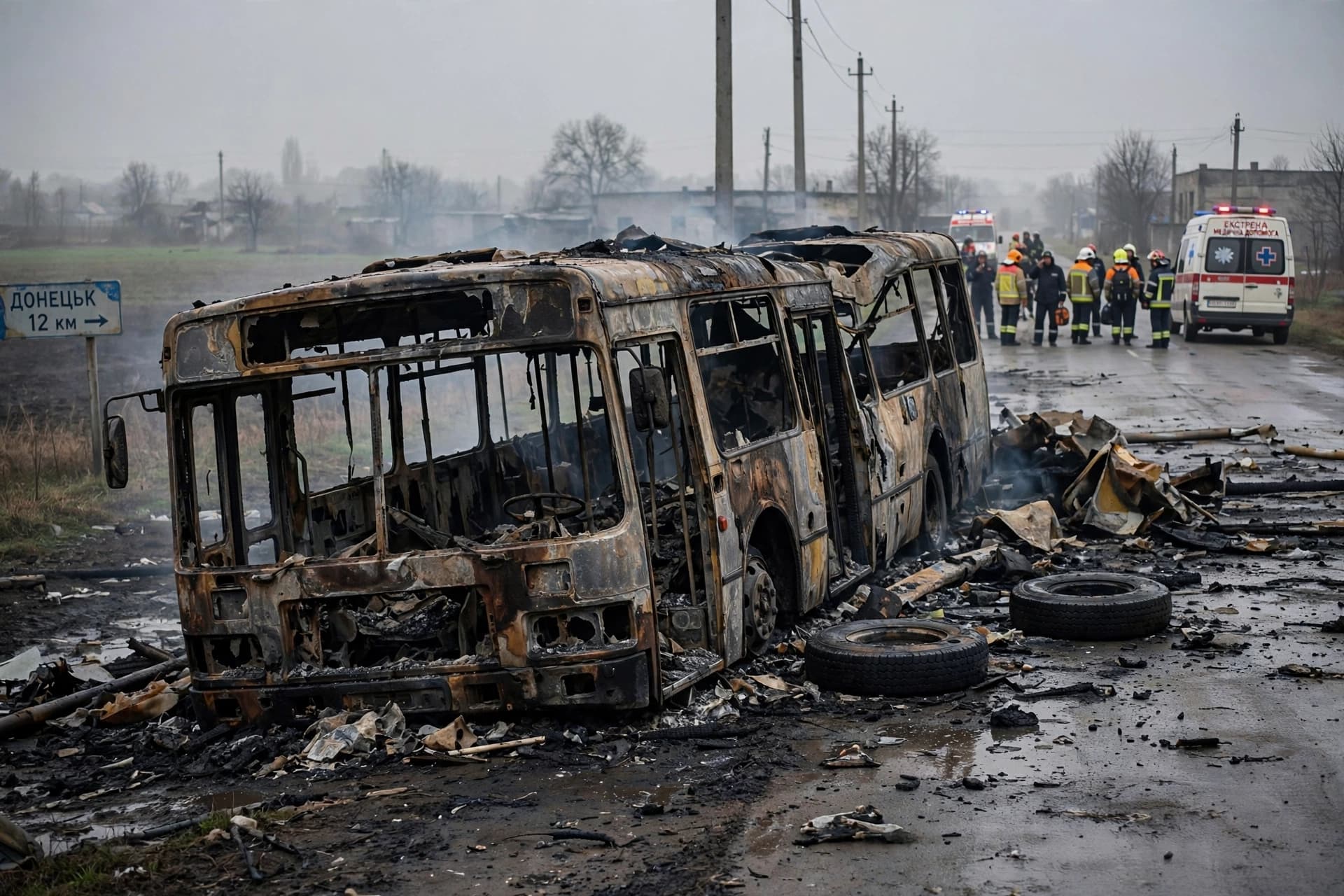
There is a particular horror in an attack on a bus—a vehicle of ordinary passage, carrying people who had no role in the war that killed them, struck in a place where they had every reason to believe they were safe. In eastern Ukraine, that horror has arrived. A Russian strike hit a bus in the Donetsk region, killing at least 30 people and wounding more than a dozen others. The attack was part of a broader Russian push against Ukraine's so-called "fortress belt"—the network of fortified cities that have formed the backbone of Kyiv's defenses in the east.
The strike occurred as Russian forces intensified their assault on the cities of the fortress belt, including Kramatorsk, Sloviansk, and Kostiantynivka. The bus was hit in a residential area, far from any military target, according to Ukrainian officials. The victims included civilians, many of them elderly, who were traveling on a route that had been used by residents for years. The strike was one of the deadliest single attacks in recent months, and it underscored the human cost of a war that has now lasted more than three and a half years.
The fortress belt is a strategic prize for Moscow. It comprises a string of cities that Ukraine has fortified over the past decade, and it stands between Russia's forces and the rest of the Donbas region. Russian forces have been advancing slowly but steadily, using glide bombs and artillery to soften defenses before sending in infantry. The strategy has been costly for both sides, but it has gradually pushed Ukraine back. Ukrainian President Volodymyr Zelensky has said the situation is "very difficult" and has renewed his calls for more Western military aid.
The bus strike came as Germany's Chancellor Friedrich Merz visited Kyiv, pledging additional military support and a joint drone production agreement. Merz said Germany would continue to support Ukraine "as long as it takes," and he called on Russia to stop the war. The visit was a show of solidarity, but the strike that greeted it was a reminder that solidarity alone does not stop bombs.
For the families of the 30 people killed on the bus, the strike is a loss that no diplomatic statement can undo. For Ukraine, it is a further sign of Russia's willingness to target civilians. For the world, it is a reminder that the war continues, that the fortress belt is still contested, and that the people who live there—who have already endured years of conflict—are still waiting for it to end.
AI Image Disclaimer: All images in this article are AI-generated and are intended for illustrative purposes only.
Sources: Reuters, Associated Press, Ukrinform, BBC
Published by Banx Network. This article is part of the Banx decentralized media programme, powered by the BXE token on the XRP Ledger.