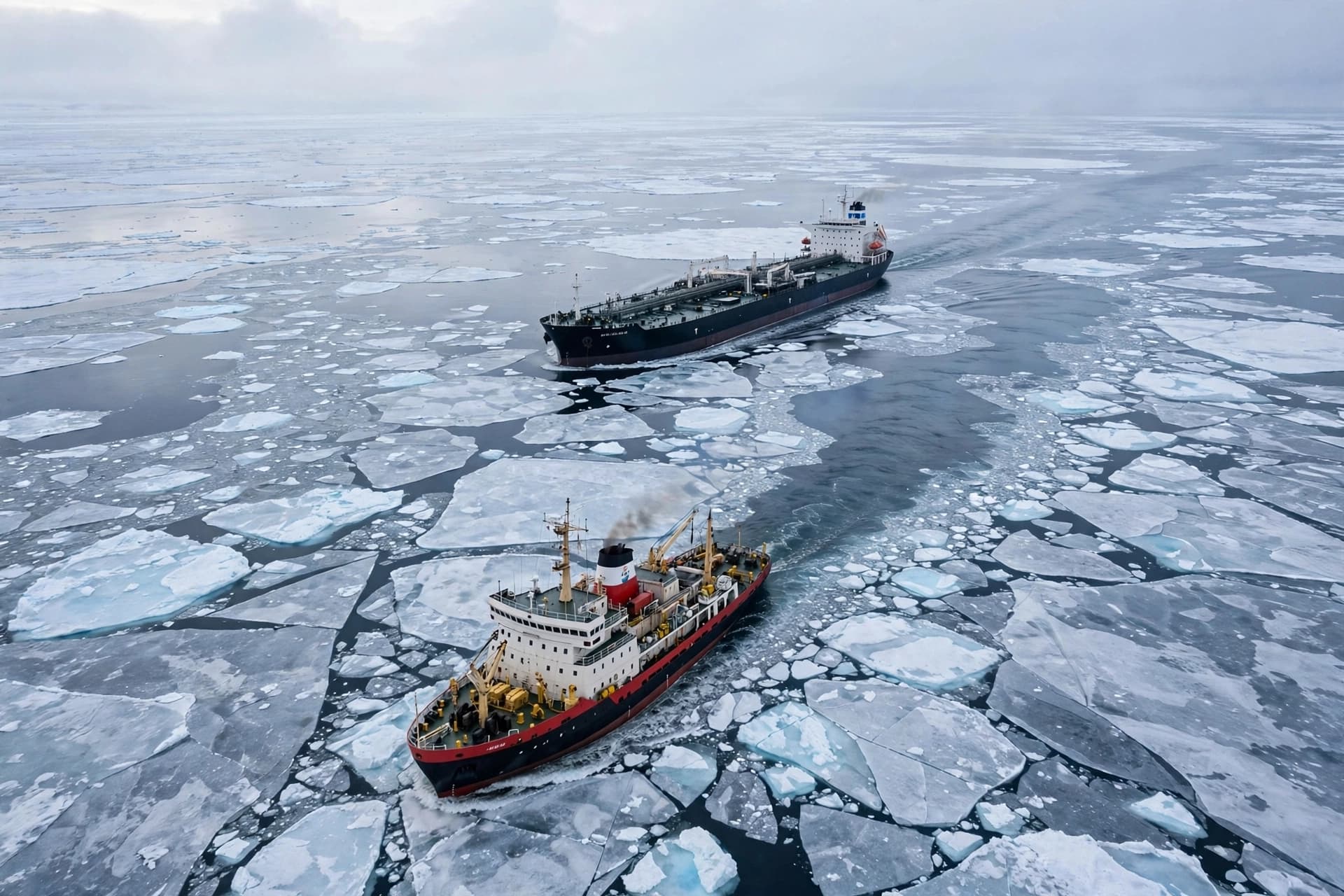
There is an old idea in navigation that the shortest path is not always the safest, and the safest path is not always the one chosen. This year, the Arctic has become a quiet witness to that truth. As traditional sea routes grow tangled with disruption and risk, Russia's Northern Sea Route—a passage through icy waters that was once considered too dangerous and too expensive for routine commerce—has seen its oil traffic swell by nearly half compared to last year, according to trader data and ship-tracking figures.
From the start of the navigation season in July through mid-October, roughly 20 million barrels of Russian oil have moved through the Arctic route to Asian markets, already exceeding the 13 million barrels shipped during the entire 2025 season. Traders expect another 5 to 10 million barrels to flow before the season closes. The route, which requires icebreaker assistance and commands high fees, has become less costly in relative terms as the usual alternatives—the Suez Canal, the Strait of Hormuz, and the Black Sea—face mounting disruptions from conflicts and security risks.
The arithmetic is straightforward, even if the geopolitics are not. Tanker freight rates have climbed to record levels as wars involving Iran and Ukraine have reshaped global shipping patterns. Asian refiners, facing higher costs and tighter access to U.S. crude, have turned to Middle Eastern and Latin American suppliers, driving demand for alternative routes. For Russia, the Arctic passage offers something more than economics: a way to move oil to Asia without passing through European waters, where tankers carrying Russian crude have been repeatedly seized this year.
Gazprom Neft, one of Russia's major oil producers, plans to increase its Arctic shipments by roughly 35 percent this year compared to 2025, its CEO Alexander Dyukov told journalists in Moscow. President Vladimir Putin has said Russia expects cargo turnover through the Northern Sea Route to double to 70 million metric tons annually by the end of the decade. The launch of Rosneft's Vostok Oil project in northern Russia last month is already contributing to the rising volumes.
There is a certain irony in the shift. The Arctic route was long framed as a symbol of Russia's ambition to reshape global trade, a project that seemed perpetually on the horizon. Now, circumstance has accelerated what ambition alone could not. The ice has not melted away, but the alternatives have become less reliable, and the calculus of risk has tilted in the Arctic's favor—at least for this season, and perhaps for longer.
The Northern Sea Route remains a demanding passage, dependent on icebreakers and favorable weather windows. But for the moment, the ships are moving, and the barrels are flowing east.
The images accompanying this article were generated by AI.
Sources: CBC News, Reuters, gCaptain, Rti Central Broadcasting, Times of India
Published by Banx Network. This article is part of the Banx decentralized media programme, powered by the BXE token on the XRP Ledger.