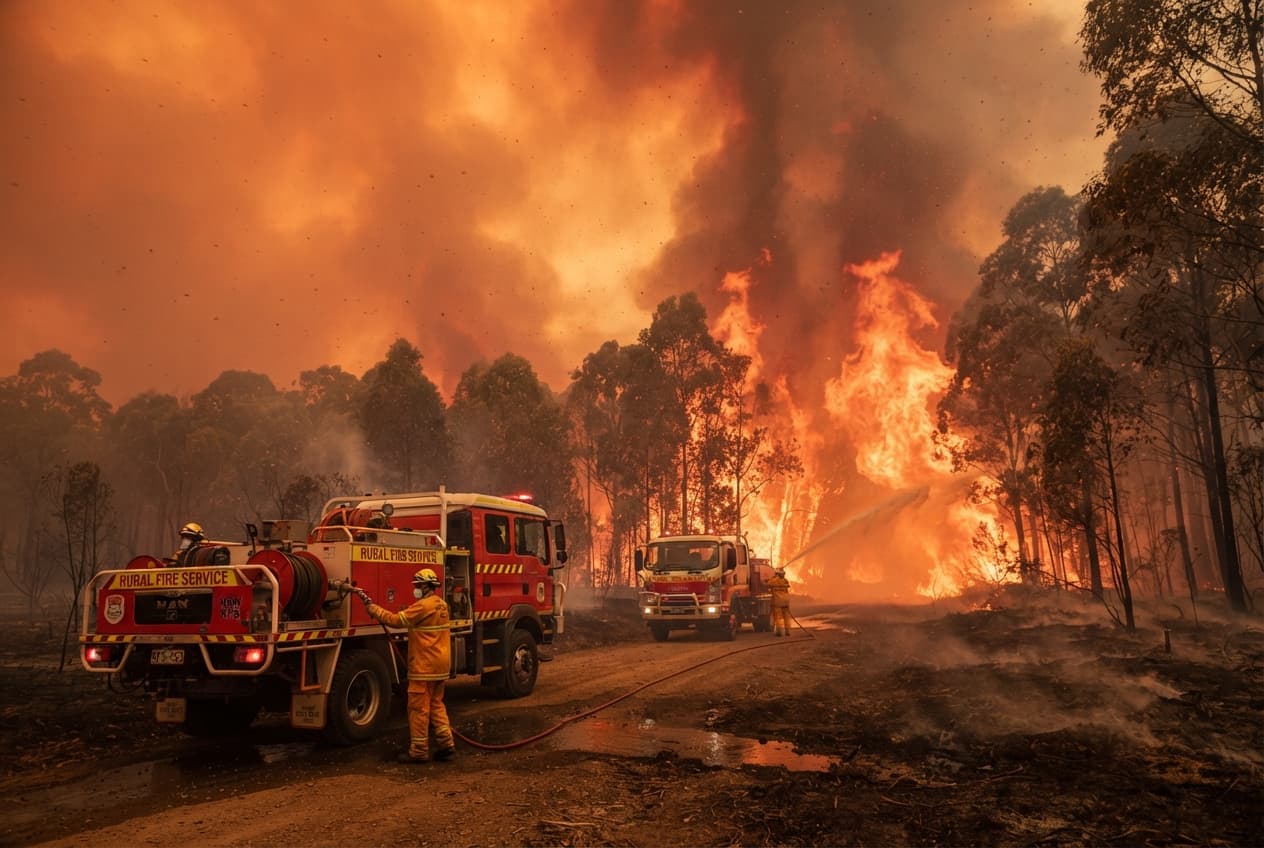
Sydney, Australia—Fierce north-westerly winds drove fast-moving forest fires through dry timber country and rural settlements across the southeast Friday afternoon. Fire authorities had issued catastrophic fire danger ratings hours before soaring temperatures and gale-force gusts ignited dry scrublands. Emergency services confirmed that eight residents perished as towering fire fronts overran rural properties before evacuation orders could be completed.
Rural fire service crews deployed hundreds of fire appliances and aerial water bombers to combat multiple fast-spreading blazes across rugged terrain. Embers carried by ninety-kilometer-per-hour winds sparked spot fires miles ahead of the primary fire front, threatening isolated homesteads. Paramedics treated dozens of evacuees for severe smoke inhalation, burns, and trauma at roadside triage centers.
Local police and emergency volunteers went door-to-door urging remaining residents to evacuate immediately as thick black smoke blanketed regional townships. Community evacuation centers established in local sports stadiums filled rapidly with displaced families and evacuated livestock. Firefighters working in grueling heat conditions reported erratic wind changes that severely hampered containment efforts.
State premier officials declared a state of emergency across the affected regional districts, mobilizing defense force transport units to assist relief operations. Power grids sustained extensive damage as burning timber poles collapsed across regional transmission lines, plunging towns into darkness. Insurance assessors and disaster recovery teams prepared to enter restricted zones once active fire fronts subsided.
Environmental scientists pointed to prolonged drought conditions and unseasonably high spring temperatures as key factors exacerbating the early bushfire season severity. Community leaders criticized delayed emergency alert broadcasts in remote valleys where mobile telephone networks failed due to power outages. Fire authorities warned that hazardous weather conditions would persist overnight, maintaining extreme fire risks across the region.
Water bomber aircraft made continuous drops over burning residential perimeters until fading daylight grounded aerial operations for the evening. Ground crews established containment lines along cleared roadsides, performing strategic backburning operations to halt the advancing flames. Weary firefighters rotated shifts around glowing ember beds while monitoring shifting wind directions under an orange-tinted sky.
The tragedy marks one of the most destructive early-season fire events recorded in the region, raising urgent questions about climate resilience and rural preparedness. Emergency management agencies urged all residents in fire-prone zones to review their bushfire survival plans immediately. Meanwhile, search and recovery teams prepared to comb through charred residential ruins at first light.
Published by Banx Network. This article is part of the Banx decentralized media programme, powered by the BXE token on the XRP Ledger.