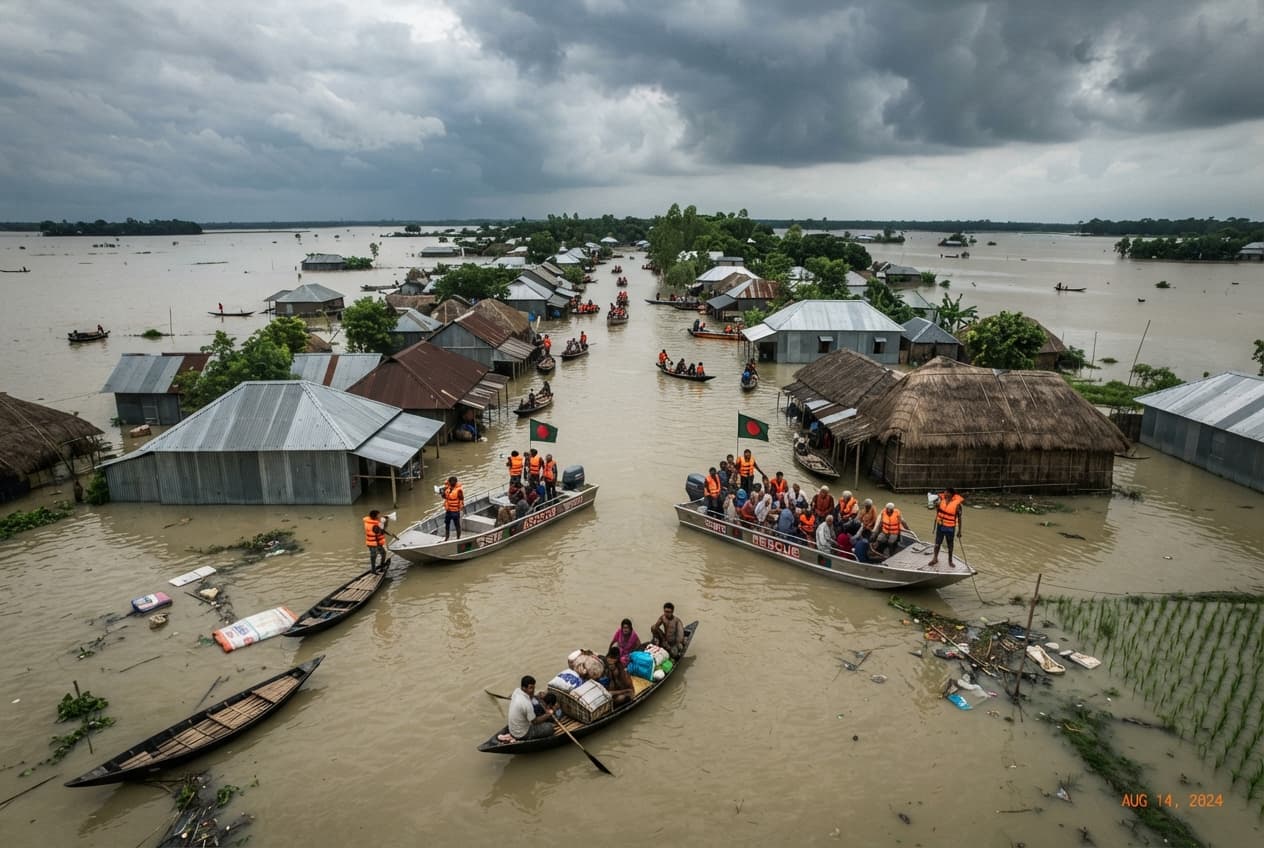
Dhaka, Bangladesh—Swollen rivers broke through regional embankments early Friday morning, spilling turbid waters across low-lying farming districts and submerging rural homesteads. Continuous upstream runoff and heavy monsoon downpours over consecutive days swelled major river networks past critical danger marks. Local disaster response teams confirmed that eleven individuals drowned as sudden surges caught families off guard in their homes.
Rescue boats navigated submerged village lanes to evacuate stranded residents seeking refuge on elevated highway embankments and school roofs. Survivors described waking up to waist-deep water inside their bedrooms before managing to break through thatch and tin walls. Rural communities struggled against rapid currents as essential food supplies and livestock were swept away downstream.
District hospitals established emergency medical posts along dry elevated roads to treat waterborne ailments, skin infections, and shock among survivors. Medical staff noted an alarming rise in diarrhea cases as contaminated floodwater mixed with local tube-well water sources. Relief coordinators distributed dry rations and water purification tablets, though supplies remained critically low in isolated sub-districts.
Water development board engineers rushed heavy sandbags and bamboo pilings to reinforce weakening dykes threatened by relentless river pressure. Government ministers convened an emergency review session in the capital to deploy additional naval rescue units and emergency relief funds. Local administrators reported that hundreds of thousands of villagers remain marooned across multiple inundated sub-districts.
Farmers surveyed ruined paddy fields submerged under feet of muddy water just weeks before the scheduled harvest season. Agricultural extension officers warned of extensive crop failures and severe economic losses for rural families dependent on seasonal yields. Transport links remained severed as regional highways disappeared beneath fast-moving river currents.
International humanitarian organizations offered immediate logistical support, dispatching water transport vessels and medical teams to the hardest-hit river basins. Community volunteers worked around the clock to construct makeshift bamboo rafts for families stranded without motorized boat access. Meteorological departments predicted additional rainfall upstream, ensuring that floodwaters will recede slowly over the coming days.
The recurring catastrophe highlights the deep vulnerability of low-lying delta settlements to shifting hydrological patterns and extreme weather cycles. Local civil society leaders demanded accelerated dredging of silted river channels and sturdier embankment construction to protect vulnerable communities. Meanwhile, weary survivors huddled under plastic sheeting along muddy roadsides, awaiting the arrival of government food distribution trucks.
Published by Banx Network. This article is part of the Banx decentralized media programme, powered by the BXE token on the XRP Ledger.