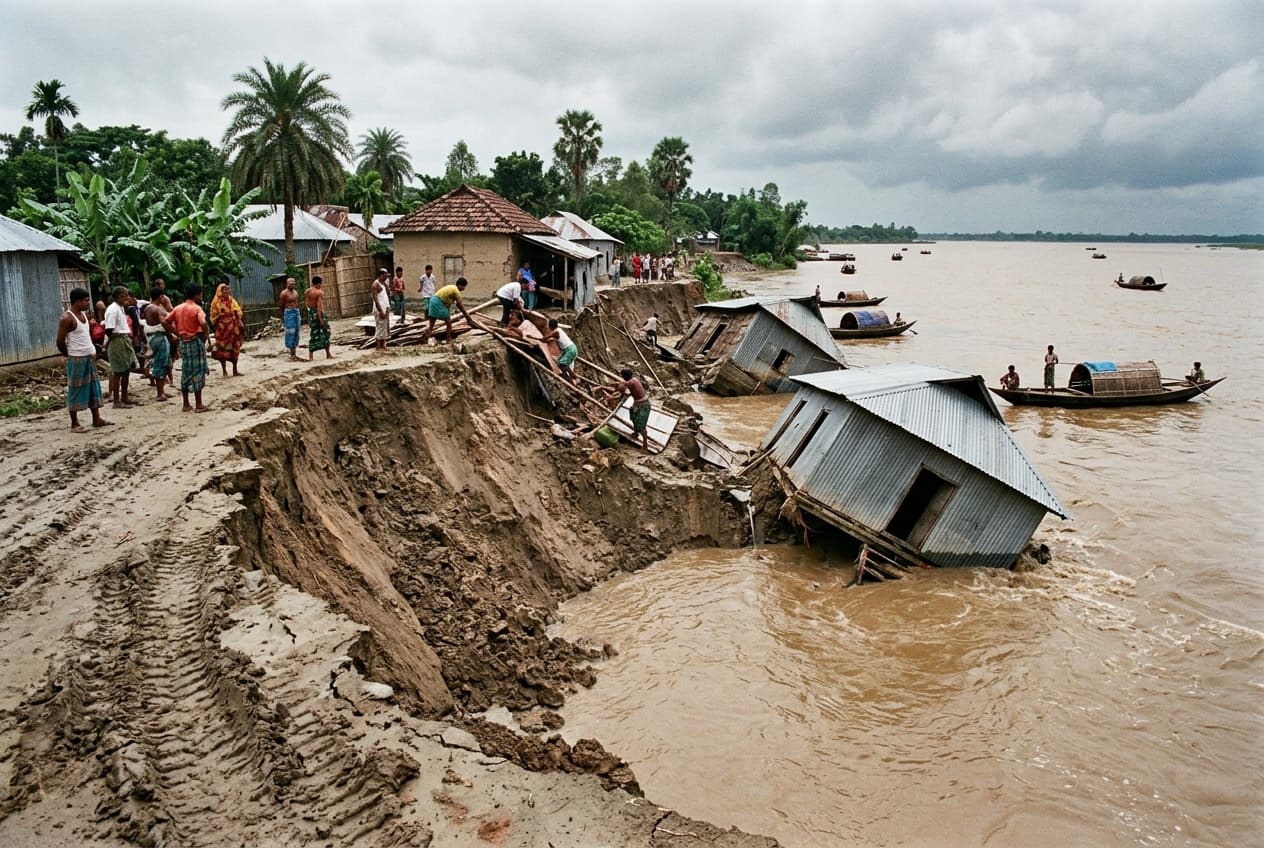
Dhaka, Bangladesh— Heavy monsoon rains triggered a sudden riverbank collapse in northern Bangladesh Thursday, drowning four people and washing away homes as the Jamuna River surged over its banks.
The collapse occurred at around 6 a.m. local time in Kurigram district, where water levels had risen more than a meter overnight. Local officials said a 200-meter stretch of embankment, weakened by days of rain and upstream flow from India, gave way without warning. At least eight houses standing on the edge were pulled into the current.
Four victims, including two children from the same family, were swept away while trying to move belongings. Their bodies were recovered downstream by afternoon. Three others were injured, and more than 50 families were displaced, according to the district administration. Many had already been living on the embankment after losing land to erosion last year.
"The river took everything in five minutes," a local union council chairman told The Daily Star. "People were shouting, but the water was too fast. We tried with bamboo poles, we could not reach them."
Bangladesh, a delta nation of 170 million, loses around 10,000 hectares a year to river erosion, a toll that monsoon season accelerates. Embankments built in the 1970s are poorly maintained, and sand mining near the base of banks has made collapses more frequent. In Kurigram, residents said they had warned the Water Development Board for weeks about cracks appearing along the bank.
The monsoon this year has been erratic, with intense bursts followed by dry spells that crack soil, then saturate it. The weather office said 180 millimeters of rain fell in the district in 24 hours. Upstream, the Teesta and Brahmaputra were both flowing above danger levels, pushing more water into the Jamuna.
Relief was slow. Boats were the only way to reach several cut-off villages. The district said it distributed dry food and tarpaulins, but families complained they had no clean drinking water. Schools were closed and turned into temporary shelters. Livestock, a key asset for these families, was lost.
Experts said the incident was not just weather, but policy failure. Embankments are built, but not monitored. Families are resettled, then return because there is nowhere else to farm. Each collapse pushes people closer to the water.
By evening, the river was still rising. Red flags were placed along the remaining embankment, and police asked families to move further back.
The current was still pulling chunks of earth into the river.
Published by Banx Network. This article is part of the Banx decentralized media programme, powered by the BXE token on the XRP Ledger.