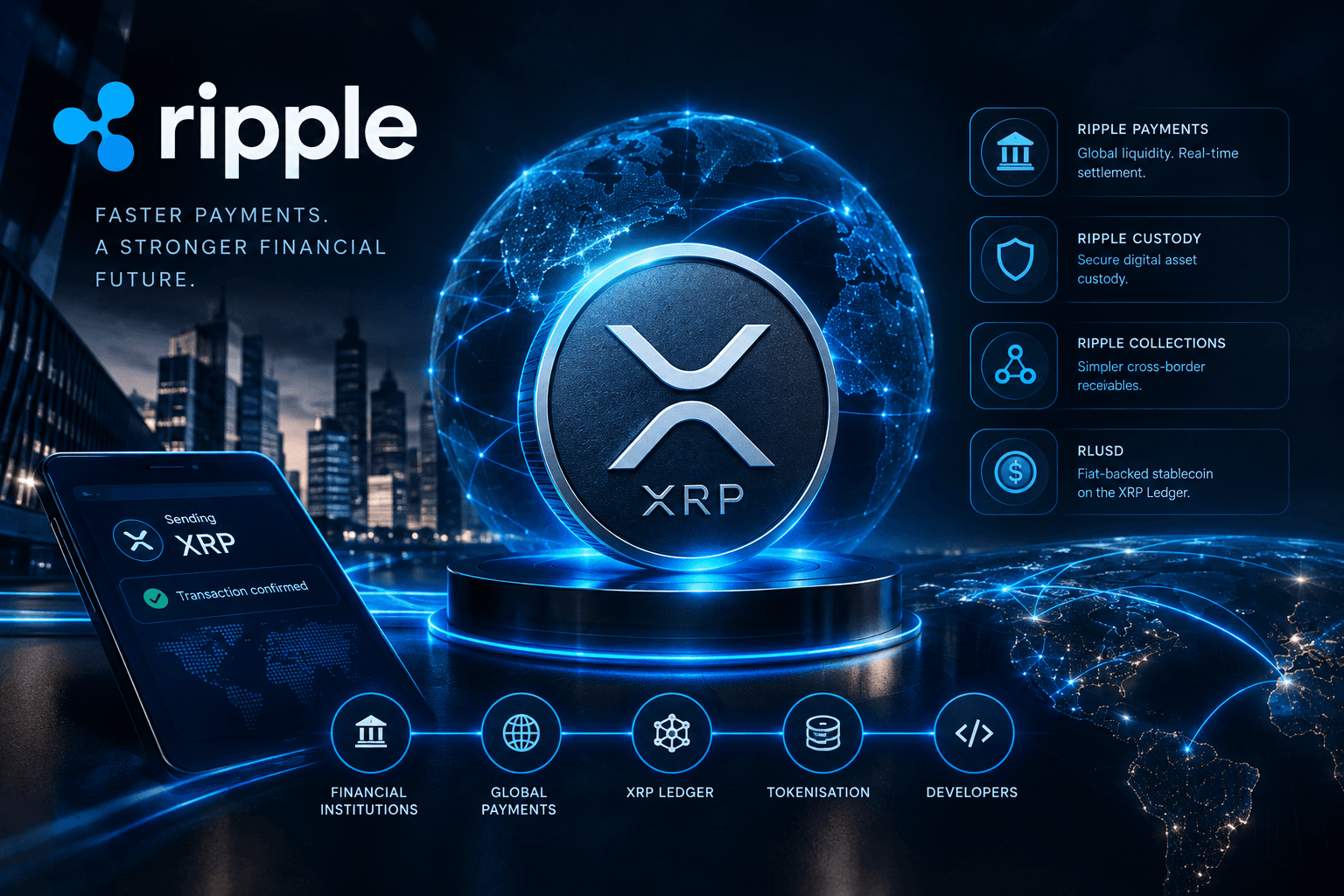
Ripple is one of the most recognised companies in the blockchain and digital payments sector. Its technology ecosystem focuses on using blockchain infrastructure to support financial institutions, businesses and digital-asset transactions.
At the centre of this ecosystem is the XRP Ledger (XRPL), a decentralised blockchain designed to record and settle digital transactions. The network uses a consensus process involving validators rather than traditional proof-of-work mining. [1]
What Is XRP?
XRP is the native digital asset of the XRP Ledger. According to XRPL documentation, XRP can be used to facilitate transactions and provide liquidity within the network. [2]
One of the key characteristics of the XRP Ledger is its built-in financial functionality. In addition to transferring XRP, the network supports issued tokens, decentralised exchange functionality and other financial applications. [1]
This makes XRP different from Ripple as a company. Ripple develops blockchain-based financial products and infrastructure, while XRP is the digital asset native to the independently operated XRP Ledger.
Ripple's Focus on Payments
Ripple has developed a range of enterprise products around blockchain-based payments. Its current product portfolio includes Ripple Payments, Ripple Custody, Ripple Collections and stablecoin infrastructure. [3]
The company's payments infrastructure is designed to connect financial institutions and businesses with fiat and digital-asset payment rails through a single technology stack. This reflects a broader shift in financial services toward faster settlement and greater interoperability between traditional and digital payment systems.
Ripple has also expanded its presence in Europe. In June 2026, the company announced that it had received preliminary approval for a Crypto-Asset Service Provider (CASP) licence from Luxembourg's financial regulator under the European Union's Markets in Crypto-Assets (MiCA) framework. Ripple said the approval would support the expansion of its payments services across the European Economic Area, subject to final conditions. [4]
The Role of RLUSD
Another important part of Ripple's ecosystem is Ripple USD (RLUSD), a fiat-backed stablecoin designed to maintain a value of one US dollar.
Ripple's documentation states that RLUSD is backed by segregated reserves of cash and cash equivalents and is issued on the XRP Ledger, Ethereum and other supported networks. [5]
Stablecoins such as RLUSD can provide a digital representation of fiat currency while operating on blockchain infrastructure. For businesses, this can create additional options for moving and settling value digitally.
Ripple and the SEC
Ripple's development has also been closely connected to a long-running regulatory case in the United States.
The U.S. Securities and Exchange Commission filed its enforcement action against Ripple in December 2020, alleging that the company and its executives conducted unregistered securities offerings involving XRP. [6]
In August 2024, the U.S. District Court for the Southern District of New York entered a final judgment imposing a civil penalty of $125,035,150 against Ripple and an injunction concerning the registration provisions of the Securities Act. Both sides subsequently appealed. [6]
On August 7, 2025, the SEC announced that its appeal and Ripple's cross-appeal had been dismissed through a joint stipulation, resolving the civil enforcement action. The SEC stated that the 2024 final judgment, including its penalty and injunction, remained in effect. [7]
The legal history remains an important part of understanding Ripple because it illustrates the regulatory questions surrounding the treatment of digital assets and the circumstances in which they are sold.
Looking Ahead
Ripple's ecosystem now extends beyond XRP transfers. Its activities encompass enterprise payments, custody, stablecoins, tokenisation and infrastructure built around the XRP Ledger.
The XRPL ecosystem is also being developed for emerging applications. In June 2026, Ripple announced an XRPL AI Starter Kit designed to help developers build applications involving AI-agent payments using XRP and RLUSD. [8]
Whether blockchain becomes a mainstream component of global finance will depend on factors including regulatory frameworks, institutional adoption, technical development and demand for digital settlement infrastructure.
For Ripple, the combination of the XRP Ledger, XRP, RLUSD and enterprise financial products places the company at the intersection of several major developments in digital finance.
References
[1] XRP Ledger, What Is the XRP Ledger? XRPL Documentation
[2] XRP Ledger, Introduction: What Is XRP and Why Is It Valuable? XRPL Documentation
[3] Ripple, Ripple Documentation – Products and Solutions. Ripple Documentation
[4] Ripple, Ripple Secures Preliminary MiCA CASP License, June 23, 2026. Ripple announcement
[5] Ripple, Ripple USD Stablecoin Documentation. Ripple Stablecoin Documentation
[6] U.S. Securities and Exchange Commission, Ripple Labs, Inc., Bradley Garlinghouse, and Christian A. Larsen, May 8, 2025. SEC Litigation Release
[7] U.S. Securities and Exchange Commission, SEC Announces Joint Stipulation to Dismiss Appeals, August 7, 2025. SEC Litigation Release
[8] Ripple, Building the Future of Agentic Payments: Introducing the XRP Ledger AI Starter Kit, June 9, 2026. Ripple Insights
This article is for informational purposes only and does not constitute financial or investment advice.
Published by Banx Network. This article is part of the Banx decentralized media programme, powered by the BXE token on the XRP Ledger.