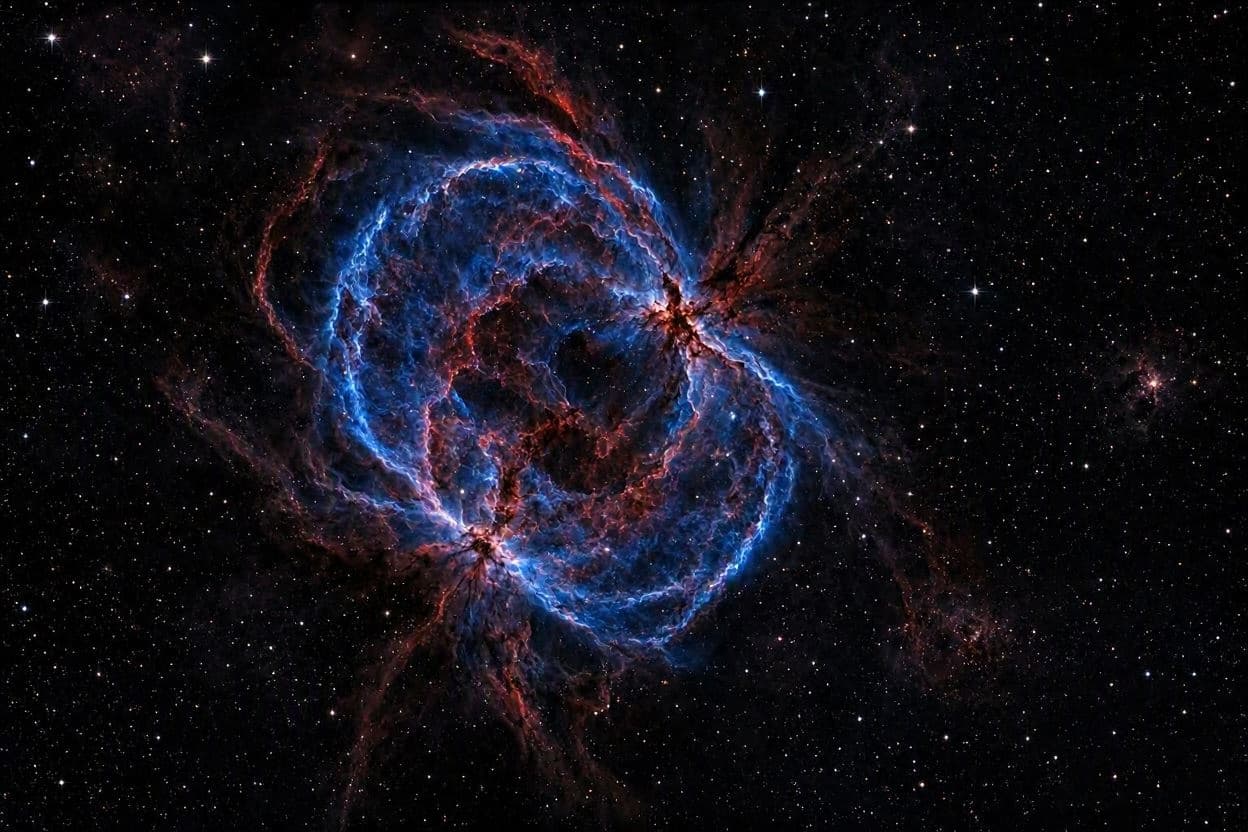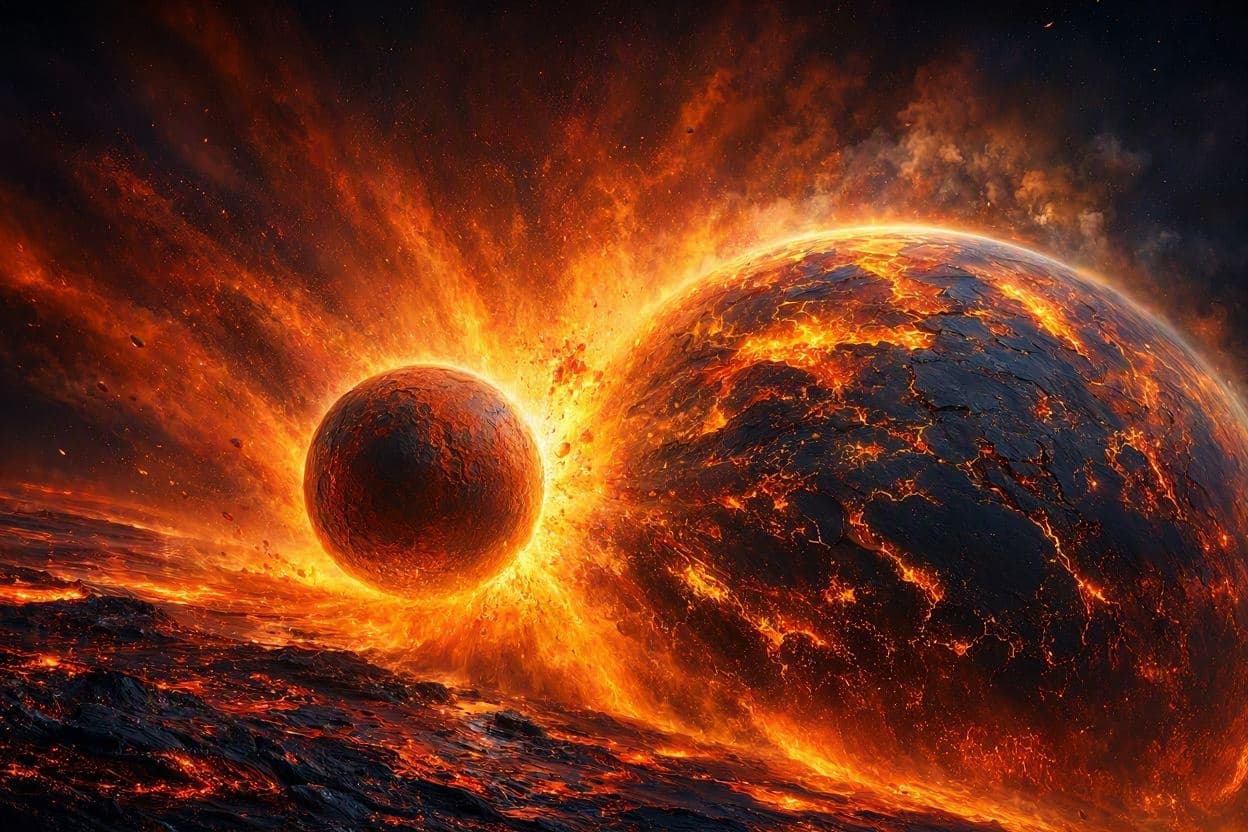
The night sky has always held a special place in human imagination, with the Moon serving as a silent companion to our planet. But how did this celestial neighbor come to be? The prevailing theory suggests a colossal impact early in Earth’s history, yet the details of that cataclysm remain a subject of intense scientific debate. A new modeling study offers fresh insights, questioning whether the early Earth was a molten ball of rock or a softer, more malleable entity during the collision. This inquiry invites us to reflect on the violent origins of our world and the delicate conditions that allowed life to eventually flourish.
The Giant Impact Hypothesis posits that a Mars-sized body, often called Theia, collided with the early Earth billions of years ago. The debris from this crash eventually coalesced to form the Moon. However, simulations have struggled to match the isotopic similarities between Earth and Moon rocks. If the impact was too violent, the materials should have mixed differently. If it was too gentle, the Moon might not have formed at all. The new study explores the physical state of the early Earth to resolve this paradox.
Researchers used advanced computer models to simulate the collision under different conditions. One scenario assumed a fully molten, magma-covered Earth, while another considered a partially solid, "soft" planet with a solid mantle. The results suggest that a softer, more deformable Earth could have absorbed the impact in a way that allowed for the right amount of material exchange. This "squishy" consistency might have enabled the debris disk to form with the correct chemical signature.
The implication is that the early Earth was not just a passive victim of cosmic violence but an active participant with physical properties that shaped the outcome. The viscosity and strength of the planet’s interior played a crucial role in determining how material was ejected into orbit. This finding challenges previous assumptions that focused primarily on the angle and speed of the impactor, adding a new layer of complexity to the narrative.
Understanding the Moon’s formation is not just about satisfying curiosity; it helps us understand the evolution of the solar system. The Moon stabilizes Earth’s axial tilt, creating the stable climate conditions necessary for life. Without this celestial anchor, our planet might have experienced extreme weather fluctuations, making the development of complex ecosystems unlikely. The Moon is thus a guardian of our habitability.
The study also has implications for exoplanet research. As astronomers discover thousands of planets around other stars, understanding how moons form becomes relevant to assessing their potential for life. If large moons are rare outcomes of specific impact conditions, then Earth-like planets with stable climates might be less common than hoped. This perspective adds weight to the uniqueness of our own planetary system.
Critics of the model point out that simulating planetary-scale collisions involves many uncertainties. The composition of Theia, the exact timing of the impact, and the thermal state of the early Earth are all variables that are difficult to pin down. However, each new model refines our understanding, narrowing the range of possibilities and guiding future observational efforts. Science progresses through this iterative process of hypothesis and testing.
Future missions to the Moon, such as NASA’s Artemis program, may provide additional data to test these theories. Samples from deeper lunar layers could offer clues about the mixing of Earth and Theia materials. Until then, computer models remain our best tool for peering back into the deep past. They allow us to replay the cosmic drama that shaped our world.
New modeling studies suggest that the physical state of the early Earth influenced the formation of the Moon. It highlights the complex interplay of physics and chance in our cosmic history. Let us continue to explore our origins.
AI Image Disclaimer: The visuals accompanying this piece are AI-generated interpretations intended for illustrative purposes only.
Sources: Nature Astronomy Smithsonian Magazine Space.com
Published by Banx Network. This article is part of the Banx decentralized media programme, powered by the BXE token on the XRP Ledger.