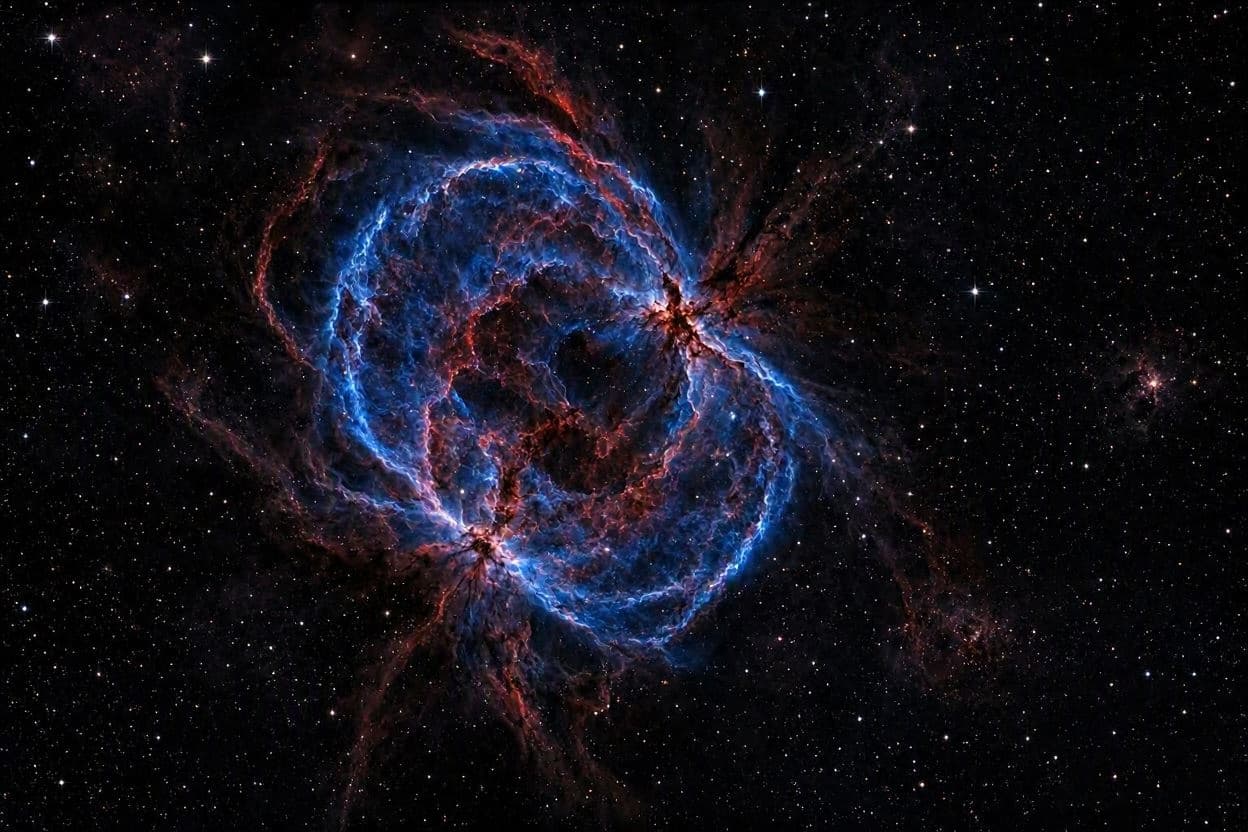
The night sky is a canvas of infinite depth, where light from distant stars tells stories of creation and destruction. Among these celestial narratives is the Crescent Nebula, a glowing arc of gas and dust shaped by the violent winds of a dying star. Recently, an astrophotographer captured a stunningly detailed image of this cosmic wonder, revealing its intricate structures and vibrant colors. This photograph is more than a beautiful picture; it is a testament to human curiosity and the technological tools that allow us to see the unseen. It invites us to pause and appreciate the grandeur of the universe above us.
The Crescent Nebula, also known as NGC 6888, is located about 5,000 light-years away in the constellation Cygnus. It was formed by the fast stellar wind from a Wolf-Rayet star colliding with the slower wind ejected during its earlier red giant phase. This collision creates shock waves that heat the gas, causing it to glow in shades of blue, green, and red. The astrophotographer’s image captures these hues with remarkable clarity, highlighting the nebula’s delicate, shell-like structure.
Capturing such detail requires patience, skill, and specialized equipment. Astrophotographers often spend hours tracking the movement of the sky, stacking multiple exposures to reduce noise and enhance faint details. The resulting image reveals filaments and bubbles that are invisible to the naked eye, offering a deeper understanding of the nebula’s physical properties. This technical mastery allows amateur and professional astronomers alike to contribute to our visual knowledge of the cosmos.
For scientists, these images are valuable tools for studying stellar evolution. Wolf-Rayet stars are rare and short-lived, representing a final stage before a supernova explosion. By observing the nebula they create, researchers can learn about the mass loss processes and chemical enrichment of the interstellar medium. The visual data complements spectroscopic analysis, providing a comprehensive view of these energetic events.
The aesthetic appeal of the Crescent Nebula also inspires public interest in astronomy. Beautiful images serve as ambassadors for science, drawing people into the story of the universe. They remind us of our place in the vastness of space, fostering a sense of humility and wonder. This emotional connection is vital for sustaining support for scientific exploration and education.
The photographer’s choice of filters and processing techniques plays a crucial role in bringing out the nebula’s features. Narrowband filters isolate specific wavelengths of light emitted by ionized oxygen, hydrogen, and sulfur. Mapping these to visible colors creates the iconic "Hubble palette" often seen in astrophotography. This artistic interpretation is grounded in scientific reality, balancing accuracy with visual impact.
Sharing such images online has created a global community of stargazers. Enthusiasts exchange tips, celebrate successes, and discuss the mysteries of the objects they capture. This collaborative spirit democratizes astronomy, allowing anyone with a telescope and a camera to participate in the discovery of the heavens. It transforms a solitary hobby into a shared journey of exploration.
As technology improves, the quality of amateur astrophotography continues to rise. Cameras become more sensitive, mounts more precise, and software more powerful. This progression means that future images will reveal even finer details, pushing the boundaries of what is possible from backyard observatories. The Crescent Nebula will likely be photographed again and again, each time revealing something new.
The breathtaking image of the Crescent Nebula highlights the beauty and complexity of stellar remnants. It underscores the value of astrophotography in science and inspiration. Let us continue to look up with awe.
AI Image Disclaimer: The visuals accompanying this piece are AI-generated interpretations intended for illustrative purposes only.
Sources: NASA Astronomy Picture of the Day Sky & Telescope Magazine Astrophotography Forums
Published by Banx Network. This article is part of the Banx decentralized media programme, powered by the BXE token on the XRP Ledger.