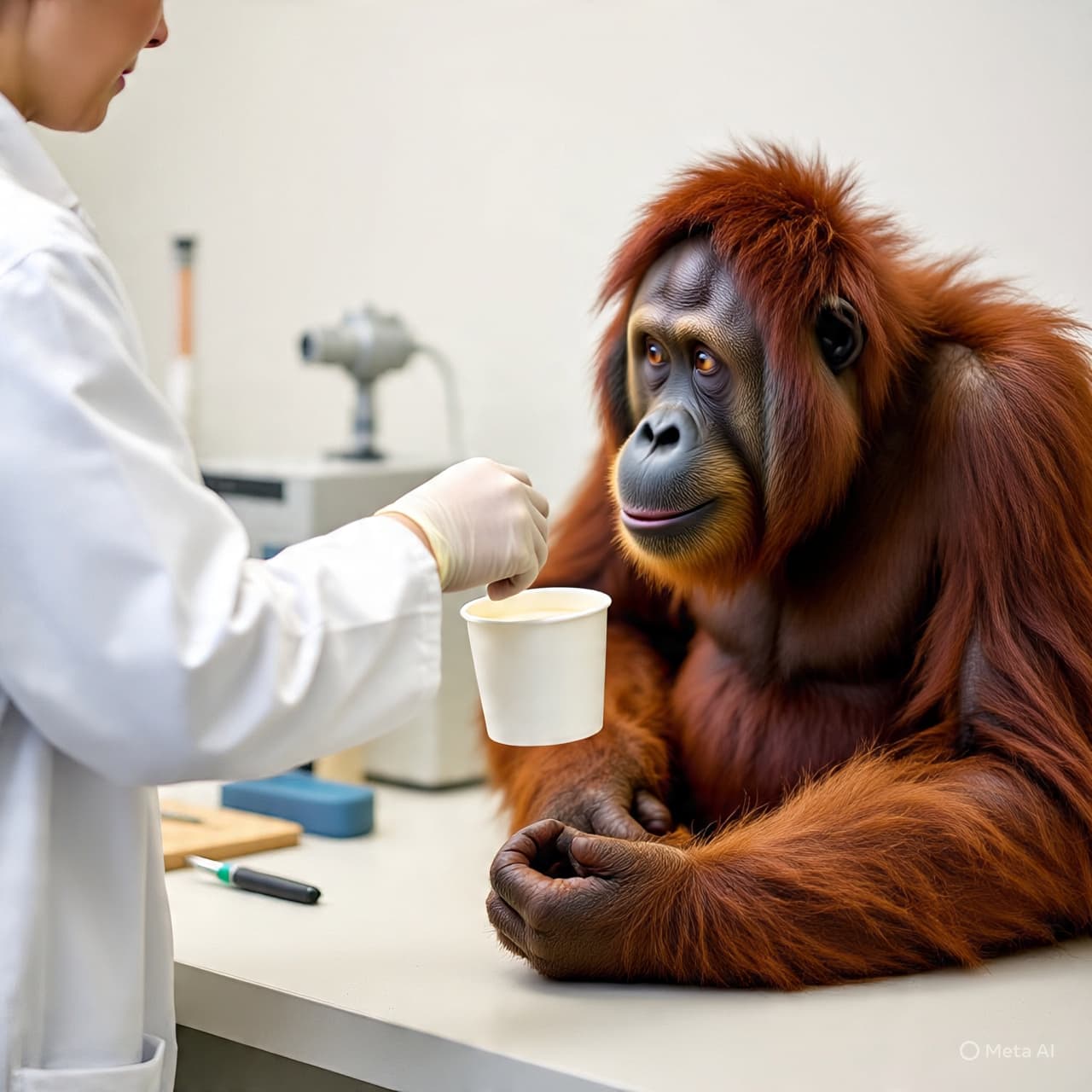
For decades, pretend play has been viewed as a hallmark of human childhood, closely tied to imagination, social learning, and cognitive development. Now, scientists are revisiting that assumption by asking a simple but provocative question: can apes play pretend?
Researchers exploring animal cognition have turned to a familiar childhood scenario — an imaginary tea party — to examine whether nonhuman primates can understand and participate in acts that involve symbolism rather than direct physical reward. The approach reflects a broader scientific effort to understand how animals perceive the world and whether they can mentally represent situations that are not literally present.
Great apes such as chimpanzees, bonobos, and orangutans are already known for advanced problem-solving skills, tool use, and complex social behavior. What remains less clear is whether they can engage in representational play, where objects stand in for something else or actions are performed “as if” a situation were real.
In the tea party setup, researchers typically observe whether apes treat empty cups, gestures, or staged actions as meaningful within a shared context. The goal is not to see whether the animals mimic human behavior, but whether they grasp the implied scenario and respond in ways that suggest understanding rather than simple conditioning.
Interpreting such behavior requires caution. Apes are highly sensitive to cues from humans, and distinguishing genuine imaginative engagement from learned responses is a persistent challenge in animal research. Scientists therefore emphasize careful observation and repeated testing across individuals and settings.
The implications of this line of research extend beyond novelty. If apes demonstrate even a limited capacity for pretend play, it could reshape how scientists think about the evolutionary roots of imagination, communication, and social learning. It may also narrow the perceived cognitive gap between humans and their closest living relatives.
At the same time, researchers stress that human imagination remains uniquely elaborate, deeply embedded in language, culture, and abstract reasoning. Any evidence of pretend play in apes would likely reflect a simpler form of symbolic thinking rather than a direct parallel to human childhood play.
As studies continue, the imaginary tea party serves less as a playful spectacle and more as a tool for probing fundamental questions about how minds — human and nonhuman — construct meaning beyond the immediate physical world.
Published by Banx Network. This article is part of the Banx decentralized media programme, powered by the BXE token on the XRP Ledger.