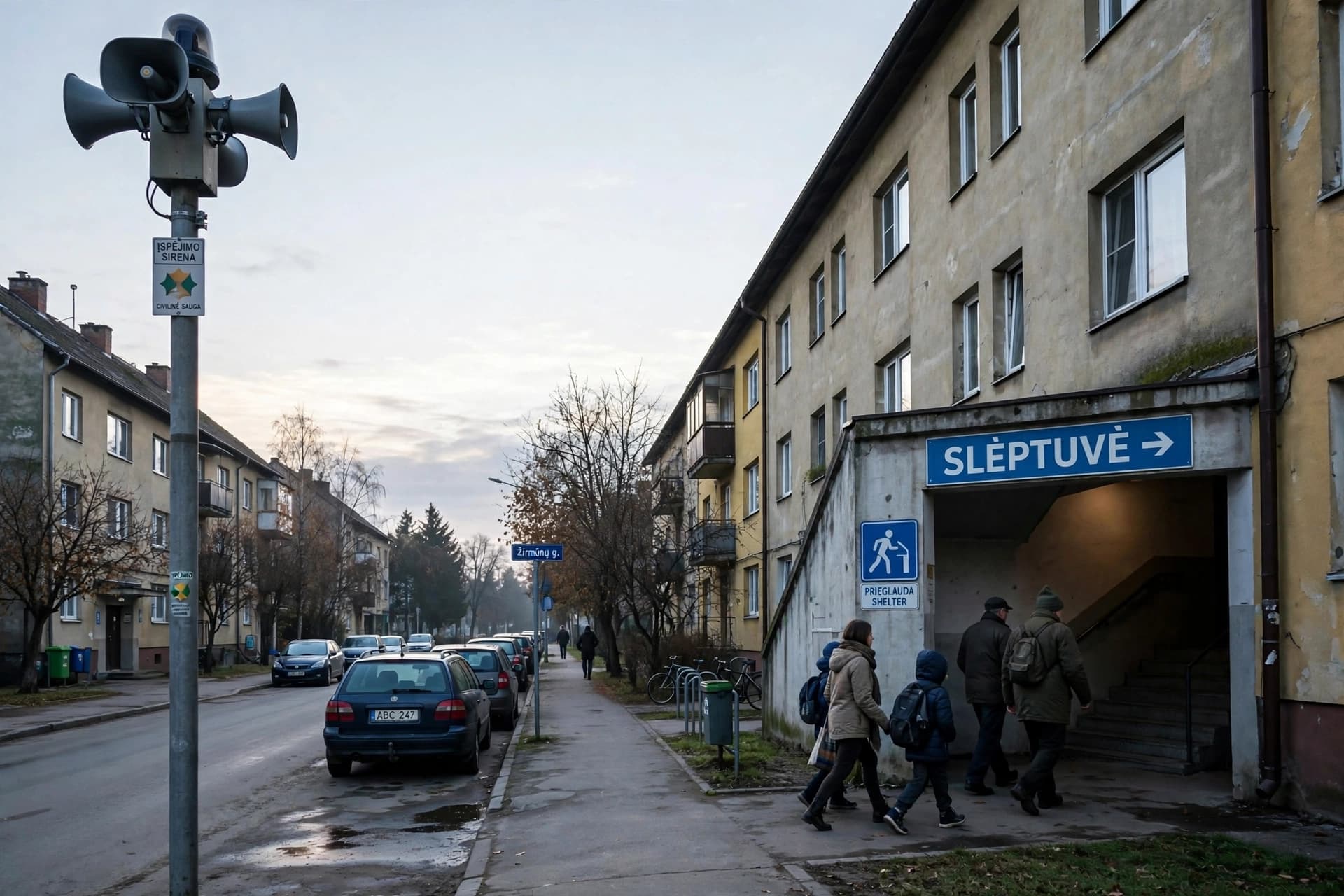
There is a particular stillness that falls over a country when the sky is no longer assumed to be empty. It is not the stillness of peace but of attention—of people pausing in their kitchens and bedrooms, listening for a sound they cannot name, waiting for an all-clear that may or may not come. In the Baltic states, this stillness has become a familiar companion, arriving uninvited and leaving without explanation.
On Sunday morning, Lithuania's National Crisis Management Centre issued a red-level air alert, urging residents in central and northern regions to seek shelter after an unidentified flying object was detected . NATO fighter jets were scrambled, and Kaunas Airport was temporarily closed . The alert lasted approximately one hour before being lifted .
The object's origin remains officially unconfirmed. Lithuania's defense minister suggested it could be a drone originating from Poland, and proposed a joint investigation with his Polish counterpart . Poland's military confirmed it was investigating a potential violation of its airspace . The object disappeared from radar, and soldiers were dispatched to the area near Juodžionys in northern Lithuania to search for possible debris; some debris reportedly struck a civilian vehicle . NATO aircraft could not visually identify the object due to weather conditions, and no attempt was made to shoot it down .
Latvia, Lithuania's northern neighbor, issued a yellow-level air alert for border regions, citing a possible threat. That warning was later lifted . The incident occurred against a backdrop of heightened concern about the spillover of Russia's war in Ukraine into NATO's eastern flank. Ukrainian drones have repeatedly entered the airspace of Baltic states in recent months, with Kyiv stating that some have deviated from their routes due to Russian electronic jamming . Authorities have not confirmed whether Sunday's object was a Ukrainian drone or directly connected to the war.
What makes such moments notable is not the confirmation of a threat but the uncertainty that precedes it. A flying object, unidentified and unclaimed, becomes a test of systems designed to protect—radar, fighter jets, emergency alerts—and a reminder that the architecture of security is only as reliable as the information that feeds it. A drone that cannot be seen in bad weather, a radar return that vanishes, a piece of debris on a roadside: these are the small, ambiguous signals from which larger conclusions must be drawn.
For the residents who went to shelters, the alert was brief. The all-clear came, the airport reopened, and the morning resumed its ordinary shape. But the questions lingered: What was it? Where did it come from? And what does it mean that such questions can be asked at all, in a country that joined NATO two decades ago precisely so that its skies would never again be uncertain?
The investigation continues. Lithuania and Poland will compare notes. The debris, if found, may offer answers. Until then, the sky over the Baltics remains what it has been for the past two years—a space that is watched, guarded, and never entirely taken for granted.
AI Image Disclaimer: The visuals in this report were produced using artificial intelligence and serve an illustrative purpose only.
Sources: Reuters (via RTP, TVR Info, Rti), LRT
Published by Banx Network. This article is part of the Banx decentralized media programme, powered by the BXE token on the XRP Ledger.