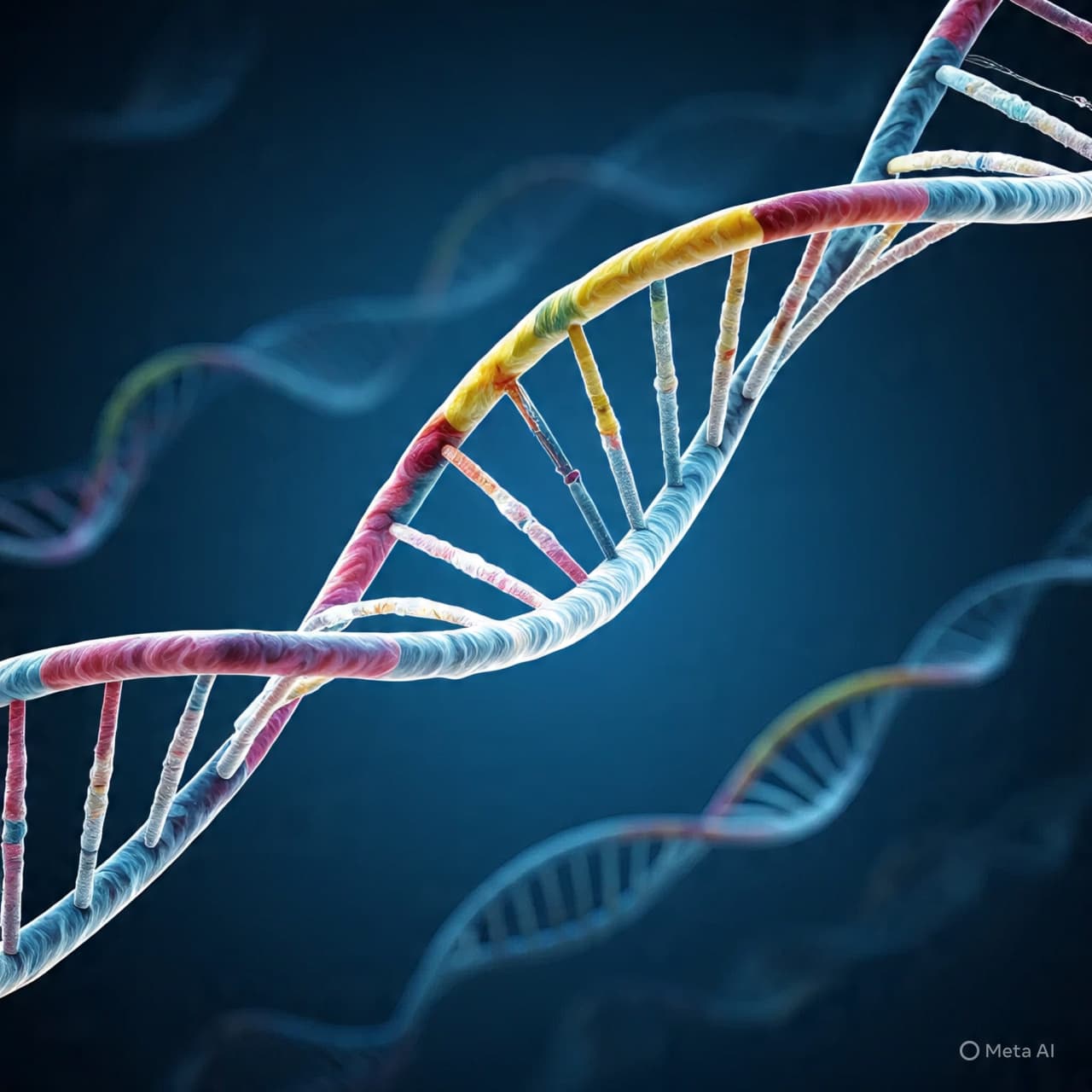
Opening In the depths of a microscopic world, where every strand of DNA weaves the story of life itself, a new kind of reader has emerged — not bound by test tubes or microscopes, but crafted from silicon and mathematics. Like an interpreter deciphering a long-forgotten script, an artificial intelligence developed by Google’s DeepMind is learning to understand the language of life. This isn’t science fiction; it is a gentle but profound shift in how we glimpse the biological patterns that underlie existence. At its heart lies an AI model called AlphaGenome, a tool that can look at colossal swaths of genetic code and begin to interpret what the tiniest changes might mean for health, disease, and the very essence of living organisms.
Body Human DNA — the vast three-billion-letter sequence that guides growth, resilience, and sometimes vulnerability — has long been compared to a recipe book for life. Most of this “book” doesn’t directly make the proteins that machines in cells need to function; instead, it contains instructions that tell the cell how, when, and where to use them. This non-coding portion, often called the genome’s “dark matter,” has puzzled scientists for decades. Traditional tools could read isolated lines of the code, but understanding the broader context — how changes in distant regions might ripple through the cell — remained an immense challenge.
Enter AlphaGenome, a deep-learning model designed to process up to one million letters of DNA at once, far larger sequences than older computational tools could manage. Instead of reading the genome in fragments, it takes a panoramic view, predicting how variations in the sequence may affect gene regulation, RNA splicing, and even the complex molecular choreography that turns genes on or off. By learning from vast public datasets and mapping patterns across different tissues and cell types, the model offers insights into questions that once required lengthy experimentation in laboratories.
The implications are both subtle and wide-ranging. Scientists can now use AlphaGenome to prioritize genetic variations that might predispose individuals to conditions such as diabetes, heart disease, or cancer. It can simulate how specific mutations alter molecular processes tied to gene expression, helping researchers decide which hypotheses to examine first in the lab. The model doesn’t replace traditional genetics; rather, it illuminates the most promising paths forward, accelerating discoveries that may lead to better treatments or deeper understanding.
Notably, DeepMind’s researchers emphasize that AlphaGenome isn’t a deterministic oracle. Its predictions reflect statistical patterns and learned associations — powerful guides, but still requiring experimental confirmation. Yet, by unifying many genomic insights into a single, high-resolution predictive framework, this AI opens doors to interpreting some of the most enigmatic portions of the human genome.
Closing By bridging artificial intelligence and genomics, AlphaGenome represents a quiet milestone in biological research. Rather than dramatics, its progress is measured — precise predictions, incremental insights, and a toolset that empowers scientists. This model may not yet narrate every detail of the genome’s story, but it lifts the veil a little more on the recipe of life itself. With careful application, the knowledge it offers could deepen scientific understanding and gently enrich the search for new treatments in years to come.
📸 AI Image Disclaimer (Rotated Wording) “Illustrations were produced with AI and serve as conceptual depictions, not real photographs.”
🧠 Source Check — Credible Mainstream / Research Sources Here are reliable sources confirming this topic:
Scientific American – DeepMind’s AlphaGenome AI predicts DNA function and gene expression. Google DeepMind Blog – official description of the AlphaGenome model and its capabilities. Wikipedia – overview of AlphaGenome and how it deciphers genomic regulatory sequences. TheOutpost.ai – details on AlphaGenome’s predictions and how it models DNA “recipe” effects. Additional reporting confirms DeepMind’s Nobel connection and the scientific context of genomic AI.
Published by Banx Network. This article is part of the Banx decentralized media programme, powered by the BXE token on the XRP Ledger.