There is a particular irony in the economics of prohibition—the way that making something harder to obtain can, if the enforcement is well-designed, drive people back toward the legitimate market rather than deeper into the shadows. In Queensland, that irony is now visible in the sales figures. In the first month after stronger enforcement laws took effect in November, legal cigarette sales rose 55 percent. They remained 40 to 45 percent above previous levels for the following six months, while the national market stayed largely flat .
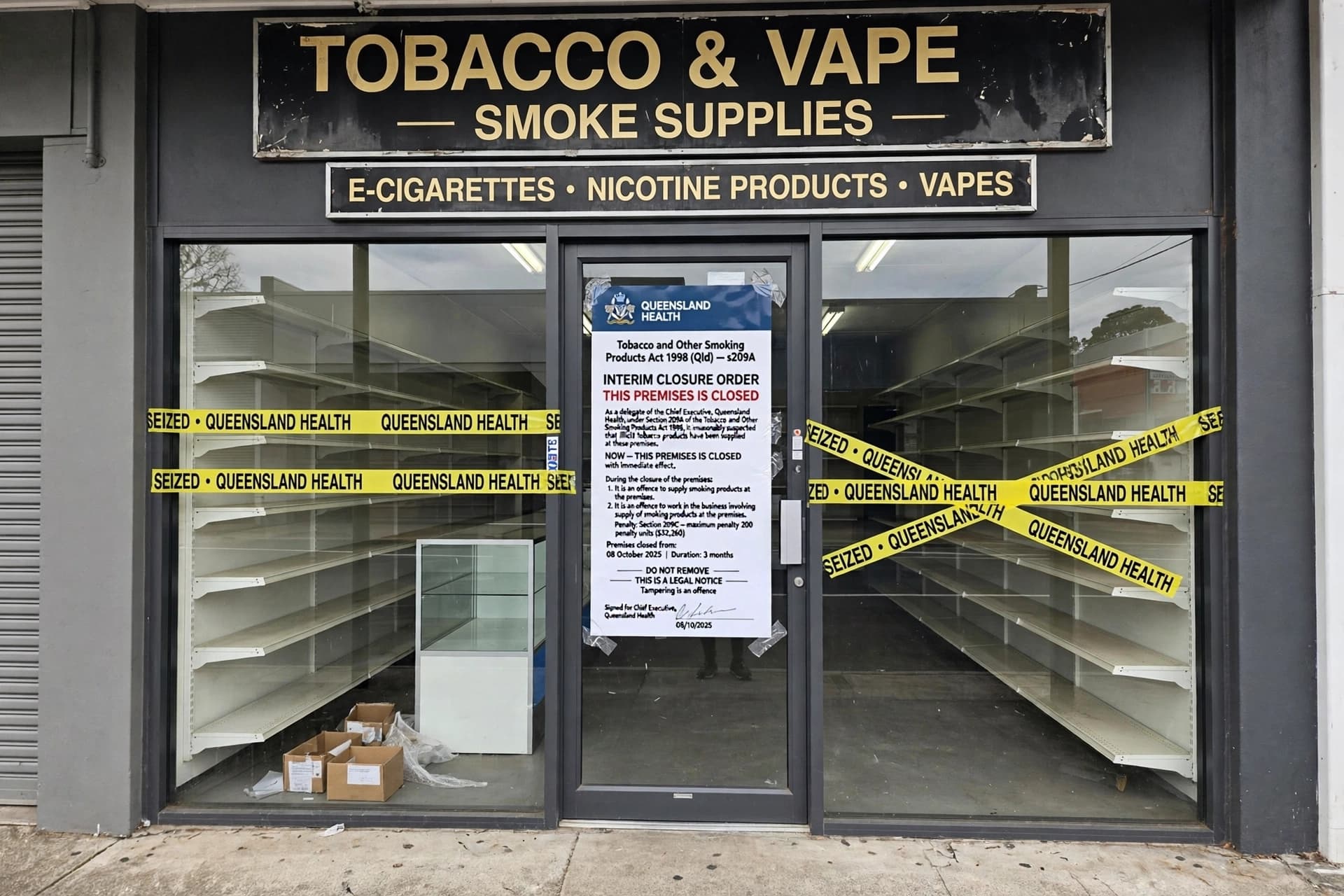
The crackdown that produced this result was not a matter of minor fines or occasional raids. Queensland Health was given the power to close illicit tobacco shops for up to 90 days without a court order. Landlords who knowingly leased premises to illegal operators face fines of up to $161,300 and 12 months in prison . Since November, the state has issued more than 300 closure orders—part of a national effort that has shuttered more than 1,000 illicit tobacco shops across Australia . A 10-day operation in September, known as Operation Major, resulted in 148 stores receiving three-month closure orders. Authorities seized more than 11.8 million cigarettes, 1.7 tonnes of loose tobacco, 87,000 vapes, and 270,000 nicotine pouches, with an estimated street value of $15.7 million .
The fiscal results have been as notable as the public health ones. The state government expects the crackdown to generate $89 million in additional tobacco excise revenue and $11 million in GST gains over two years—an amount that could cover and potentially exceed the cost of enforcement . Assistant Minister for Customs Julian Hill described the outcome in terms that left little room for ambiguity: "Queensland's results, built on South Australia's pioneering approach, show that sustained street-level enforcement can disrupt illegal markets and redirect consumers back to legal products" .
But the most intriguing data point may be what happened alongside the sales increase. Calls to Quitline more than doubled in the ten days after the major enforcement operations . This suggests that the crackdown did not simply shift smokers from one vendor to another; it may have prompted some to reconsider the habit altogether. The disruption of easy access to cheap illicit cigarettes—which are often sold without health warnings or age verification—appears to have created a moment of pause for some smokers.
The federal government is expected to point to Queensland's data as it resists calls to reduce tobacco excise. The Coalition and One Nation have proposed major excise cuts, arguing that high taxes fuel the black market. Queensland's experience suggests a different lesson: that enforcement, combined with strong laws and consistent effort, can shrink the illicit market without lowering taxes . The federal government has committed more than $365 million to enforcement action since taking office .
For Queensland, the results are preliminary but encouraging. The state has demonstrated that the black market is not an immutable feature of the tobacco landscape—that it can be disrupted, that consumers can be redirected, and that the revenue lost to criminal syndicates can, at least in part, be recovered for the public purse. The question now is whether the trend will hold as the enforcement effort continues, and whether other states will follow the Queensland blueprint. "Those days are ending," Julian Hill said of the criminal groups that treated illicit tobacco as a "low-risk, high-profit enterprise" . The sales figures suggest he may be right.
AI Image Disclaimer: All images in this article are AI-generated and are intended for illustrative purposes only.
Sources: OZ Arab Media, china.com.au, Flipboard, Perspecta.news
Published by Banx Network. This article is part of the Banx decentralized media programme, powered by the BXE token on the XRP Ledger.