There is a particular kind of quiet on a dairy farm in the early morning, before the milking sheds come alive and the herds begin their slow procession across the paddocks. It is a rhythm measured not in minutes but in generations—the same tracks walked by the same cows, season after season, as dependable as the sunrise. Now, across parts of rural Victoria, that rhythm is being tested by something buried beneath the surface: a trench, a cable, and a promise of national infrastructure that some farmers fear will cost them everything.
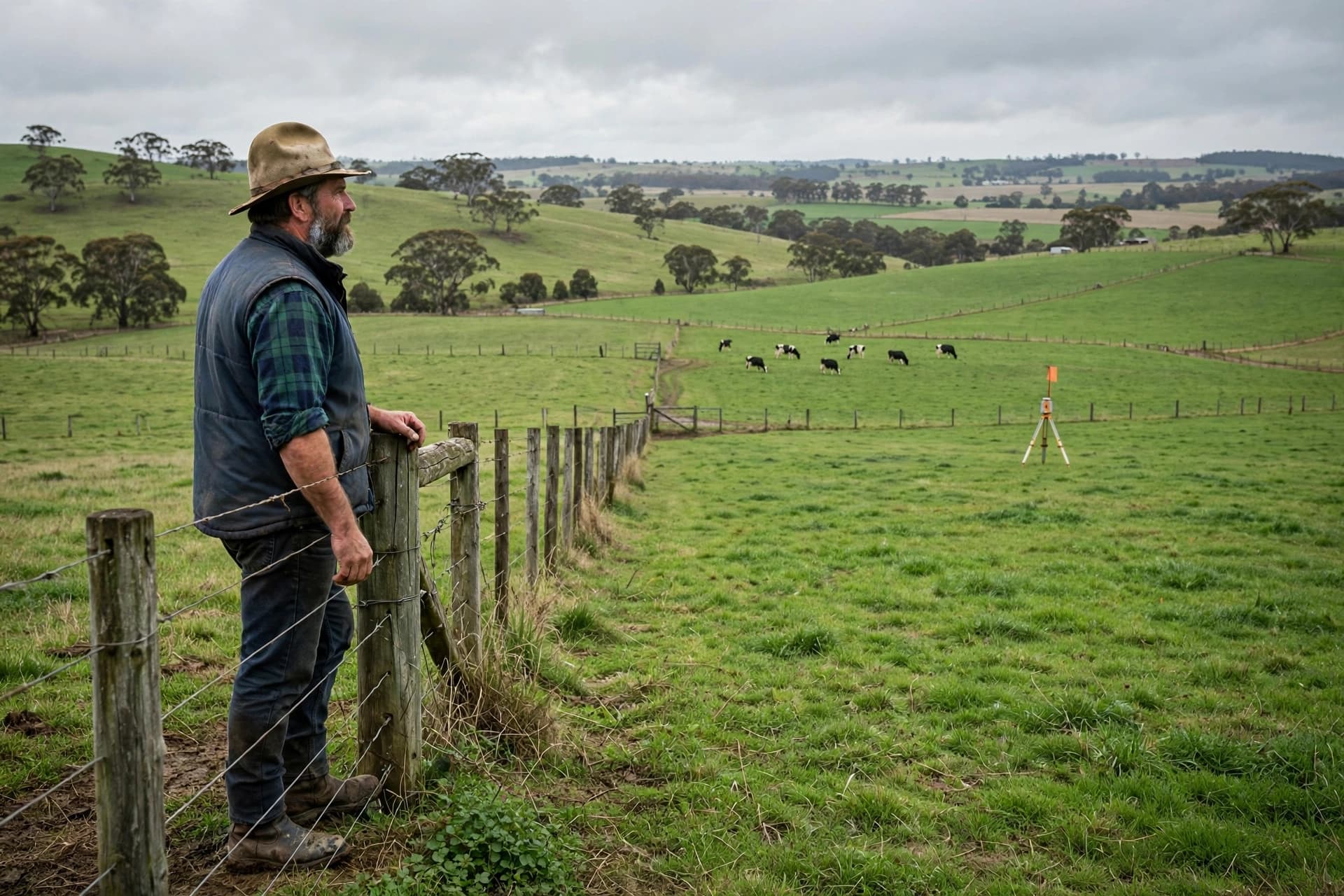
The Marinus Link project, a proposed 345-kilometer power and data cable connecting Tasmania's hydroelectric capacity to mainland Australia, will run underground for roughly 90 kilometers through Gippsland before reaching its Victorian endpoint. For Paul Peluso, a dairy farmer in Mirboo North, the four-hectare easement cutting through his 180-hectare property represents not merely an inconvenience but an existential threat to his livelihood. "What they're proposing to do will shut me down as a dairy farmer," he told The Age, describing how the trench would sever the arterial tracks his herd depends on to move between paddocks and the milking shed.
The mathematics of dairy farming are unforgiving. Cows must be moved twice daily, and any disruption to that movement affects milk production, animal health, and the farm's economic viability. Peluso's concern is not abstract. The construction window spans six years, during which access to portions of his land could be restricted or impossible. His niece, Emma Germano, a former president of the Victorian Farmers Federation, has been helping negotiate with Marinus Link. She notes that real estate agents have advised there would be little buyer interest in the farm while uncertainty hangs over the easement and construction timeline.
This is not an isolated anxiety. In the United Kingdom, farmers near Bungay have raised similar objections to a proposed 50-meter cable corridor for the East Pye Solar project. Rebecca Mayhew of Old Hall Farm described how the corridor would cross grazing land for her 300-head dairy herd, potentially fencing off the equivalent of nearly a fifth of their productive acreage for up to two years. The pattern is familiar: renewable energy infrastructure, essential for decarbonization, often lands hardest on the very landscapes it ostensibly seeks to protect.
What makes the Victorian case particularly delicate is the asymmetry of negotiating power. Landholders are not typically trained in infrastructure law or compensation valuation. A Marinus Link spokesman told The Age that the company has engaged with landholders since 2019 and is committed to respectful negotiations, resorting to compulsory acquisition only "when absolutely necessary." Yet for farmers like Peluso, the language of "necessary" carries little comfort when the stakes involve the permanent alteration of water flows, soil disturbance, and the slow recovery of pasture.
The tension here is not between good and bad actors but between two legitimate claims on the same land. The energy transition requires transmission capacity; Tasmania's hydroelectric surplus and Victoria's solar and wind surpluses need to flow to where they are needed. Marinus Link, with an estimated cost of $7.57 billion for its first two stages, is projected to carry enough power for roughly 750,000 homes. These are not trivial benefits. But neither is the loss of a family farm that has fed its community for decades.
Perhaps what is needed is a more honest accounting. Compensation packages, however generous on paper, cannot easily replace the web of relationships, knowledge, and intergenerational stewardship that constitutes a working farm. If infrastructure is to be built on agricultural land, the burden of proof should lie not with the farmer to prove harm, but with the project to demonstrate that no viable alternative exists—and that the terms of engagement reflect the true cost of what is being asked.
The Marinus Link project is scheduled for completion in stages, with the first phase targeted for 2030. As preparatory works begin, the conversations between landholders and developers will continue, measured in meetings and negotiations rather than in the quiet rhythm of cows walking familiar tracks. Whether those tracks remain intact is a question that will be answered not in policy documents but in the daily life of farms that have no backup plan.
---
AI Image Disclaimer: The images accompanying this article are generated by artificial intelligence and are intended for illustrative purposes only.
Sources: The Age, DairyNews, Region Canberra
Published by Banx Network. This article is part of the Banx decentralized media programme, powered by the BXE token on the XRP Ledger.