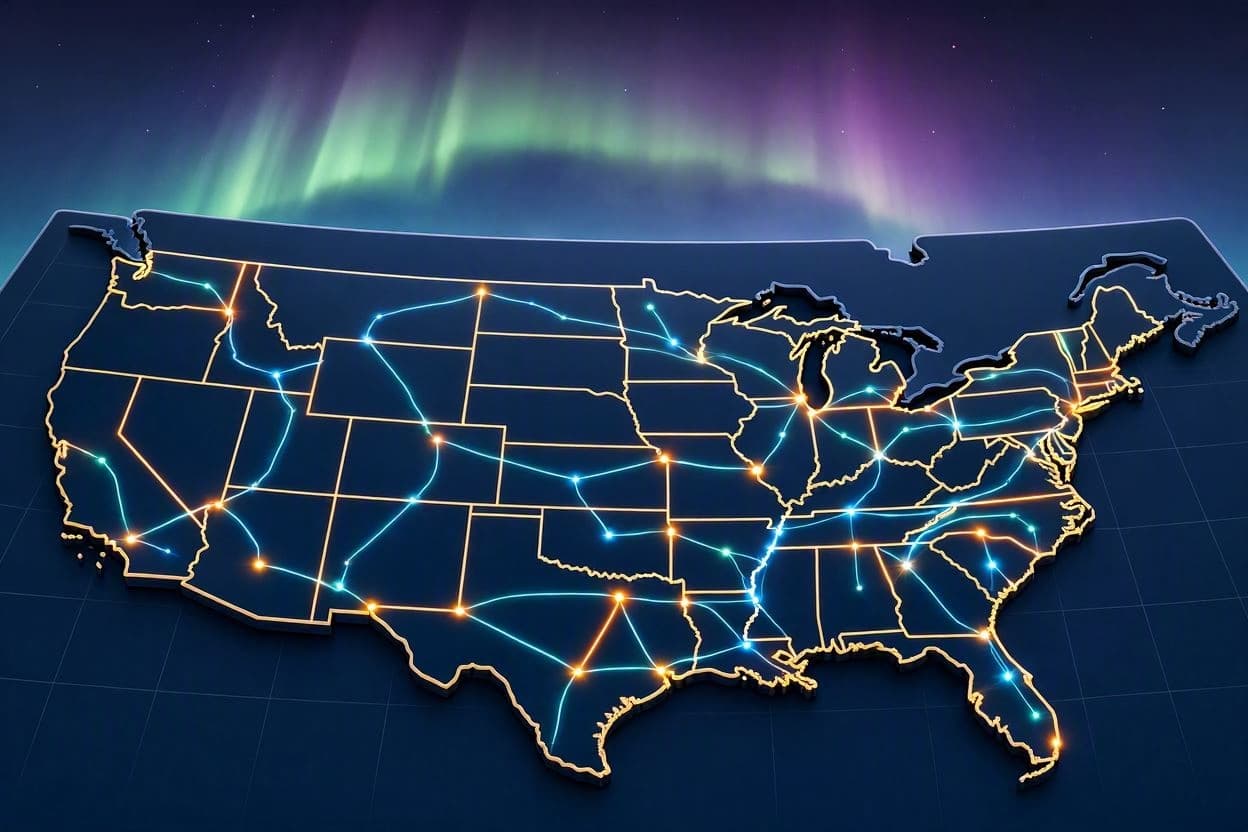
We live in an age defined by connectivity, where the hum of electricity powers our lives, our economies, and our communications. It is easy to forget that this intricate web of energy is vulnerable to forces beyond our control, originating from the star at the center of our solar system. Solar storms, eruptions of charged particles from the sun, have long been known to threaten technological infrastructure. Now, a new model seeks to quantify the economic risks these celestial events pose to the US power grid, bringing a clearer focus to a potentially costly vulnerability.
Solar storms, or coronal mass ejections, can induce powerful geomagnetic currents in the Earth’s atmosphere. These currents can flow into power lines, transformers, and other grid components, causing overheating, damage, or even widespread blackouts. The famous Carrington Event of 1859 is a historical benchmark, but in today’s highly electrified society, the consequences of a similar event would be far more severe. The new model aims to predict the financial impact of such disruptions, helping policymakers and utility companies prepare.
The model integrates data on solar activity, grid topology, and economic dependencies. By simulating various storm scenarios, it estimates the potential cost of repairs, lost productivity, and supply chain disruptions. This approach moves beyond technical assessments to include broader economic implications, such as the impact on healthcare, transportation, and digital services. It provides a holistic view of risk, recognizing that a power outage is not just an inconvenience but a systemic shock.
One of the key findings is the variability of risk across different regions. Some parts of the US grid are more susceptible to geomagnetic induction due to their geological location and infrastructure design. The model identifies these hotspots, allowing for targeted investments in protective measures, such as installing capacitors or upgrading transformers. This precision helps optimize resource allocation, ensuring that the most vulnerable areas receive the necessary attention.
The economic stakes are high. A severe solar storm could cause billions of dollars in damages, with recovery taking months or even years. The model underscores the importance of resilience, urging stakeholders to consider long-term mitigation strategies. It also highlights the interdependence of modern systems, where a failure in the power grid can cascade into other sectors, amplifying the initial impact. Understanding these connections is crucial for effective risk management.
Moreover, the model serves as a tool for insurance and financial planning. By providing a standardized measure of risk, it enables better pricing of insurance products and more accurate assessment of liability. This financial clarity can encourage private sector investment in grid hardening, creating a market-driven incentive for improved security. It bridges the gap between scientific prediction and economic action, fostering collaboration between experts in different fields.
Public awareness of solar storm risks remains low, despite the potential for significant disruption. The release of this model offers an opportunity to educate stakeholders and the general public about the importance of space weather monitoring. It demystifies the phenomenon, presenting it not as a sci-fi scenario but as a manageable engineering and economic challenge. Transparency in risk assessment builds trust and supports proactive policy decisions.
As solar activity enters a period of increased intensity, the relevance of this model grows. Continuous updates and refinements will be necessary to keep pace with changing grid configurations and solar cycles. The goal is not to predict the exact timing of the next major storm, but to ensure that society is prepared for whatever comes. Preparedness reduces fear and enhances resilience, turning uncertainty into manageable risk.
The new model for assessing solar storm risks marks a step forward in protecting our economic infrastructure. It invites us to look upward with awareness, recognizing the connection between solar activity and terrestrial stability. Let us build a grid that is as resilient as it is essential.
AI Image Disclaimer: Please be aware that images used in this context are AI-generated visualizations for illustrative purposes.
Sources: Reuters Bloomberg National Oceanic and Atmospheric Administration (NOAA)
Published by Banx Network. This article is part of the Banx decentralized media programme, powered by the BXE token on the XRP Ledger.