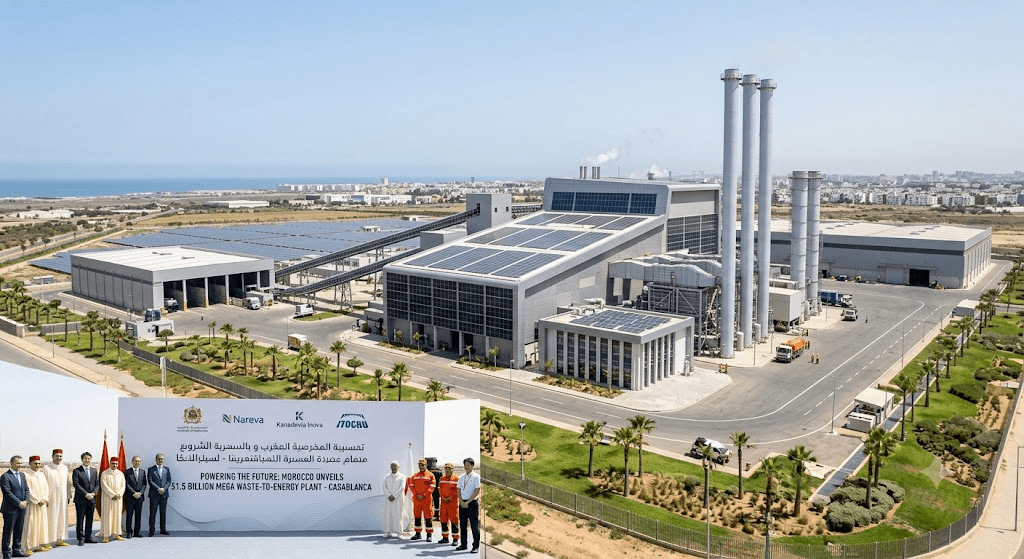
CASABLANCA, MOROCCO — In a major milestone for Africa’s green energy transition, the city government of Casablanca has officially awarded a concession agreement to construct a $1.5 billion waste-to-energy facility. Set to become the second-largest waste-to-energy plant on the continent, the megaproject will transform the region’s waste management framework while expanding Morocco's renewable energy capacity.
The project is being spearheaded by an international joint venture led by Swiss-Japanese waste management firm Kanadevia Inova, alongside Moroccan energy leader Nareva and Japanese conglomerate Itochu. Construction is slated to begin before the end of 2026, with full operations expected by mid-2030.
Spanning a 264-hectare site in the Médiouna province, the facility will combine thermal treatment, solar energy, and landfill gas recovery to process approximately 1.5 million metric tons of municipal waste annually—averaging over 4,000 tons per day. It is projected to generate roughly 115 megawatts of electricity, which is enough to power nearly one million homes and cover about 20% of Casablanca’s total residential electricity demand. Constructed by local contractor Somagec over a 3.5-year timeline, the project will feature a phased rollout, with initial waste treatment and energy generation scheduled to begin up to 10 months before full facility completion.
Beyond energy generation, the facility directly addresses a long-standing environmental crisis surrounding the Médiouna landfill, the largest in the country. Having accumulated waste mounds nearly 70 meters high, the landfill has caused severe air quality issues, odor pollution, and groundwater contamination for surrounding agricultural communities.
By diverting millions of tons of refuse into controlled energy generation, the new plant will significantly curb harmful methane emissions and reduce overall waste volume by up to 87%. Analysts estimate the facility's greenhouse gas abatement will equal nearly 20% of Switzerland's total annual emissions. "Simply burying waste means losing both economic and energy value while creating long-term environmental costs," noted regional environmental researchers, highlighting the shift toward treating municipal waste as a sustainable economic resource.
Secured under a long-term power purchase agreement with state-owned utility ONEE, the initiative reinforces Morocco’s commitment to climate resilience and urban modernization. As urban populations across North Africa continue to expand, Casablanca’s landmark facility offers a scalable blueprint for turning municipal waste challenges into clean energy solutions across the MENA region.
Published by Banx Network. This article is part of the Banx decentralized media programme, powered by the BXE token on the XRP Ledger.