Jakarta, Indonesia—A shallow, highly destructive earthquake rocked eastern island communities Friday morning, shattering concrete structures and sending terrified residents running into the streets. The US Geological Survey registered the tremor at a preliminary magnitude of 7.7, with its epicenter located just off the densely populated coastline. Initial shockwaves knocked out regional power grids and severed telecommunication lines within minutes of the initial rupture.
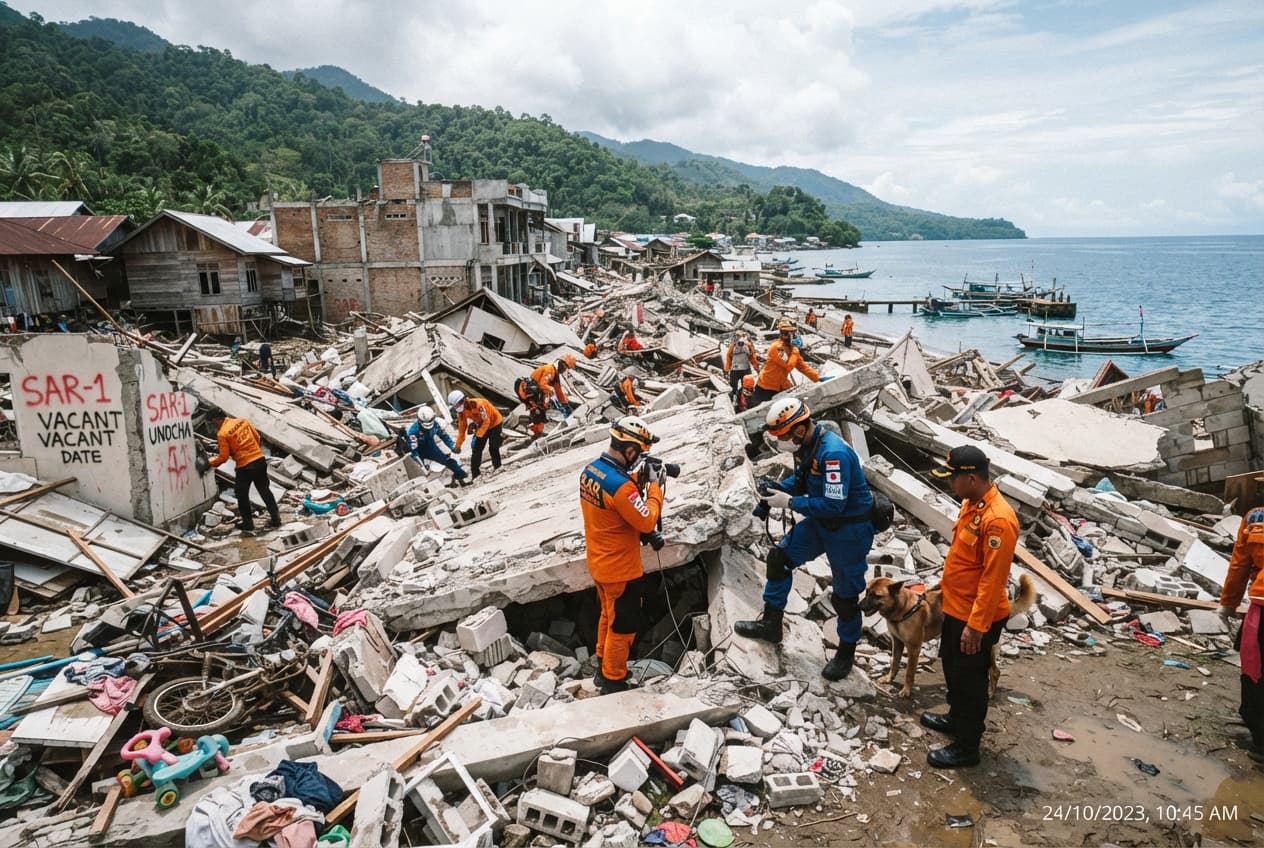
Local emergency services confirmed that at least thirty-eight people lost their lives when homes, schools, and commercial storefronts collapsed under violent lateral shaking. Rescue teams pulled survivors from beneath heaps of rubble throughout the afternoon while aftershocks continued to rattle the battered coastline. Hospitals operating on emergency generators treated scores of patients with severe trauma injuries in makeshift triage areas set up outdoors.
Coastal residents fled toward higher ground on foot and motorcycles immediately after the shaking subsided, fearing potential tsunami waves triggered by the offshore fault movement. Regional authorities issued a brief tsunami advisory before canceling it once tidal gauge readings confirmed no significant sea-level displacement occurred. Structural engineers dispatched to the disaster zone reported that unreinforced brick buildings sustained the heaviest damage during the tremor.
National disaster mitigation agency coordinators mobilized navy vessels to transport heavy rescue gear, medical supplies, and bottled water to isolated coastal villages. Search dogs and specialized acoustic detection equipment arrived via military cargo flights to assist local volunteers probing unstable debris piles. Survivors gathered in public parks and open sports fields, setting up temporary sleeping areas as structural safety assessments continued.
Presidential spokespersons announced immediate financial relief allocations for municipal reconstruction and emergency medical support across the affected districts. Local mayors described entire neighborhoods reduced to rubble, with downed utility poles blocking narrow access roads needed by emergency responders. Community members used hand tools and bare hands to claw through fallen roof timbers before heavy machinery could reach remote side streets.
International seismologists noted that the region sits along the active tectonic boundary known as the Pacific Ring of Fire, which experiences frequent seismic activity. Public safety advocates renewed calls for stricter building code enforcement and community-wide earthquake preparedness drills across vulnerable island provinces. Communications links remained patchy as telecommunication technicians worked frantically to restore fiber-optic cable lines and cellular relay towers.
Relief agencies distributed food packets and folding cots to families camped outdoors amid persistent aftershocks that kept residents on edge. Local merchants surveyed shattered storefront inventories, counting mounting economic losses from damaged goods and structural failures. Regional authorities urged citizens to stay away from compromised buildings until municipal inspectors could verify structural integrity.
The immediate aftermath settled into a tense night of recovery operations as floodlights illuminated twisted metal frames and collapsed concrete facades across the harbor town. Emergency coordinators warned that the death toll could rise further as reports trickled in from outlying islands accessible only by boat. Rescue personnel maintained round-the-clock watches, hoping to locate additional survivors trapped beneath pancaked floor slabs.
Published by Banx Network. This article is part of the Banx decentralized media programme, powered by the BXE token on the XRP Ledger.