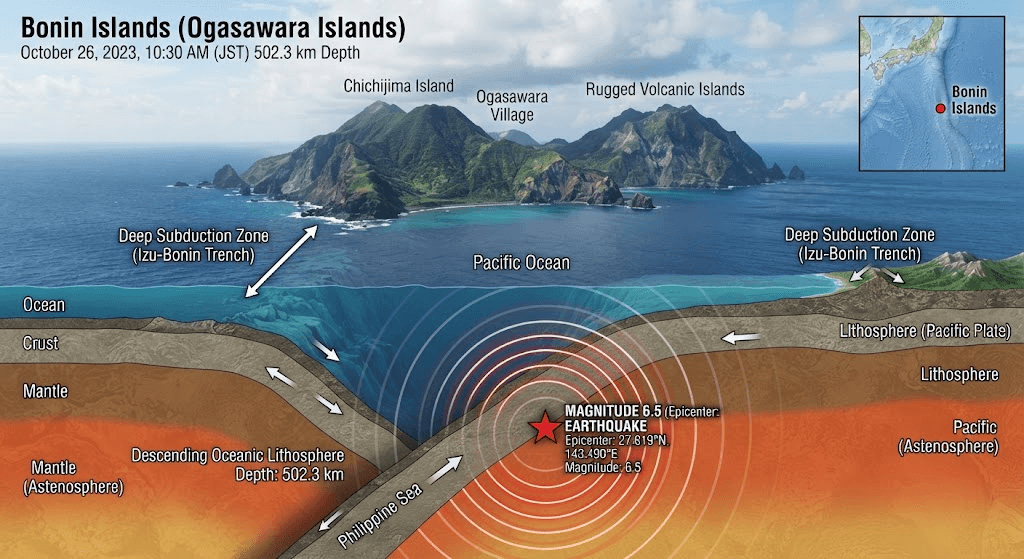
TOKYO, Japan — A powerful magnitude 6.5 earthquake struck deep beneath the ocean bed in the remote Bonin Islands region south of Tokyo early Sunday morning, October 25, 2026 according to monitoring reports from the United States Geological Survey (USGS).
The quake occurred at approximately 11:09 AM local time (02:09 UTC), centered in the Pacific Ocean roughly 1,000 kilometers south-southeast of the Japanese capital. Seismic data indicates the earthquake registered at a significant depth of over 490 kilometers beneath the seabed.
Because the hypocenter was located so deep within the Earth's crust, the surface shaking felt across nearby island chains was considerably muted, limiting the potential for widespread structural destruction.
Following the event, the Pacific Tsunami Warning Center and Japanese authorities confirmed that no tsunami warning or advisory was issued.
Emergency management agencies reported no immediate casualties or major damage across the lightly populated Ogasawara (Bonin) archipelago. Officials maintain that infrastructure across the region remained intact, though monitoring stations continue to assess local conditions for any minor secondary impacts.
The Bonin Islands sit along a highly volatile tectonic boundary where the Pacific Plate sub ducts beneath the Philippine Sea Plate. As part of the Pacific "Ring of Fire," the region frequently experiences deep-focus earthquakes as sub ducting tectonic slabs slide deep into the Earth's mantle.
Seismologists continue to monitor regional activity, though no immediate aftershock threats or heightened volcanic alerts have been issued for the area.
Japan’s Meteorological Agency (JMA) reassured residents that deep-focus quakes of this magnitude rarely disrupt maritime traffic or telecommunication cables linking the outlying archipelago to the mainland. However, local disaster preparedness teams in the Ogasawara municipality remain on standby, advising residents to keep emergency supplies accessible as routine seismic assessments continue across the region.
International seismic monitoring agencies, including the USGS, issued a "Green alert" for the event, indicating a very low probability of shaking-related fatalities or economic losses. While Japan remains one of the world's most seismically active nations—situated at the intersection of four major tectonic plates—the structural resilience of local building design and the extreme depth of the hypocenter effectively shielded regional communities from any major disruption.
Published by Banx Network. This article is part of the Banx decentralized media programme, powered by the BXE token on the XRP Ledger.